
As filed with the Securities and Exchange Commission on May 26, 2026.
Registration No. 333-
UNITED STATES
SECURITIES AND EXCHANGE COMMISSION
Washington, D.C. 20549
FORM F-3
REGISTRATION STATEMENT
UNDER
THE SECURITIES ACT OF 1933
AIFU Inc.
(Exact name of Registrant as specified in its charter)
Not Applicable
(Translation of Registrant’s name into English)
| Cayman Islands | Not Applicable | |
| (State
or other jurisdiction of incorporation or organization) |
(I.R.S.
Employer Identification Number) |
Room 1, Building 10,
Jinzhong Guobin Hui Qinyuan 2nd Road
Lihu Community, Xili Street
Shenzhen, 518055
People’s Republic of China
+86 755 22671879
(Address and telephone number of Registrant’s principal executive offices)
Cogency
Global Inc.
122 East 42nd Street, 18th Floor
New York, NY 10168
(800) 221-0102
(Name, address, and telephone number of agent for service)
Copies to:
Steve Lin, Esq.
Han Kun Law Offices LLP
Rooms 4301-10, 43/F., Gloucester Tower
The Landmark
15 Queen’s Road Central
Hong Kong
+852 2820 5600
Approximate date of commencement of proposed sale to the public: From time to time after the effective date of this registration statement.
If only securities being registered on this Form are being offered pursuant to dividend or interest reinvestment plans, please check the following box. ☐
If any of the securities being registered on this Form are to be offered on a delayed or continuous basis pursuant to Rule 415 under the Securities Act of 1933, check the following box. ☒
If this Form is filed to register additional securities for an offering pursuant to Rule 462(b) under the Securities Act, please check the following box and list the Securities Act registration statement number of the earlier effective registration statement for the same offering. ☐
If this Form is a post-effective amendment filed pursuant to Rule 462(c) under the Securities Act, check the following box and list the Securities Act registration statement number of the earlier effective registration statement for the same offering. ☐
If this Form is a registration statement pursuant to General Instruction I.C. or a post-effective amendment thereto that shall become effective upon filing with the Commission pursuant to Rule 462(e) under the Securities Act, check the following box. ☐
If this Form is a post-effective amendment to a registration statement filed pursuant to General Instruction I.C. filed to register additional securities or additional classes of securities pursuant to Rule 413(b) under the Securities Act, check the following box. ☐
Indicate by check mark whether the registrant is an emerging growth company as defined in Rule 405 of the Securities Act of 1933.
Emerging growth company ☐
If an emerging growth company that prepares its financial statements in accordance with U.S. GAAP, indicate by check mark if the registrant has elected not to use the extended transition period for complying with any new or revised financial accounting standards† provided pursuant to Section 7(a)(2)(B) of the Securities Act ☐
The registrant hereby amends this registration statement on such date or dates as may be necessary to delay its effective date until the registrant shall file a further amendment which specifically states that this registration statement shall thereafter become effective in accordance with Section 8(a) of the Securities Act of 1933 or until the registration statement shall become effective on such date as the Securities and Exchange Commission, acting pursuant to said Section 8(a), may determine.
| † | The term “new or revised financial accounting standard” refers to any update issued by the Financial Accounting Standards Board to its Accounting Standards Codification after April 5, 2012. |
The information in this prospectus is not complete and may be changed. We may not sell these securities until the registration statement filed with the Securities and Exchange Commission is effective. This prospectus is not an offer to sell these securities and we are not soliciting an offer to buy these securities in any jurisdiction where the offer or sale is not permitted.
SUBJECT TO COMPLETION, DATED MAY 26, 2026.
PROSPECTUS

AIFU Inc.
US$ 300,000,000
Class A Ordinary Shares
Preferred Shares
Warrants
Subscription Rights
Units
Up to 103,747,628 Class A Ordinary Shares Offered by the Selling Shareholders Named Herein
We may from time to time in one or more offerings offer and sell our Class A ordinary shares, preferred shares, warrants, subscription rights and/or a combination of such securities, separately or as units, of an aggregate offering price of up to US$300,000,000. We refer to our Class A ordinary shares, preferred shares, warrants, subscription rights and units collectively as “securities” in this prospectus. This prospectus provides a general description of offerings of these securities that we may undertake.
In addition, this prospectus also covers the sale by certain selling shareholders described herein of up to an aggregate of 103,747,628 Class A ordinary shares. We will not receive any of the proceeds from the sale of Class A ordinary shares by selling shareholders.
We will provide specific terms of any offered securities and offering in one or more supplements to this prospectus. Any prospectus supplement may also add, update, or change information contained in this prospectus. You should carefully read this prospectus and the applicable prospectus supplement as well as the documents incorporated or deemed to be incorporated by reference in this prospectus before you purchase any of the securities offered hereby.
These securities may be offered and sold in the same offering or in separate offerings; to or through underwriters, dealers, and agents; or directly to purchasers. The names of any underwriters, dealers, or agents involved in the sale of our securities, their compensation and any over-allotment options held by them will be described in the applicable prospectus supplement. For a more complete description of the plan of distribution of these securities, see the section entitled “Plan of Distribution” beginning on page 28 of this prospectus.
Pursuant to General Instruction I.B.5 of Form F-3, in no event will we sell the securities covered hereby in a public primary offering with a value exceeding one-third of the aggregate market value of our voting and non-voting common equity held by non-affiliates in any 12-month period so long as the aggregate market value of our outstanding voting and non-voting common equity held by non-affiliates remains below US$75,000,000. The aggregate market value of our outstanding voting and non-voting common equity held by non-affiliates was approximately US$50.8 million, which was calculated based on 21,987,212 Class A ordinary shares held by non-affiliates and the per share price of US$2.31, which was the closing price of our Class A ordinary shares on May 15, 2026. During the 12 calendar months prior to and including the date of this prospectus, we have not offered or sold any securities pursuant to General Instruction I.B.5 of Form F-3.
Our Class A ordinary shares are listed on the Nasdaq Global Select Market, or Nasdaq, under the symbol “AIFU.” On May 22, 2026, the closing price of our Class A ordinary shares on Nasdaq was US$2.17 per share.
AIFU Inc. is a Cayman Islands holding company primarily operating in China through our PRC subsidiaries, including Zhonglian Enterprise and Xinlian Information, and their subsidiaries in which we hold equity ownership interests. PRC laws, regulations, and rules restrict and impose conditions on direct foreign investment in value-added telecommunication services, and therefore prior to December 27, 2024 we operated our internet-based insurance distribution business through Xinbao Investment and Fanhua RONS Technologies, which we refer to as the former consolidated VIEs in this prospectus. There were historical contractual arrangements among (x) our wholly-owned PRC subsidiaries Fanhua Group Company and Fanlian Investment, (y) the former consolidated VIEs, and (z) the individual nominee shareholders of the former consolidated VIEs (the “Contractual Arrangements”). Except for 49% equity interests that we previously held in Xinbao Investment, we and our shareholders did not have any equity interests in the former consolidated VIEs and relied on the Contractual Arrangements to direct the business operations of the former consolidated VIEs. In December 2024, as part of a share exchange transaction with BGM Group Ltd. (“BGM”), our beneficial ownership in Xinbao Investment and Fanhua RONS Technologies was transferred to BGM in exchange of shares of BGM (“Share Exchange”). The Contractual Arrangements were subsequently terminated. As a result, Xinbao Investment and Fanhua RONS Technologies have been deconsolidated from our consolidated financial statements since December 31, 2024. As of the date of this prospectus, our operations in China are conducted by our PRC subsidiaries and we do not have any VIE structure. As used in this prospectus, “we,” “us,” or “our” refers to AIFU Inc. and its subsidiaries.
We face various legal and operational risks and uncertainties as a company based in and primarily operating in China. Similar to situations of many other countries, the PRC government has significant authority to exert influence on the ability of a China-based company, like us, to conduct its business, accept foreign investments or list on a U.S. stock exchange. For example, the PRC government has historically initiated a series of regulatory actions and statements to regulate business operations in China, including cracking down on illegal activities in the securities market, strengthened supervision on overseas listings by China-based companies, adopting new measures to extend the scope of cybersecurity reviews and data security protection, and expanding the efforts in anti-monopoly enforcement. The PRC government may also regulate our operations by adopting new laws and regulations from time to time. The PRC government has historically published policies that significantly affected certain industries. Furthermore, the PRC government has recently made efforts to exert more oversight and control over securities offerings and other capital markets activities that are conducted overseas and foreign investment in China-based companies like us. Any such actions could significantly limit or completely hinder our ability to offer or continue to offer securities to investors and cause the value of such securities to significantly decline or in extreme cases, become worthless. For a detailed description of risks relating to doing business in China, see “Item 3. Key Information—3.D. Risk Factors—Risks Related to Doing Business in China” in our annual report on Form 20-F for the fiscal year ended December 31, 2025, or the 2025 Form 20-F.
The Holding Foreign Companies Accountable Act, or the HFCA Act, was enacted on December 18, 2020 and amended by the Consolidated Appropriations Act, 2023 enacted on December 29, 2022. The amended HFCA Act states if the SEC determines that we have filed audit reports issued by a registered public accounting firm that has not been subject to inspection by the PCAOB for two consecutive years, the SEC shall prohibit our shares from being traded on a national securities exchange or in the over-the-counter trading market in the United States. On December 16, 2021, the PCAOB issued its report notifying the SEC of its determination that it was unable to inspect or investigate completely registered public accounting firms headquartered in mainland China or Hong Kong, or the 2021 Determination, including our former auditor. On May 26, 2022, we were conclusively identified by the SEC as a Commission-Identified Issuer under the HFCA Act. On December 15, 2022, the PCAOB issued a report that vacated its 2021 Determination and removed mainland China and Hong Kong from the list of jurisdictions where it is unable to inspect or investigate completely registered public accounting firms.
Our current auditor, Enrome LLP which replaced Deloitte Touche Tohmatsu Certified Public Accountants LLP on January 23, 2025, is headquartered in Singapore and subject to inspection by the PCAOB. Our current auditor was not among the PCAOB-registered public accounting firms headquartered in mainland China or Hong Kong that were subject to the 2021 Determination. As a result, we do not believe we are at risk of having our securities subject to a trading prohibition under the HFCA Act unless a new determination is made by the PCAOB.
Each year, the PCAOB will determine whether it can inspect and investigate completely audit firms in mainland China and Hong Kong, among other jurisdictions. If the PCAOB determines in the future that it no longer has full access to inspect and investigate completely accounting firms in mainland China and Hong Kong and we use an accounting firm headquartered in one of these jurisdictions to issue an audit report on our financial statements filed with the SEC, we would be identified as a “Commission-Identified Issuer” following the filing of the annual report on Form 20-F for the relevant fiscal year. There can be no assurance that we would not be identified as a “Commission-Identified Issuer” for any future fiscal year, and if we were so identified for two consecutive years, we would become subject to the prohibition on trading under the HFCA Act. The delisting of our shares, or the threat of their being delisted, may materially and adversely affect the value of your investment. These risks could result in a material adverse change in our operations and the value of our shares, significantly limit or completely hinder our ability to continue to offer securities to investors, or cause the value of such securities to significantly decline or become worthless. See “Item 3. Key Information—3.D. Risk Factors—Risks Related to Our Ordinary Shares—The PCAOB had historically been unable to inspect our auditors in relation to their audit work performed for our financial statements and the inability of the PCAOB to conduct inspections of our auditors in the past has deprived our investors with the benefits of such inspections.” and “Item 3. Key Information—3.D. Risk Factors—Risks Related to Our Ordinary Shares—Our Class A ordinary shares may be prohibited from trading in the United States under the HFCA Act in the future if the PCAOB is unable to inspect or investigate completely our auditors. The delisting of our Class A ordinary shares, or the threat of their being delisted, may materially and adversely affect the value of your investment.” in our 2025 Form 20-F.
Under PRC law, we may provide funding to our PRC subsidiaries only through capital contributions or loans, and to the former consolidated VIEs only through loans, subject to the satisfaction of applicable government registration and approval requirements. We rely on dividends and other distributions from our PRC subsidiaries to satisfy part of our liquidity requirement. Under the historical Contractual Arrangements among our WFOEs, namely Fanhua Group Company and Fanlian Investment, the former consolidated VIEs, and the shareholders of the former consolidated VIEs, our WFOEs provided consultation and training services to the former consolidated VIEs, and were entitled to all of the economic benefits of the former consolidated VIEs and its subsidiaries in the form of service fees. The historical Contractual Arrangements provided that the former consolidated VIEs shall pay a quarterly fee calculated primarily based on a percentage of its revenues.
Technology consulting and service agreements were entered into between (i) Fanhua Group Company and (ii) Xinbao Investment and each of its subsidiaries on March 1, 2022 and consulting and service agreements were entered into between (i) Fanlian Investment and (ii) Fanhua RONS Technologies and each of its subsidiaries. No service fees were incurred in 2023, 2024 and 2025. The cash flows occurred between our subsidiaries and the former consolidated VIEs included the following: (1) cash received by the former consolidated VIEs from our subsidiaries as inter-company advances amounted to RMB39.4 million, RMB46.8 million and nil for the years ended December 31, 2023, 2024 and 2025, respectively; and (2) net commissions received by our subsidiaries from the former consolidated VIEs offset by technology services paid by our subsidiaries to the former consolidated VIEs amounted to RMB56.7 million, RMB34.5 million and nil for the years ended December 31, 2023, 2024 and 2025, respectively. Although we had previously declared and paid cash dividends, we have no plan to declare or pay any dividends in the near future on our Class A ordinary shares. For risks relating to the fund flows of our China operations, see “Item 3. Key Information—3.D. Risk Factors—Risks Related to Doing Business in China—We rely principally on dividends and other distributions on equity paid by our subsidiaries to fund any cash and financing requirements we may have, and any limitation on the ability of our subsidiaries to make payments to us could have a material adverse effect on our ability to conduct our business.”
As of the date of this prospectus, we do not have cash management policies and procedures in place that dictate how funds are transferred through our organization. Rather, the funds can be transferred in accordance with the applicable PRC laws and regulations, subject to satisfaction of applicable government registration and approval requirements. To the extent cash or assets are held in mainland China or by a mainland China entity, the funds or assets may not be available to fund operations or for other use outside of mainland China due to the intervention in or imposition of restrictions and limitations on the ability of AIFU Inc. or our subsidiaries by the PRC government to transfer cash or assets. While there are currently no such restrictions or limitations in Hong Kong on cash transfers to, or from, entities in Hong Kong, if certain PRC laws and regulations, including existing laws and regulations and those enacted or promulgated in the future, were to become applicable to our Hong Kong subsidiaries in the future, and to the extent our cash or assets are in Hong Kong or a Hong Kong entity, such funds or assets may not be available due to the interventions in or imposition of restrictions and limitations on our ability to transfer funds or assets by the PRC government. AIFU Inc.’s ability to pay dividends, if any, to its shareholders and to service any debt it may incur will depend upon dividends paid by the WFOEs. Under PRC laws and regulations, the WFOEs are subject to certain restrictions with respect to paying dividends or otherwise transferring any of their net assets offshore to AIFU Inc. In particular, under the current effective PRC laws and regulations, dividends may be paid only out of distributable profits. Distributable profits are the net profit as determined under PRC GAAP, less any recovery of accumulated losses and appropriations to statutory and other reserves required to be made. The WFOEs are required to set aside at least 10% of their respective after-tax profits each year, after making up previous years’ accumulated losses, if any, to fund certain statutory reserve funds, until the aggregate amount of such a fund reaches 50% of their respective registered capital. At its discretion, each of the WFOEs may allocate a portion of its after-tax profits based on PRC GAAP to discretional funds. As a result, the WFOEs may not have sufficient distributable profits to pay dividends to us in the near future.
Investing in these securities involves certain risks. Please see the “Risk Factors” in Item 3.D of our most recent annual report on Form 20-F incorporated by reference in this prospectus, the “Risk Factors” contained in this prospectus, and the risks described in any applicable prospectus supplement, for a discussion of the factors you should consider carefully before making a decision to invest in our securities.
This prospectus may not be used to offer or sell any securities unless accompanied by a prospectus supplement.
Neither the Securities and Exchange Commission nor any state securities commission has approved or disapproved of these securities or passed upon the accuracy or adequacy of the disclosures in this prospectus, including any prospectus supplement and documents incorporated by reference. Any representation to the contrary is a criminal offense.
The date of this prospectus is , 2026
TABLE OF CONTENTS
You should rely only on the information contained or incorporated by reference into this prospectus, in the applicable prospectus supplement or in any free writing prospectus filed by us with the SEC. We have not authorized any other person to provide you with different information. If anyone provides you with different or inconsistent information, you should not rely on it. You should not assume that the information contained or incorporated by reference into this prospectus and any prospectus supplement or in any free writing prospectus is accurate as of any date other than the respective dates thereof. Our business, financial condition, results of operations and prospects may have changed since those dates.
We and the selling shareholders are not making an offer to sell the securities or soliciting an offer to buy the securities in any jurisdiction where the offer or sale is not permitted.
i
This prospectus is part of a shelf registration statement that we filed with the Securities and Exchange Commission, or the SEC. By using a shelf registration statement, we or any selling shareholder may, at any time and from time to time, offer and/or sell the securities described in this prospectus in one or more offerings. This prospectus provides you with a general description of the securities offered. We may also add, update or change information contained in this prospectus by means of a prospectus supplement or by incorporating by reference information that we file or furnish to the SEC. If there is any inconsistency between the information in this prospectus and any related prospectus supplement, you should rely on the information in the applicable prospectus supplement. As allowed by the SEC rules, this prospectus and any accompanying prospectus supplement do not contain all of the information included in the registration statement. For further information, we refer you to the registration statement, including its exhibits. Statements contained in this prospectus or any prospectus supplement about the provisions or contents of any agreement or other document are not necessarily complete. If the SEC’s rules and regulations require that an agreement or document be filed as an exhibit to the registration statement, please see that agreement or document for a complete description of these matters.
You should carefully read this document and any applicable prospectus supplement. You should also read the documents we have referred you to under “Where You Can Find More Information About Us” and “Incorporation of Documents by Reference” below for information on our company, the risks we face and our financial statements. The registration statement and exhibits can be read on the SEC’s website as described under “Where You Can Find More Information About Us.”
In this prospectus, unless otherwise indicated or unless the context otherwise requires:
| ● | “ADSs” refers to the American depositary shares, each of which previously represented 20 Class A ordinary shares; on May 20, 2025 we implemented a substitution listing whereby all ADSs were exchanged into Class A ordinary shares, and our ADR facility was terminated; |
| ● | “China” or “the PRC” refers to the People’s Republic of China, including the special administrative regions of Hong Kong and Macau (“Hong Kong ASR” and “Macau SAR”), and only when this prospectus refers to specific laws and regulations adopted by the PRC, reference to “China” or the “PRC” excludes Taiwan, Hong Kong SAR and Macau SAR). Unless the context otherwise indicates, the legal and operational risks associated with operating in China discussed in this prospectus also apply to any operations we may now or in the future carry out in Hong Kong SAR or Macau SAR; |
| ● | “Class A ordinary shares” refers to our Class A ordinary shares, par value US$0.002 per share, unless otherwise stated; | |
| ● | “Class B ordinary shares” refers to our Class B ordinary shares, par value US$0.002 per share, unless otherwise stated; |
| ● | “former consolidated VIEs” refers to Shenzhen Xinbao Investment Management Co., Ltd., or Xinbao Investment, Fanhua RONS (Beijing) Technologies Co., Ltd., or Fanhua RONS Technologies, and their respective subsidiaries, all of which have been divested in a share exchange transaction with BGM Group Ltd. (“BGM”) on December 27, 2024; |
| ● | “WFOEs” refers to Fanhua Insurance Sales Service Group Company Limited, or Fanhua Group Company, and Beijing Fanlian Investment Co., Ltd., or Fanlian Investment. Fanlian Investment was disposed of in June 2025; | |
| ● | “customer” refers to policyholder or our insurance company partner which we define as customer under ASC 606; | |
| ● | “HK$” and “HK dollars” refers to the legal currency of Hong Kong SAR; | |
| ● | “Parent” refers to AIFU Inc., a Cayman Islands holding company; | |
| ● | “provinces” of China refer to the 23 provinces, the four municipalities directly administered by the central government (Beijing, Shanghai, Tianjin and Chongqing), the five autonomous regions (Xinjiang, Tibet, Inner Mongolia, Ningxia and Guangxi), excluding, solely for the purpose of this prospectus, Taiwan, Hong Kong SAR and Macau SAR; | |
| ● | “RMB” or “Renminbi” refers to the legal currency of China; | |
| ● | “US$,” “U.S. dollars,” “$” or “dollars” refers to the legal currency of the United States; and |
ii
| ● | “we,” “us,” “our company,” “the Company”, “our” or “AIFU” refers to AIFU Inc. (formerly known as CNinsure Inc., Fanhua Inc. and AIX Inc.) and its subsidiaries and, in the context of describing its operations and consolidated financial information, its former consolidated VIEs which are its consolidated affiliated entities, if applicable. As described elsewhere in this prospectus, we did not own these former consolidated VIEs, and the results of the former consolidated VIEs’ operations only accrued to us through the Contractual Arrangements between the former consolidated VIEs, the former consolidated VIEs’ nominee shareholders, and certain of our subsidiaries. Accordingly, in appropriate contexts we will describe the former consolidated VIEs’ activities separately from those of our directly and indirectly owned subsidiaries, and our use of the terms “we,” “us,” and “our” may not include the former consolidated VIEs in those contexts. |
Unless otherwise noted, all translations from Renminbi to U.S. dollars and from U.S. dollars to Renminbi in this prospectus are made at a rate of RMB6.9931 to US$1.00, the exchange rate in effect as of December 31, 2025 as set forth in the H.10 statistical release of the Board of Governors of the Federal Reserve System. We make no representation that any Renminbi or U.S. dollar amounts could have been, or could be, converted into U.S. dollars or Renminbi, as the case may be, at any particular rate, or at all. All discrepancies in any table between the amounts identified as total amounts and the sum of the amounts listed therein are due to rounding.
On October 31, 2024, our then authorized share capital was reclassified as US$10,000,000 divided into (i) 8,000,000,000 Class A ordinary shares of a nominal or par value of US$0.001 each and (ii) 2,000,000,000 Class B ordinary shares of a nominal or par value of US$0.001 each. Each holder of our Class A ordinary shares is entitled to one vote per share, and each holder of our Class B ordinary shares is entitled to 100 votes per share on all matters subject to vote at a general meeting of us.
On May 20, 2025, we terminated the American depositary receipt facility for our ADSs and ceased the listing of the ADSs on Nasdaq. On May 21, 2025, we implemented a 400-for-1 share consolidation (the “First Share Consolidation”), pursuant to which every four hundred (400) issued and authorized Class A ordinary shares and Class B ordinary shares of a par value of US$0.001 each were consolidated into one (1) Class A ordinary shares or Class B ordinary share, respectively, with a par value of US$0.4 per share.
Immediately following the completion of the First Share Consolidation, on May 21, 2025, our authorized share capital was increased to US$4,000,000,000 divided into 10,000,000,000 ordinary shares comprising of (i) 8,000,000,000 Class A ordinary shares of a nominal or par value of US$0.4 each, and (ii) 2,000,000,000 Class B ordinary shares of a nominal or par value of US$0.4 each.
On May 21, 2025, our Class A ordinary shares commenced trading on Nasdaq on a post-Share Consolidation basis in substitution for the ADSs, under the same symbol “AIFU.”
On April 29, 2026, we obtained shareholder approval at an extraordinary general meeting to effect, among other matters, a second share consolidation (the “Second Share Consolidation”) consisting of the following steps:
| (i) | a reduction in the par value of each issued and unissued Class A ordinary share and Class B ordinary share from US$0.4 per share to US$0.0001 per share (the “Capital Reduction”); | |
| (ii) | immediately following the Capital Reduction, a consolidation of every twenty (20) issued and unissued Class A ordinary shares of a par value of US$0.0001 each into one Class A ordinary share of a par value of US$0.002 each, and every twenty (20) issued and unissued Class B ordinary shares of a par value of US$0.0001 each into one Class B ordinary share of a par value of US$0.002 each, such that following such share consolidation, the authorized share capital of the Company will be US$1,000,000 divided into 500,000,000 ordinary shares of a nominal or par value of US$0.002 each, comprising of 400,000,000 Class A ordinary shares of a nominal or par value of US$0.002 each and 100,000,000 Class B ordinary shares of a nominal or par value of US$0.002 each; and | |
| (iii) | immediately following the Second Share Consolidation, an increase in the authorized share capital from US$1,000,000 divided into 500,000,000 ordinary shares of a par value of US$0.002 each, comprising 400,000,000 Class A ordinary shares of a par value of US$0.002 each and 100,000,000 Class B ordinary shares of a par value of US$0.002 each, to US$20,000,000 divided into 10,000,000,000 ordinary shares, comprising of (i) 8,000,000,000 Class A ordinary shares of a nominal or par value of US$0.002 each and (ii) 2,000,000,000 Class B ordinary shares of a nominal or par value of US$0.002 each. |
As of the date of this prospectus, the registration of the Second Share Consolidation has been completed at the Registrar of Companies of the Cayman Islands, and the par value of our Class A and Class B ordinary shares is US$0.002 per share. However, the Second Share Consolidation has not yet become market-effective on Nasdaq for trading purposes. We are currently in the process of obtaining Depository Trust Company (DTC) eligibility for the new CUSIP number assigned to our post-consolidation Class A ordinary shares. Upon receiving DTC eligibility, we are required to provide Nasdaq with at least ten (10) days’ prior notice before the Second Share Consolidation can become market-effective. Until the Second Share Consolidation becomes market-effective on Nasdaq, our Class A ordinary shares will continue to trade under the pre-consolidation CUSIP and, for market trading purposes, will reflect the pre-consolidation par value of US$0.4 per share.
Unless otherwise indicated, all references in this prospectus to the number of issued and outstanding shares are presented on a post-First Share Consolidation but pre-Second Share Consolidation basis. Accordingly, these figures do not reflect the Capital Reduction, the 20-for-1 share consolidation, or the relevant authorized share capital increase described above.
References in any prospectus supplement to “the accompanying prospectus” are to this prospectus and to “the prospectus” are to this prospectus and the applicable prospectus supplement taken together.
iii
This prospectus and any prospectus supplement, and the information incorporated by reference herein may contain forward-looking statements that involve risks and uncertainties. All statements other than statements of current or historical facts are forward-looking statements. These forward-looking statements are made under the “safe harbor” provisions of the U.S. Private Securities Litigation Reform Act of 1995. These statements involve known and unknown risks, uncertainties and other factors, including those listed under “Risk Factors,” that may cause our actual results, performance or achievements to be materially different from those expressed or implied by the forward-looking statements.
You can identify these forward-looking statements by words or phrases such as “may,” “will,” “expect,” “anticipate,” “aim,” “estimate,” “intend,” “plan,” “believe,” “likely to” or other similar expressions. We have based these forward-looking statements largely on our current expectations and projections about future events and financial trends that we believe may affect our financial condition, results of operations, business strategy and financial needs. These forward-looking statements include, but not limited to, statements about our goals and growth strategies, our future business development, financial condition and results of operations, our expectations regarding demand for and market acceptance of our products and services, and assumptions underlying or related to any of the foregoing.
You should read these statements in conjunction with the risk factors discussed under the heading “Risk Factors” included in the applicable prospectus supplement or under similar headings in other documents which are incorporated by reference in this prospectus. And you should read thoroughly this prospectus and the documents that we refer to in this prospectus thoroughly with the understanding that our actual future results may be materially different from and worse than what we expect. Other sections of this prospectus include additional factors which could adversely impact our business and financial performance. Moreover, we operate in an evolving environment. New risk factors and uncertainties emerge from time to time and it is not possible for our management to predict all risk factors and uncertainties, nor can we assess the impact of all factors on our business or the extent to which any factor, or combination of factors, may cause actual results to differ materially from those contained in any forward-looking statements. We qualify all of our forward-looking statements by these cautionary statements.
You should not rely upon forward-looking statements as predictions of future events. The forward-looking statements made in this prospectus relate only to events or information as of the date on which the statements are made in this prospectus. Except as required by law, we undertake no obligation to update or revise any forward-looking statements, whether as a result of new information, future events or otherwise. You should read this prospectus and the documents that we refer to in this prospectus and have filed as exhibits to the registration statement, of which this prospectus is a part, completely and with the understanding that our actual future results may be materially different from what we expect.
iv
Overview
We are a leading independent financial services platform powered by artificial intelligence. Founded in 1998, we specialize in delivering full-lifecycle insurance solutions and value-added services to individuals and families, with a focus on the mass-affluent and high-net-worth segments.
Through end-to-end integration across the insurance value chain, we have built an ecosystem connecting financial institutions, licensed intermediaries (including independent agencies), and third-party service providers. Our platform provides holistic support and AI-driven solutions to empower partners in enhancing operational efficiency, enabling precision client matching, and facilitating scalable growth.
By deeply integrating technologies such as artificial intelligence, big data analytics, and robotic process automation, we offer a suite of intelligent services, including smart customer engagement, risk forecasting and management, intelligent marketing and client education, as well as compliance management and data security. These capabilities enable us and our partners to expand market reach, reduce operational costs, and deliver faster, more tailored services to end customers.
Against the backdrop of China’s aging population and expanding middle class, demand for retirement planning, health insurance, and wealth management solutions is rising rapidly. To capitalize on these trends, We remain committed to strengthening our AI and data capabilities, advancing the professionalism of our advisory teams, expanding online and offline distribution channels, and deepening integration across our ecosystem to drive industry consolidation and unlock sustained value creation.
As of March 31, 2026, we, through Fanhua Group Company, controlled seven insurance intermediary companies in mainland China, including one insurance agency with a national operating license, four regional agencies and two insurance brokerage firms.
Our Holding Company Structure and Contractual Arrangements with the Former Consolidated VIEs
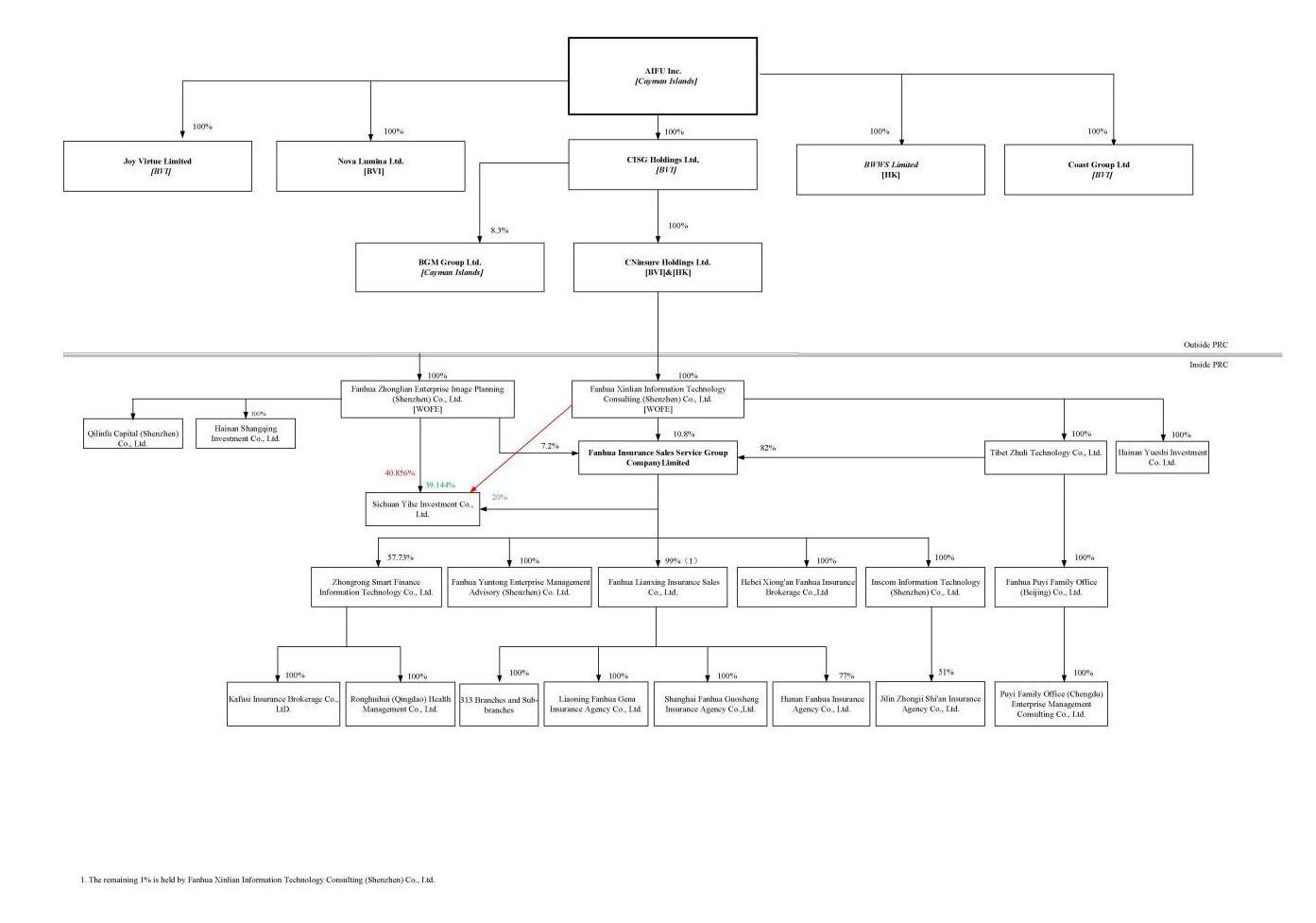
AIFU Inc. is a Cayman Islands holding company primarily operating in China through our PRC subsidiaries, including Fanhua Zhonglian Enterprise Image Planning (Shenzhen) Co., Ltd., or Zhonglian Enterprise, and Fanhua Xinlian Information Technology Consulting (Shenzhen) Co., Ltd., or Xinlian Information, and their respective subsidiaries.
We currently conduct our insurance agency business in mainland China primarily through our wholly-owned subsidiary Fanhua Group Company and its subsidiaries. As of March 31, 2026, we, through Fanhua Group Company, have controlling equity ownership in one insurance agency with a national operating license, four regional insurance agencies and two insurance brokerage firms. Fanhua Group Company and its direct and indirect subsidiaries hold the licenses and permits necessary to conduct our insurance intermediary business and internet insurance distribution business in China.
The following diagram illustrates the corporate structure of us, including the names, places of incorporation and the proportion of ownership interests in our significant subsidiaries and their respective subsidiaries as of the date of this prospectus:
1
Prior to December 27, 2024, due to restriction on foreign ownership and investment in certain internet-based businesses, we operated our internet-based business in China through the former consolidated VIEs, namely Xinbao Investment and Fanhua RONS Technologies, and their subsidiaries, and relied on the Contractual Arrangements among (x) our wholly-owned PRC subsidiaries Fanhua Group Company and Fanlian Investment, (y) the former consolidated VIEs and (z) the individual nominee shareholders of the former consolidated VIEs to control the business operations of the former consolidated VIEs and their subsidiaries.
Our historical contractual agreements included: (i) technology consulting and service agreements and consulting and service agreements, which enabled us to receive all of the economic benefits of the former consolidated VIEs and their subsidiaries, (ii) loan agreements, powers of attorney and equity pledge agreements, which provided us with effective control over the former consolidated VIEs and their subsidiaries, and (iii) exclusive purchase option agreements, which provided us with the option to purchase all of the equity interests in the former consolidated VIEs, and (iv) equity pledge agreements, which, in combination of the aforementioned loan agreements, provided us with control over the former consolidated VIEs and their subsidiaries. As a result of the historical Contractual Arrangements, we were able to direct the activities of and derive economic benefits from the former consolidated VIEs and were considered the primary beneficiary of the former consolidated VIEs for accounting purposes. Accordingly, we have consolidated the financial results of the former consolidated VIEs in our consolidated financial statements in accordance with U.S. GAAP.
In December 2024, as part of a share exchange transaction with BGM, our beneficial ownership in Xinbao Investment and Fanhua RONS Technologies was transferred to BGM in exchange of Class A ordinary shares of BGM. These Contractual Arrangements were subsequently terminated. As a result, Xinbao Investment and Fanhua RONS Technologies have been deconsolidated from our consolidated financial statements since December 31, 2024. As of the date of this prospectus, our operations in China are conducted by our PRC subsidiaries and we do not have any VIE structure.
In the opinion of Hai Run Law Firm, our PRC legal counsel, (i) the ownership structure relating to the former consolidated VIEs did not violate the existing PRC laws and regulations; (ii) the Contractual Arrangements with the former consolidated VIEs and the individual shareholders were legal, valid and binding obligation of such parties, and enforceable against such parties in accordance with their respective terms; and (iii) the execution, delivery and performance of the Contractual Arrangements did not result in any violation of the provisions of the articles of association and business licenses of the former consolidated VIEs, and any violation of any current PRC laws and regulations.
CSRC Approval and Filing Required for Overseas Securities Offerings
On February 17, 2023, the China Securities Regulatory Commission, or the CSRC, issued the New Overseas Listing Rules and five guidelines, or collectively, the Filing Rules, which came into effect on March 31, 2023. Under the Filing Rules, a filing-based regulatory system shall be applied to “indirect overseas offerings and listings” of PRC domestic companies, which refers to securities offerings and listings in an overseas market made under the name of an offshore entity but based on the underlying equity, assets, earnings or other similar rights of a domestic company that operates its main business domestically. The Filing Rules state that, any post-listing follow-on offering by an issuer in the same overseas market, including issuance of shares, convertible notes and other similar securities, shall be subject to filing requirement within three business days after the completion of the offering. Therefore, any of our future securities offerings and listings in an overseas market may also be subject to the filing requirements under the Filing Rules. In addition, we cannot guarantee that new rules or regulations promulgated in the future will not impose any additional requirement on us or otherwise to tighten the regulations on PRC companies seeking overseas offering or listing. Any failure to obtain the relevant approval or complete the filings and other relevant regulatory procedures may subject us to regulatory actions or other penalties from the CSRC or other PRC regulatory authorities, which may have a material adverse effect on our business, operations or financial conditions. See “Item 3. Key Information—3.D. Risk Factors—Risks Related to Doing Business in China—The approval of and filing with the CSRC or other PRC government authorities may be required in connection with our future offshore offerings, capital raising activities and acquisitions or other trading arrangements of domestic enterprises conducted by China-based issuers. We must file with the CSRC within three business days after the issuance, and also may be required to go through cybersecurity review under the new laws and the draft laws and regulations of mainland China if authorities identifying us as a critical information infrastructure operator or requiring us to going through review by the CAC, which remains unclear. And, if required, we cannot predict whether or for how long we will be able to obtain such approval or complete such filing or other regulatory procedures” in the 2025 Form 20-F.
We are required to make a filing with the CSRC after the completion of any future offering made pursuant to this prospectus and for our other future offerings and listing of our securities in an overseas market under the Filing Rules.
2
Permissions and Licenses for Our Operations in PRC
We currently conduct our business primarily through our subsidiaries in China, and historically through the former consolidated VIEs and their subsidiaries in China until December 27, 2024. As of the date of this prospectus, our subsidiaries have obtained the requisite licenses and permits from the PRC government authorities that are material for our operations in China, including, among others, the business license, insurance distribution licenses, insurance broker licenses. Theses licenses are the only permissions and approvals that our PRC subsidiaries are required to obtain to conduct our business in China. However, there can be no assurance that we will be able to obtain, renew and/or convert all of the approvals, licenses, and permits required for our existing business operations upon their expiration in a timely manner or duly complete necessary registration or filings with the relevant governmental authorities for any of our new business.
In addition, as described above, the PRC government has recently tightened the regulation of cybersecurity, and indicated an intent to exert more oversight and control over securities offerings and other capital markets activities that are conducted overseas and foreign investment in China-based companies like us. In addition, we are required to complete the filing with the CSRC for our future overseas securities offerings under the Filing Rules.
We manage our business operations in a prudent manner where we determine whether a particular regulatory permission or approval is required based on opinions and guidance from our in-house and external legal counsel and relevant governmental authorities, as the case may be. As of the date of this prospectus, we have not received any regulatory notice requesting us to obtain a permission or approval that we have concluded is not required. However, given the significant uncertainties of interpretation and implementation of relevant laws and regulations and the enforcement practice by relevant government authorities, we may be required to apply for and obtain additional licenses, permits, filings, or approvals for our business operations in the future. If (i) we or our PRC subsidiaries do not receive or maintain any required permission or approval, (ii) we or our PRC subsidiaries inadvertently concluded that certain permissions or approvals have been acquired or are not required, or (iii) applicable laws, regulations, or interpretations thereof change, and we or our PRC subsidiaries become subject to the requirement of additional permissions or approvals in the future, we may have to expend significant time and costs to procure them. If we are unable to do so, in a timely manner or otherwise, we may become subject to sanctions imposed by the PRC regulatory authorities, which could include fines, penalties, and proceedings against us, and other forms of sanctions, and our ability to conduct our business, invest in mainland China as foreign investments or accept foreign investments, or list on a U.S. or other overseas exchange may be restricted, and our business, reputation, financial condition, and results of operations may be materially and adversely affected, and the value of our shares could significantly decline or become worthless.
Implication of the Holding Foreign Companies Accountable Act
The Holding Foreign Companies Accountable Act, or the HFCA Act, was enacted on December 18, 2020 and amended by the Consolidated Appropriations Act, 2023 enacted on December 29, 2022. The amended HFCA Act states if the SEC determines that we have filed audit reports issued by a registered public accounting firm that has not been subject to inspection by the PCAOB for two consecutive years, the SEC shall prohibit our shares from being traded on a national securities exchange or in the over-the-counter trading market in the United States. On December 16, 2021, the PCAOB issued its report notifying the SEC of its determination that it was unable to inspect or investigate completely registered public accounting firms headquartered in mainland China or Hong Kong, or the 2021 Determination, including our former auditor. On May 26, 2022, we were conclusively identified by the SEC as a Commission-Identified Issuer under the HFCA Act. On December 15, 2022, the PCAOB issued a report that vacated its 2021 Determination and removed mainland China and Hong Kong from the list of jurisdictions where it is unable to inspect or investigate completely registered public accounting firms.
Our current auditor, Enrome LLP which replaced Deloitte Touche Tohmatsu Certified Public Accountants LLP on January 23, 2025, is headquartered in Singapore and subject to inspection by the PCAOB. Our current auditor was not among the PCAOB-registered public accounting firms headquartered in mainland China or Hong Kong that were subject to the 2021 Determination. As a result, we do not believe we are at risk of having our securities subject to a trading prohibition under the HFCA Act unless a new determination is made by the PCAOB.
3
Each year, the PCAOB will determine whether it can inspect and investigate completely audit firms in mainland China and Hong Kong, among other jurisdictions. If the PCAOB determines in the future that it no longer has full access to inspect and investigate completely accounting firms in mainland China and Hong Kong and we use an accounting firm headquartered in one of these jurisdictions to issue an audit report on our financial statements filed with the SEC, we would be identified as a “Commission-Identified Issuer” following the filing of the annual report on Form 20-F for the relevant fiscal year. There can be no assurance that we would not be identified as a “Commission-Identified Issuer” for any future fiscal year, and if we were so identified for two consecutive years, we would become subject to the prohibition on trading under the HFCA Act. The delisting of our shares, or the threat of their being delisted, may materially and adversely affect the value of your investment. These risks could result in a material adverse change in our operations and the value of our shares, significantly limit or completely hinder our ability to continue to offer securities to investors, or cause the value of such securities to significantly decline or become worthless. See “Item 3. Key Information—3.D. Risk Factors—Risks Related to Our Ordinary Shares—The PCAOB had historically been unable to inspect our auditors in relation to their audit work performed for our financial statements and the inability of the PCAOB to conduct inspections of our auditors in the past has deprived our investors with the benefits of such inspections.” and “Item 3. Key Information—3.D. Risk Factors—Risks Related to Our Ordinary Shares—Our Class A ordinary shares may be prohibited from trading in the United States under the HFCA Act in the future if the PCAOB is unable to inspect or investigate completely our auditors. The delisting of our Class A ordinary shares, or the threat of their being delisted, may materially and adversely affect the value of your investment.” in our 2025 Form 20-F.
Cash Flows between AIFU Inc, its Subsidiaries and the Former Consolidated VIEs
Under PRC law, we may provide funding to our PRC subsidiaries only through capital contributions or loans, and to the former consolidated VIEs only through loans, subject to the satisfaction of applicable government registration and approval requirements. We rely on dividends and other distributions from our PRC subsidiaries to satisfy part of our liquidity requirement. Under the historical Contractual Arrangements among our WFOEs, namely Fanhua Group Company and Fanlian Investment, the former consolidated VIEs, and the shareholders of the former consolidated VIEs, our WFOEs provided consultation and training services to the former consolidated VIEs, and were entitled to all of the economic benefits of the former consolidated VIEs and its subsidiaries in the form of service fees. The historical Contractual Arrangements provided that the former consolidated VIEs shall pay a quarterly fee calculated primarily based on a percentage of its revenues.
Technology consulting and service agreements were entered into between (i) Fanhua Group Company and (ii) Xinbao Investment and each of its subsidiaries on March 1, 2022 and consulting and service agreements were entered into between (i) Fanlian Investment and (ii) Fanhua RONS Technologies and each of its subsidiaries. No service fees were incurred in 2023, 2024 and 2025. The cash flows occurred between our subsidiaries and the former consolidated VIEs included the following: (1) cash received by the former consolidated VIEs from our subsidiaries as inter-company advances amounted to RMB39.4 million, RMB46.8 million and nil for the years ended December 31, 2023, 2024 and 2025, respectively; and (2) net commissions received by our subsidiaries from the former consolidated VIEs offset by technology services paid by our subsidiaries to the former consolidated VIEs amounted to RMB56.7 million, RMB34.5 million and nil for the years ended December 31, 2023, 2024 and 2025, respectively. Although we had previously declared and paid cash dividends, we have no plan to declare or pay any dividends in the near future on our Class A ordinary shares. We currently intend to retain most, if not all, of our available funds and any future earnings to operate and expand our business. See “—Financial Information Related to the Former Consolidated VIEs” below and “Item 8. Financial Information—8.A. Consolidated Statements and Other Financial Information—Dividend Policy” in our 2025 Form 20-F.
4
Restrictions on Foreign Exchange and our Ability to Transfer Cash between Entities, Across Borders and to U.S. Investors
As of the date of this prospectus, we do not have cash management policies and procedures in place that dictate how funds are transferred through our organization. Rather, the funds can be transferred in accordance with the applicable PRC laws and regulations, subject to satisfaction of applicable government registration and approval requirements. To the extent cash or assets are held in mainland China or by a mainland China entity, the funds or assets may not be available to fund operations or for other use outside of mainland China due to the intervention in or imposition of restrictions and limitations on the ability of AIFU Inc. or our subsidiaries by the PRC government to transfer cash or assets. While there are currently no such restrictions or limitations in Hong Kong on cash transfers to, or from, entities in Hong Kong, if certain PRC laws and regulations, including existing laws and regulations and those enacted or promulgated in the future, were to become applicable to our Hong Kong subsidiaries in the future, and to the extent our cash or assets are in Hong Kong or a Hong Kong entity, such funds or assets may not be available due to the interventions in or imposition of restrictions and limitations on our ability to transfer funds or assets by the PRC government.
AIFU Inc.’s ability to pay dividends, if any, to its shareholders and to service any debt it may incur will depend upon dividends paid by the WFOEs. Under PRC laws and regulations, the WFOEs are subject to certain restrictions with respect to paying dividends or otherwise transferring any of their net assets offshore to AIFU Inc. In particular, under the current effective PRC laws and regulations, dividends may be paid only out of distributable profits. Distributable profits are the net profit as determined under PRC GAAP, less any recovery of accumulated losses and appropriations to statutory and other reserves required to be made. The WFOEs are required to set aside at least 10% of their respective after-tax profits each year, after making up previous years’ accumulated losses, if any, to fund certain statutory reserve funds, until the aggregate amount of such a fund reaches 50% of their respective registered capital. At its discretion, each of the WFOEs may allocate a portion of its after-tax profits based on PRC GAAP to discretional funds. As a result, the WFOEs may not have sufficient distributable profits to pay dividends to us in the near future. See “Item 3. Key Information—3.D. Risk Factors—Risks Related to Doing Business in China—We rely principally on dividends and other distributions on equity paid by our subsidiaries to fund any cash and financing requirements we may have, and any limitation on the ability of our subsidiaries to make payments to us could have a material adverse effect on our ability to conduct our business.” in our 2025 Form 20-F.
Furthermore, if certain procedural requirements are satisfied, the payment of current account items, including profit distributions and trade and service related foreign exchange transactions, can be made in foreign currencies without prior approval from State Administration of Foreign Exchange, or the SAFE, or its local branches, by complying with certain procedural requirements under PRC foreign exchange regulations, such as the overseas investment registrations by the beneficial owners of our Company who are PRC residents. However, where RMB is to be converted into foreign currency and remitted out of China to pay capital expenses, such as the repayment of loans denominated in foreign currencies, approval from or registration with competent government authorities or its authorized banks is required. The PRC government may take measures at its discretion from time to time to restrict access to foreign currencies for current account or capital account transactions. If the foreign exchange control system prevents us from obtaining sufficient foreign currencies to satisfy our foreign currency demands, we may not be able to pay dividends in foreign currencies to our offshore intermediary holding companies or ultimate parent company, and therefore, our shareholders. Further, we cannot assure you that new regulations or policies will not be promulgated in the future, which may further restrict the remittance of RMB into or out of the PRC. We cannot assure you, in light of the restrictions in place, or any amendment to be made from time to time, that our current or future PRC subsidiaries will be able to satisfy their respective payment obligations that are denominated in foreign currencies, including the remittance of dividends outside of the PRC. If any of our subsidiaries incurs debt on its own behalf in the future, the instruments governing such debt may restrict its ability to pay dividends to AIFU Inc. In addition, the WFOE is required to make appropriations to certain statutory reserve funds, which are not distributable as cash dividends except in the event of a solvent liquidation of the companies. See “Item 3. Key Information—3.D. Risk Factors—Risks Related to Doing Business in China—PRC governmental control of currency conversion may limit our ability to utilize our revenues effectively and affect the value of your investment” in the 2025 Form 20-F.
For PRC and United States federal income tax consideration of an investment in our shares, see “Taxation.”
5
Financial Information Related to the Former Consolidated VIEs
The following tables set forth the summary of the consolidated statement of income and cash flows in 2023 and 2024 of AIFU Inc., our wholly foreign-owned subsidiaries (“WFOEs”), or Fanhua Group Company and Fanlian Investment, that were the primary beneficiaries of the former consolidated VIEs under accounting principles generally accepted in the United States, or U.S. GAAP, our other subsidiaries and the former consolidated VIEs and their subsidiaries.
| For the year ended December 31, 2024 | ||||||||||||||||||||||||
| Parent | Consolidated VIEs and their subsidiaries | WFOEs | Other subsidiaries | Eliminating adjustments (1) | Consolidated total | |||||||||||||||||||
| (RMB in thousands) | ||||||||||||||||||||||||
| Total net revenues | - | 178,697 | - | 1,279,788 | (126,707 | ) | 1,331,778 | |||||||||||||||||
| Third-party revenues | - | 123,593 | - | 1,208,185 | - | 1,331,778 | ||||||||||||||||||
| Intra-Group revenues | - | 55,104 | - | 71,603 | (126,707 | ) | - | |||||||||||||||||
| Total operating costs and expenses | (46,159 | ) | (164,218 | ) | (15,775 | ) | (1,679,451 | ) | 126,707 | (1,778,896 | ) | |||||||||||||
| Third-party operating costs and expenses | (46,159 | ) | (92,617 | ) | (15,773 | ) | (1,624,347 | ) | - | (1,778,896 | ) | |||||||||||||
| Intra-Group operating costs and expenses | - | (71,601 | ) | (2 | ) | (55,104 | ) | 126,707 | - | |||||||||||||||
| Income (loss) from operations | (46,159 | ) | 14,479 | (15,775 | ) | (399,663 | ) | - | (447,118 | ) | ||||||||||||||
| Interest income, net | 353 | 1,422 | 10,566 | 2,751 | - | 15,092 | ||||||||||||||||||
| Investment income | 5,095 | - | 23,131 | 14,062 | - | 42,288 | ||||||||||||||||||
| Gains (Losses) from fair value change of a short term investment | 4,089 | - | - | (82,588 | ) | - | (78,499 | ) | ||||||||||||||||
| Gain from the disposal of subsidiaries | - | - | 2,635 | 894,671 | - | 897,306 | ||||||||||||||||||
| Others, net | 3,844 | 5,581 | (47,970 | ) | 10,784 | - | (27,761 | ) | ||||||||||||||||
| Share of income from subsidiaries and the VIEs and VIEs’ subsidiaries | 487,738 | - | 12,327 | - | (500,065 | ) | - | |||||||||||||||||
| Share of income of affiliates, net of impairment | - | - | - | (5,052 | ) | - | (5,052 | ) | ||||||||||||||||
| Income tax expenses | - | (612 | ) | - | (91,342 | ) | - | (91,954 | ) | |||||||||||||||
| Net (loss) income from continuing operations | 454,960 | 20,870 | (15,086 | ) | 343,623 | (500,065 | ) | 304,302 | ||||||||||||||||
| Net income from discontinued operations, net of tax | 5,172 | 5,172 | ||||||||||||||||||||||
| Net income (loss) | 454,960 | 20,870 | (15,086 | ) | 348,795 | (500,065 | ) | 309,474 | ||||||||||||||||
Note:
| (1) | The elimination mainly represents (i) the intercompany service fee related to agency services for distributing life insurance products and non-life insurance products on behalf of insurance companies provide by consolidated affiliated entities to subsidiaries and (ii) the intercompany service fee related to technology services provided by our consolidated variable interest entities to our subsidiaries. |
6
| For the year ended December 31, 2023 | ||||||||||||||||||||||||
| Parent | Consolidated VIEs and their subsidiaries | WFOEs | Other subsidiaries | Eliminating adjustments (1) | Consolidated total | |||||||||||||||||||
| Total net revenues | - | 168,965 | - | 2,718,767 | (127,284 | ) | 2,760,448 | |||||||||||||||||
| Third-party revenues | - | 122,880 | - | 2,637,568 | - | 2,760,448 | ||||||||||||||||||
| Intra-Group revenues | - | 46,085 | - | 81,199 | (127,284 | ) | - | |||||||||||||||||
| Total operating costs and expenses | (24,645 | ) | (182,156 | ) | (29,953 | ) | (2,472,510 | ) | 125,289 | (2,583,975 | ) | |||||||||||||
| Third-party operating costs and expenses | (24,645 | ) | (100,956 | ) | (29,953 | ) | (2,428,421 | ) | - | (2,583,975 | ) | |||||||||||||
| Intra-Group operating costs and expenses | - | (81,200 | ) | - | (44,089 | ) | 125,289 | - | ||||||||||||||||
| Income (loss) from operations | (24,645 | ) | (13,191 | ) | (29,953 | ) | 246,257 | (1,995 | ) | 176,473 | ||||||||||||||
| Interest income, net | 1,201 | 1,182 | 7,934 | 4,688 | - | 15,005 | ||||||||||||||||||
| Investment income | 10,359 | - | 21,105 | 16,786 | - | 48,250 | ||||||||||||||||||
| Gains from fair value change of a short term investment | 6,650 | - | - | 96,217 | - | 102,867 | ||||||||||||||||||
| Others, net | - | 409 | 4,355 | 1,408 | - | 6,172 | ||||||||||||||||||
| Share of income from subsidiaries and the VIEs and VIEs’ subsidiaries | 285,595 | - | 194,973 | (480,568 | ) | - | ||||||||||||||||||
| Share of income (loss) of affiliates, net of impairment | 1,317 | - | - | (2,634 | ) | - | (1,317 | ) | ||||||||||||||||
| Income tax expenses | - | (1,485 | ) | - | (57,721 | ) | - | (59,206 | ) | |||||||||||||||
| Net (loss) income from continuing operations | 280,477 | (13,085 | ) | 198,414 | 305,001 | (482,563 | ) | 288,244 | ||||||||||||||||
| Net income from discontinued operations, net of tax | 855 | 855 | ||||||||||||||||||||||
| Net income (loss) | 280,477 | (13,085 | ) | 198,414 | 305,856 | (482,563 | ) | 289,099 | ||||||||||||||||
Note:
| (1) | The elimination mainly represents (i) the intercompany service fee related to agency services for distributing life insurance products and non-life insurance products on behalf of insurance companies provide by consolidated affiliated entities to subsidiaries and (ii) the intercompany service fee related to technology services provided by our consolidated variable interest entities to our subsidiaries. |
7
| For the year ended December 31, 2024 | ||||||||||||||||||||||||
| Parent | Consolidated VIEs and their subsidiaries | WFOEs | Other subsidiaries | Eliminating adjustments | Consolidated total | |||||||||||||||||||
| (RMB in thousands) | ||||||||||||||||||||||||
| Cash flows from operating activities: | (22,904 | ) | (32,908 | ) | 33,079 | 165,585 | - | 142,852 | ||||||||||||||||
| Net cash (used in) generated from transactions with external parties | (22,904 | ) | 1,618 | 33,079 | 131,059 | - | 142,852 | |||||||||||||||||
| Net cash (used in) generated from transactions with internal companies | - | (34,526 | ) | - | 34,526 | - | - | |||||||||||||||||
| Cash flows from investing activities: | (3,937 | ) | (25,182 | ) | (650,466 | ) | (410,622 | ) | 653,617 | (436,590 | ) | |||||||||||||
| Net cash generated from (used in) transactions with external parties | (15,024 | ) | (25,182 | ) | (650,466 | ) | 254,082 | - | (436,590 | ) | ||||||||||||||
| Net cash generated from (used in) transactions with internal companies | 11,087 | - | - | (664,704 | ) | 653,617 | - | |||||||||||||||||
| Cash flows from financing activities: | (5,642 | ) | 46,797 | 617,403 | (69,330 | ) | (653,617 | ) | (64,389 | ) | ||||||||||||||
| Net cash (used in) generated from transactions with external parties | (5,642 | ) | - | - | (58,747) | - | (64,389 | ) | ||||||||||||||||
| Net cash generated from (used in) transactions with internal companies | - | 46,797 | 617,403 | (10,583 | ) | (653,617 | ) | - | ||||||||||||||||
| For the year ended December 31, 2023 | ||||||||||||||||||||||||
| Parent | Consolidated VIEs and their subsidiaries | WFOEs | Other subsidiaries | Eliminating adjustments | Consolidated total | |||||||||||||||||||
| (RMB in thousands) | ||||||||||||||||||||||||
| Cash flows from operating activities: | (36,520 | ) | (52,983 | ) | 6,620 | 184,670 | - | 101,787 | ||||||||||||||||
| Net cash (used in) generated from transactions with external parties | (36,520 | ) | 3,754 | 6,620 | 127,933 | - | 101,787 | |||||||||||||||||
| Net cash (used in) generated from transactions with internal companies | - | (56,737 | ) | - | 56,737 | - | - | |||||||||||||||||
| Cash flows from investing activities: | 20,092 | (20,095 | ) | 384,002 | (177,970 | ) | (451,849 | ) | (245,820 | ) | ||||||||||||||
| Net cash generated from (used in) transactions with external parties | 30,097 | (20,095 | ) | 384,002 | (639,824 | ) | - | (245,820 | ) | |||||||||||||||
| Net cash (used in) generated from transactions with internal companies | (10,005 | ) | - | - | 461,854 | (451,849 | ) | - | ||||||||||||||||
| Cash flows from financing activities: | (29,044 | ) | 39,359 | (502,207 | ) | 137,731 | 451,849 | 97,688 | ||||||||||||||||
| Net cash (used in) generated from transactions with external parties | (29,044 | ) | - | - | 126,732 | - | 97,688 | |||||||||||||||||
| Net cash generated from (used in) transactions with internal companies | - | 39,359 | (502,207 | ) | 10,999 | 451,849 | - | |||||||||||||||||
8
Summary of Risk Factors
Investing in our securities involves significant risks. You should carefully consider all of the information in this prospectus before making an investment in our securities. Below please find a summary of the principal risks we face, organized under relevant headings. These risks are discussed more fully in “Risk Factors” and “Item 3. Key Information — D. Risk Factors” in the 2025 Form 20-F, which is incorporated herein by reference.
Risks Related to Our Business and Industry
We face risks and uncertainties in realizing our business objectives and executing our strategies, including:
| ● | We may not be successful in implementing our refined growth strategy or pursuing new growth opportunities, which could adversely affect our business and financial results. |
| ● | If and when our contracts with insurance companies are suspended or changed, our business and operating results will be materially and adversely affected. |
| ● | If we fail to attract and retain productive agents, especially entrepreneurial agents, our business and operating results could be materially and adversely affected. |
| ● | Failure of our digitalization and technology initiatives could materially and adversely affect our business, financial condition and results of operations. |
| ● | All of our personnel engaging in insurance agency activities are required under relevant PRC regulations to register with the NFRA’s Insurance Intermediaries Regulatory Information System. If our sales personnel fail to finish practice registration, our business may be materially and adversely affected. |
| ● | Our businesses are highly regulated, and the administration, interpretation and enforcement of the laws and regulations currently applicable to us involve uncertainties, which could materially and adversely affect our business and results of operations. |
| ● | Changes in the regulatory environment in China have materially affected, and may continue to materially and adversely affect, our business and results of operations. |
| ● | We may be unsuccessful in identifying suitable acquisition candidates, completing acquisitions, integrating acquired companies or the acquired companies may not perform to our expectations, which could adversely affect our growth. |
| ● | Competition in our industry is intense and, if we are unable to compete effectively with both existing and new market participants, we may lose customers, and our financial results may be negatively affected. |
| ● | Because the commission and fee we earn on the sale of insurance products is based on premiums, commission and fee rates set by insurance companies, any decrease in these premiums, commission or fee rates may have an adverse effect on our results of operations. |
9
Risks Related to Our Corporate Structure
| ● | AIFU Inc. is a Cayman Islands holding company primarily operating in China through its subsidiaries. It historically also operated a small part of its business through Contractual Arrangements with our Former Consolidated VIEs until December 27, 2024. If the PRC government determines that the historical contractual arrangements with the former VIEs structure did not comply with the regulations of mainland China, or if these regulations change or are interpreted differently in the future, our shares may decline in value or become worthless if we are deemed to be unable to assert our contractual control rights over the assets of the former VIEs. |
| ● | The historical Contractual arrangements we have entered into with our former consolidated VIEs may be subject to scrutiny by the PRC tax authorities. A finding that we owe additional taxes could substantially reduce our consolidated net income and the value of your investment. |
| ● | The PRC government has significant authority to exert influence on the China operations of an offshore holding company, such as us. Therefore, investors in our shares and our business face potential uncertainty from the PRC government’s policy. Changes in China’s economic, political or social conditions, or government policies could materially and adversely affect our business, financial condition, and results of operations. |
| ● | We are subject to extensive and evolving legal development, non-compliance with which, or changes in which, may materially and adversely affect our business and prospects, and may result in a material change in our operations and/or the value of our shares or could significantly limit or completely hinder our ability to offer or continue to offer securities to investors and cause the value of our securities to significantly decline or be worthless. |
| ● | It is unclear whether we will be subject to the oversight of the Cyberspace Administration of China and how such oversight may impact us. Our business could be interrupted or we could be subject to liabilities which may materially and adversely affect the results of our operation and the value of your investment. |
Risks Related to Doing Business in China
| ● | The approval of and filing with the CSRC or other PRC government authorities may be required in connection with our future offshore offerings, capital raising activities and acquisitions or other trading arrangements of domestic enterprises conducted by China-based issuers. We must file with the CSRC within three business days after the issuance, and also may be required to go through cybersecurity review under the new laws and the draft laws and regulations of mainland China if authorities identifying us as a critical information infrastructure operator or requiring us to going through review by the CAC, which remains unclear. And, if required, we cannot predict whether or for how long we will be able to obtain such approval or complete such filing or other regulatory procedures. |
| ● | Uncertainties in the PRC legal system and the interpretation and enforcement of PRC laws and regulations could limit the legal protections available to you and us, significantly limit or completely hinder our ability to offer or continue to offer our shares, cause significant disruption to our business operations, and severely damage our reputation, which would materially and adversely affect our financial condition and results of operations and cause our shares to significantly decline in value or become worthless. In addition, rules and regulations in China can change quickly with little advance notice, therefore, our assertions and beliefs of the risks imposed by the Chinese legal and regulatory system cannot be certain. |
10
| ● | A downturn in the Chinese or global economy could have a material adverse effect on our business. |
| ● | Governmental control of currency conversion may affect the value of your investment. |
| ● | The PRC Enterprise Income Tax Law may increase the enterprise income tax rate applicable to some of our PRC subsidiaries, which could have a material adverse effect on our result of operations. |
Risks Related to Our Ordinary Shares
| ● | We may be unable to comply with the applicable continued listing requirements of Nasdaq. |
| ● | The PCAOB had historically been unable to inspect our auditors in relation to their audit work performed for our financial statements and the inability of the PCAOB to conduct inspections of our auditors in the past has deprived our investors with the benefits of such inspections. |
| ● | Our Class A ordinary shares may be prohibited from trading in the United States under the HFCA Act in the future if the PCAOB is unable to inspect or investigate completely our auditors. The delisting of our Class A ordinary shares, or the threat of their being delisted, may materially and adversely affect the value of your investment. |
| ● | The trading price of our Class A ordinary shares may be volatile. |
| ● | Under our dual-class share structure with different voting rights, holders of Class B ordinary shares have complete control of the outcome of matters put to a vote of shareholders, which may limit ability of holders of our Class A ordinary shares to influence corporate matters and could discourage others from pursuing any change of control transactions that holders of our Class A ordinary shares may view as beneficial. |
| ● | Substantial future sales or perceived potential sales of our ordinary shares or other equity securities in the public market could cause the price of our shares to decline. |
Corporate Information
Our principal executive offices are located at Room 1, Building 10, Jinzhong Guobin Hui Qinyuan 2nd Road, Lihu Community, Xili Street, Shenzhen, 518055, People’s Republic of China. Our telephone number at this address is +86-755-2267-1879. Our registered office is at the offices of Maples Corporate Services Limited, PO Box 309, Ugland House, Grand Cayman, KY1-1104, Cayman Islands. Our agent for service of process in the United States is Cogency Global Inc., located at 122 East 42nd Street, 18th Floor, New York, N.Y. 10168, United States.
The SEC maintains an internet site that contains reports, proxy and information statements, and other information regarding issuers that file electronically with the SEC at www.sec.gov. You can also find information on our website at http://ir.aifugroup.com. The information contained on our website is not a part of this prospectus.
11
Any investment in our securities involves a high degree of risk. You should carefully consider the risk factors discussed or incorporated by reference in the applicable prospectus supplement, together with all the other information contained in the prospectus supplement or incorporated by reference in this prospectus. You should also consider the risks and uncertainties discussed under the heading “Risk Factors” in our annual report on Form 20-F for the fiscal year ended December 31, 2025, which is incorporated by reference in this prospectus, and which may be amended, supplemented or superseded from time to time by other reports we file with the SEC in the future.
12
We intend to use the net proceeds from the sale of the securities we offer as set forth in the applicable prospectus supplement(s).
We will not receive any proceeds from the sale or other distribution of our securities by the selling shareholders.
13
The following is a summary of our share capital and certain provisions of our currently effective memorandum and articles of association. This summary does not purport to be complete and is qualified in its entirety by the provisions of our currently effective memorandum and articles of association and applicable provisions of the laws of the Cayman Islands. All capitalized terms used in this section are as defined in our currently effective memorandum and articles of association, unless elsewhere defined herein.
We are an exempted company incorporated under the laws of the Cayman Islands with limited liability and our affairs are governed by our memorandum and articles of association, as amended and restated from time to time, and the Companies Act (As Revised) of the Cayman Islands, which we refer to as the “Companies Act” below, and the common law of the Cayman Islands.
As of the date of this prospectus, as a result of the Second Share Consolidation, our authorized share capital is US$20,000,000 divided into 10,000,000,000 ordinary shares, comprising of (i) 8,000,000,000 Class A ordinary shares of a nominal or par value of US$0.002 each and (ii) 2,000,000,000 Class B ordinary shares of a nominal or par value of US$0.002 each.
Our Memorandum and Articles of Association
The following are summaries of material provisions of our amended and restated memorandum and articles of association adopted by a special resolution passed on April 29, 2025 and the Companies Act, insofar as they relate to the material terms of our ordinary shares.
Objects of Our Company. The objects for which our company is established are unrestricted and we have full power and authority to carry out any object not prohibited by the Companies Act or as the same may be revised from time to time, or any other law of the Cayman Islands.
Ordinary Shares. Our authorized share capital is US$20,000,000 divided into 10,000,000,000 ordinary shares, comprising of (i) 8,000,000,000 Class A ordinary shares of a nominal or par value of US$0.002 each and (ii) 2,000,000,000 Class B ordinary shares of a nominal or par value of US$0.002 each. All of our issued and outstanding ordinary shares are fully paid and non-assessable. Certificates representing the ordinary shares are issued in registered form. Our shareholders who are nonresidents of the Cayman Islands may freely hold and vote their shares.
Dividend Rights. The holders of our Class A ordinary shares are entitled to such dividends as may be declared by our board of directors subject to the Companies Act. In addition, our shareholders may declare dividends by ordinary resolution, but no dividend shall exceed the amount recommended by our directors. Each Class B ordinary shares confers upon the holder no right to any share in any dividend or distribution paid by the Company.
Voting Rights. Holders of Class A ordinary shares and Class B ordinary shares shall at all times vote together as one class on all resolutions submitted to a vote by the Members. On a show of hands, each shareholder present in person or by proxy (or, for a corporation or other non-natural person, present by its duly authorized representative or proxy) at a general meeting shall have one vote and on a poll, shall have one vote for each Class A ordinary share registered in his name in the register of members of our company and one hundred (100) votes for each Class B ordinary share registered in his or her name in the Register, on any and all matters subject to a vote at such meeting. Voting at any meeting of shareholders is by show of hands unless a poll is (before or on the declaration of the result of the show of hands) demanded. A poll may be demanded by the chairman of the meeting or by any one or more shareholders together holding not less than ten percent of our paid-up voting share capital, present in person or by proxy.
A quorum required for a meeting of shareholders consists of shareholders holding in aggregate not less than one-third of all our issued voting share capital present in person or by proxy or, if a corporation or other non-natural person, by its duly authorized representative. We may, but are not obliged, to hold an annual general meeting of shareholders. General meetings may be convened by our board of directors on its own initiative or upon a request to the directors by shareholders holding in aggregate not less than one-third of our voting share capital as at the date of deposit of the requisition. Advance notice of at least 14 calendar days is required for the convening of our annual general meeting and other shareholders’ meetings.
14
An ordinary resolution to be passed by the shareholders requires the affirmative vote of a simple majority of the votes attaching to the ordinary shares cast in a general meeting or may be approved in writing by all of the shareholders entitled to vote at a general meeting, while a special resolution requires the affirmative vote of no less than two-thirds of the votes attaching to the ordinary shares cast in a general meeting or may be passed as a unanimous written resolution. A special resolution is required for important matters such as a change of name. Holders of the ordinary shares may effect certain changes by ordinary resolution, including consolidating and dividing all or any of our share capital into shares of a larger amount than our existing shares, and canceling any shares which have not been taken or agreed to be taken.
Transfer of Shares. Subject to the restrictions of our articles of association, as applicable, any of our Class A ordinary shareholders may transfer all or any of his or her Class A ordinary shares by an instrument of transfer in the usual or common form or any other form approved by our board. No Class B ordinary share may be sold, transferred, assigned, pledged, or otherwise disposed of, or used as collateral for loans or any obligations.
Conversion. Each Class B ordinary share is convertible into one Class A ordinary share, at the option of the holder, subject to approval by no less than two-thirds of the board of directors or by written resolutions of all the directors. In no event shall Class A ordinary shares be convertible into Class B ordinary shares under any circumstances. Class B ordinary shares shall be automatically and immediately converted into an equal number of Class A ordinary shares under the following circumstances: (i) if the holder is an employee, upon the termination of their employment (howsoever arising) with the Company; (ii) if the holder is a Director, upon their resignation or removal from the board of directors; and (iii) if the holder is a wholly-owned company (“Owned Company”) of a director, senior Management, or an existing shareholder, upon the individual ceasing to wholly own the Owned Company.
Liquidation. On a return of capital on winding up or otherwise (other than on conversion, redemption or purchase of shares), assets available for distribution among the holders of Class A ordinary shares may be distributed among the holders of the Class A ordinary shares as determined by the liquidator, subject to sanction of an ordinary resolution of our company. Each Class B ordinary share confers upon the holder no right to any share in the distribution of the surplus assets of the Company upon liquidation or otherwise,
Calls on Shares and Forfeiture of Shares. Our board of directors may from time to time make calls upon shareholders for any amounts unpaid on their shares in a notice served to such shareholders at least 14 days prior to the specified time of payment. The shares that have been called upon and remain unpaid on the specified time are subject to forfeiture.
Redemption, Repurchase and Surrender of Shares. Subject to the provisions of the Companies Act and our articles of association, we may issue shares on terms that they are subject to redemption, at our option or at the option of the holders, on such terms and in such manner as our board of directors may determine before the issue of such shares. We also may purchase our own shares (including any redeemable shares) in such manner and on such other terms as determined by the board of directors in their sole discretion and agreed with the relevant shareholder, in accordance with our articles of association. The manner of purchase specified in our articles of association, which cover purchases of shares listed on an internationally recognized stock exchange and shares not so listed, is in accordance with Section 37(2) of the Companies Act or any modification or reenactment thereof for the time being in force. In addition, our company may accept the surrender of any fully paid share for no consideration. Pursuant to the Companies Act, upon the repurchase, redemption or surrender of shares, the board of directors can determine whether or not to cancel those shares or hold them as treasury shares pending cancellation, transfer or sale. The company must obtain authorization to hold such shares as treasury shares either in accordance with the procedures set out in the company’s articles of association or (if there are none) by a board resolution before being repurchased, redeemed or surrendered in accordance with the usual rules and articles. The Company may, at its option, redeem all or any of the Class B ordinary shares held by any person at any time, at such price, and in such manner as may be determined by the board of directors, in accordance with our articles of association.
15
Variations of Rights of Shares. If at any time the share capital is divided into different classes of shares, the rights attached to any class of shares (unless otherwise provided by the terms of issue of the shares of that class) may, subject to our articles of association, be varied or abrogated with the written consent of the holders of a majority of the issued shares of that class or with the sanction of a special resolution passed at a general meeting of the holders of the shares of that class. The rights conferred upon the holders of the shares of any class shall not, unless otherwise expressly provided by the terms of issue of the shares of that class, be deemed to be varied by the creation or issue of further shares ranking in priority to or pari passu therewith.
Inspection of Books and Records. Holders of our ordinary shares have no general right under Cayman Islands law to inspect or obtain copies of our register of members or our corporate records (other than our memorandum and articles of association, special resolutions, and our register of mortgages and charges). However, we make our annual reports, which contain our audited financial statements, available to our shareholders. See “Item 10. Additional Information—10.H. Documents on Display” in the 2025 Form 20-F.
Differences in Corporate Law
The Companies Act is derived, to a large extent, from the older Companies Acts of England but does not follow recent English statutory enactments and accordingly there are significant differences between the Companies Act and the current Companies Act of England. In addition, the Companies Act differs from laws applicable to U.S. corporations and their shareholders. Set forth below is a summary of the significant differences between the provisions of the Companies Act applicable to us and the laws applicable to companies incorporated in the United States and their shareholders.
Mergers and Similar Arrangements. The Companies Act permits mergers and consolidations between Cayman Islands companies and between Cayman Islands companies and non-Cayman Islands companies. For these purposes, (a) “merger” means the merging of two or more constituent companies and the vesting of their undertaking, property and liabilities in one of such companies as the surviving company, and (b) a “consolidation” means the combination of two or more constituent companies into a consolidated company and the vesting of the undertaking, property and liabilities of such companies to the consolidated company. In order to effect such a merger or consolidation, the directors of each constituent company must approve a written plan of merger or consolidation, which must then be authorized by (a) a special resolution of the shareholders of each constituent company, and (b) such other authorization, if any, as may be specified in such constituent company’s articles of association. The plan must be filed with the Registrar of Companies of the Cayman Islands together with a declaration as to the solvency of the consolidated or surviving company, a list of the assets and liabilities of each constituent company and an undertaking that a copy of the certificate of merger or consolidation will be given to the members and creditors of each constituent company and that notification of the merger or consolidation will be published in the Cayman Islands Gazette. Court approval is not required for a merger or consolidation which is effected in compliance with these statutory procedures.
A merger between a Cayman parent company and its Cayman subsidiary or subsidiaries does not require authorization by a resolution of shareholders of that Cayman subsidiary if a copy of the plan of merger is given to every member of that Cayman subsidiary to be merged unless that member agrees otherwise. For this purpose a company is a “parent” of a subsidiary if it holds issued shares that together represent at least ninety percent (90%) of the votes at a general meeting of the subsidiary.
The consent of each holder of a fixed or floating security interest over a constituent company is required unless this requirement is waived by a court in the Cayman Islands.
Save in certain limited circumstances, a shareholder of a Cayman constituent company who dissents from the merger or consolidation is entitled to payment of the fair value of his shares (which, if not agreed between the parties, will be determined by the Cayman Islands court) upon dissenting to the merger or consolidation, provided the dissenting shareholder complies strictly with the procedures set out in the Companies Act. The exercise of dissenter rights will preclude the exercise by the dissenting shareholder of any other rights to which he or she might otherwise be entitled by virtue of holding shares, save for the right to seek relief on the grounds that the merger or consolidation is void or unlawful.
16
Separate from the statutory provisions relating to mergers and consolidations, the Companies Act also contains statutory provisions that facilitate the reconstruction and amalgamation of companies by way of schemes of arrangement, provided that the arrangement is approved by (a) 75% in value of shareholders or class of shareholders, as the case may be; or (b) a majority in number representing 75% in value of creditors or each class of creditors, as the case may be, that are present and voting either in person or by proxy at a meeting, or meetings, convened for that purpose. The convening of the meetings and subsequently the arrangement must be sanctioned by the Grand Court of the Cayman Islands. While a dissenting shareholder has the right to express to the court the view that the transaction ought not to be approved, the court can be expected to approve the arrangement if it determines that:
| ● | the statutory provisions as to the required majority vote have been met; |
| ● | the shareholders have been fairly represented at the meeting in question and the statutory majority are acting bona fide without coercion of the minority to promote interests adverse to those of the class; |
| ● | the arrangement is such that may be reasonably approved by an intelligent and honest man of that class acting in respect of his interest; and |
| ● | the arrangement is not one that would more properly be sanctioned under some other provision of the Companies Act. |
The Companies Act also contains a statutory power of compulsory acquisition which may facilitate the “squeeze out” of a dissentient minority shareholder upon a tender offer. When a tender offer is made and accepted by holders of 90% in value of the shares for which the offer has been made, the offeror may, within a two-month period after the approval by the said holders, require the holders of the remaining shares to transfer such shares to the offeror on the terms of the offer. An objection can be made to the Grand Court of the Cayman Islands but this is unlikely to succeed in the case of an offer which has been so approved unless there is evidence of fraud, bad faith or collusion.
If an arrangement and reconstruction by way of scheme of arrangement is thus approved and sanctioned, or if a tender offer is made and accepted, in accordance with the foregoing statutory procedures, a dissenting shareholder would have no rights comparable to appraisal rights, save that objectors to a takeover offer may apply to the Grand Court of the Cayman Islands for various orders that the Grand Court of the Cayman Islands has a broad discretion to make, which would otherwise ordinarily be available to dissenting shareholders of Delaware corporations, providing rights to receive payment in cash for the judicially determined value of the shares.
Shareholders’ Suits. In principle, we will normally be the proper plaintiff and as a general rule a derivative action may not be brought by a minority shareholder. However, based on English authorities, which would in all likelihood be of persuasive authority in the Cayman Islands, the Cayman Islands courts can be expected to follow and apply the common law principles (namely the rule in Foss v. Harbottle and the exceptions thereto) so that a non-controlling shareholder may be permitted to commence a class action against or derivative actions in the name of the company to challenge actions where:
| ● | a company acts or proposes to act illegally or ultra vires; |
| ● | the act complained of, although not ultra vires, could only be effected duly if authorized by more than a simple majority vote that has not been obtained; and |
| ● | those who control the company are perpetrating a “fraud on the minority.” |
Indemnification of Directors and Executive Officers and Limitation of Liability. Cayman Islands law does not limit the extent to which a company’s memorandum and articles of association may provide for indemnification of officers and directors, except to the extent any such provision may be held by the Cayman Islands courts to be contrary to public policy, such as to provide indemnification against civil fraud or the consequences of committing a crime. Our amended and restated memorandum and articles of association provide that that we shall indemnify our directors and officers for the time being and from time to time, against all actions, proceedings, costs, charges, expenses, losses, damages or liabilities incurred or sustained by such persons, other than by reason of such person’s willful neglect or default, in connection with the execution or discharge of his duties, powers, authorities or discretions as a director or officer of the Company, including without prejudice to the generality of the foregoing, any costs, expenses, losses or liabilities incurred by such director or officer in defending (whether successfully or otherwise) any civil proceedings concerning or in any way related to our company or its affairs in any court whether in the Cayman Islands or elsewhere. This standard of conduct is generally the same as permitted under the Delaware General Corporation Law for a Delaware corporation.
17
In addition, we have entered into indemnification agreements with our directors and executive officers that provide such persons with additional indemnification beyond that provided in our amended and restated memorandum and articles of association.
Insofar as indemnification for liabilities arising under the Securities Act may be permitted to our directors, officers or persons controlling us under the foregoing provisions, we have been informed that in the opinion of the SEC, such indemnification is against public policy as expressed in the Securities Act and is therefore unenforceable.
Directors’ Fiduciary Duties. Under Delaware corporate law, a director of a Delaware corporation has a fiduciary duty to the corporation and its shareholders. This duty has two components: the duty of care and the duty of loyalty. The duty of care requires that a director act in good faith, with the care that an ordinarily prudent person would exercise under similar circumstances. Under this duty, a director must inform himself of, and disclose to shareholders, all material information reasonably available regarding a significant transaction. The duty of loyalty requires that a director acts in a manner he reasonably believes to be in the best interests of the corporation. He must not use his corporate position for personal gain or advantage. This duty prohibits self-dealing by a director and mandates that the best interest of the corporation and its shareholders take precedence over any interest possessed by a director, officer or controlling shareholder and not shared by the shareholders generally. In general, actions of a director are presumed to have been made on an informed basis, in good faith and in the honest belief that the action taken was in the best interests of the corporation. However, this presumption may be rebutted by evidence of a breach of one of the fiduciary duties. Should such evidence be presented concerning a transaction by a director, the director must prove the procedural fairness of the transaction, and that the transaction was of fair value to the corporation.
As a matter of Cayman Islands law, a director of a Cayman Islands company is in the position of a fiduciary with respect to the company and therefore it is considered that he owes the following duties to the company — a duty to act in good faith in the best interests of the company, a duty not to make a personal profit based on his position as director (unless the company permits him to do so), a duty not to put himself in a position where the interests of the company conflict with his personal interest or his duty to a third party and a duty to exercise powers for the purpose for which such powers were intended. A director of a Cayman Islands company owes to the company a duty to act with skill and care. It was previously considered that a director need not exhibit in the performance of his duties a greater degree of skill than may reasonably be expected from a person of his knowledge and experience. However, English and Commonwealth courts have moved towards an objective standard with regard to the required skill and care and these authorities are likely to be followed in the Cayman Islands.
Shareholder Action by Written Consent. Under the Delaware General Corporation Law, a corporation may eliminate the right of shareholders to act by written consent by amendment to its certificate of incorporation. Cayman Islands law and our amended and restated memorandum and articles of association provide that shareholders may approve corporate matters by way of a unanimous written resolution signed by or on behalf of each shareholder who would have been entitled to vote on such matter at a general meeting without a meeting being held.
Shareholder Proposals. Under the Delaware General Corporation Law, a shareholder has the right to put any proposal before the annual meeting of shareholders, provided it complies with the notice provisions in the governing documents. A special meeting may be called by the board of directors or any other person authorized to do so in the governing documents, but shareholders may be precluded from calling special meetings.
18
The Companies Act provides shareholders with only limited rights to requisition a general meeting, and does not provide shareholders with any right to put any proposal before a general meeting. However, these rights may be provided in a company’s articles of association. Our amended and restated memorandum and articles of association allow our shareholders holding, at the date of deposit of the requisition, not less than one-third of the share capital of the Company which as at that date carry the right to vote at general meetings to requisition an extraordinary general meeting of our shareholders, in which case our board is obliged to convene an extraordinary general meeting and to put the resolutions so requisitioned to a vote at such meeting. Other than this right to requisition a shareholders’ meeting, our amended and restated memorandum and articles of association do not provide our shareholders with any other right to put proposals before annual general meetings or extraordinary general meetings. As an exempted Cayman Islands company, we are not obliged by law to call shareholders’ annual general meetings.
Cumulative Voting. Under the Delaware General Corporation Law, cumulative voting for elections of directors is not permitted unless the corporation’s certificate of incorporation specifically provides for it. Cumulative voting potentially facilitates the representation of minority shareholders on a board of directors since it permits the minority shareholder to cast all the votes to which the shareholder is entitled on a single director, which increases the shareholder’s voting power with respect to electing such director. There are no prohibitions in relation to cumulative voting under the laws of the Cayman Islands but our amended and restated memorandum and articles of association do not provide for cumulative voting. As a result, our shareholders are not afforded any less protections or rights on this issue than shareholders of a Delaware corporation.
Removal of Directors. Under the Delaware General Corporation Law, a director of a corporation with a classified board may be removed only for cause with the approval of a majority of the outstanding shares entitled to vote, unless the certificate of incorporation provides otherwise. Under our amended and restated memorandum and articles of association, subject to certain restrictions as contained therein, directors may be removed by a special resolution of our shareholders. In addition, a director’s office shall be vacated if the director (i) becomes bankrupt or makes any arrangement or composition with his creditors; (ii) is found to be or becomes of unsound mind; (iii) resigns his office by notice in writing to the company; (iv) without special leave of absence from our board of directors, is absent from meetings of our board of directors for six consecutive months and our board of directors resolves that his office be vacated; or (v) is removed from office pursuant to any other provisions of our amended and restated memorandum and articles of association or the Companies Act.
Transactions with Interested Shareholders. The Delaware General Corporation Law contains a business combination statute applicable to Delaware corporations whereby, unless the corporation has specifically elected not to be governed by such statute by amendment to its certificate of incorporation, it is prohibited from engaging in certain business combinations with an “interested shareholder” for three years following the date that such person becomes an interested shareholder. An interested shareholder generally is a person or a group who or which owns or owned 15% or more of the target’s outstanding voting share within the past three years. This has the effect of limiting the ability of a potential acquirer to make a two-tiered bid for the target in which all shareholders would not be treated equally. The statute does not apply if, among other things, prior to the date on which such shareholder becomes an interested shareholder, the board of directors approves either the business combination or the transaction which resulted in the person becoming an interested shareholder. This encourages any potential acquirer of a Delaware corporation to negotiate the terms of any acquisition transaction with the target’s board of directors.
Cayman Islands law has no comparable statute. As a result, we cannot avail ourselves of the types of protections afforded by the Delaware business combination statute. However, although Cayman Islands law does not regulate transactions between a company and its significant shareholders, it does provide that such transactions must be entered into bona fide in the best interests of the company and not with the effect of constituting a fraud on the minority shareholders.
Restructuring. A company may present a petition to the Grand Court of the Cayman Islands for the appointment of a restructuring officer on the grounds that the company:
(a) is or is likely to become unable to pay its debts; and
(b) intends to present a compromise or arrangement to its creditors (or classes thereof) either pursuant to the Companies Act, the law of a foreign country or by way of a consensual restructuring.
The Grand Court may, among other things, make an order appointing a restructuring officer upon hearing of such petition, with such powers and to carry out such functions as the court may order. At any time (i) after the presentation of a petition for the appointment of a restructuring officer but before an order for the appointment of a restructuring officer has been made, and (ii) when an order for the appointment of a restructuring officer is made, until such order has been discharged, no suit, action or other proceedings (other than criminal proceedings) shall be proceeded with or commenced against the company, no resolution to wind up the company shall be passed, and no winding up petition may be presented against the company, except with the leave of the court. However, notwithstanding the presentation of a petition for the appointment of a restructuring officer or the appointment of a restructuring officer, a creditor who has security over the whole or part of the assets of the company is entitled to enforce the security without the leave of the court and without reference to the restructuring officer appointed.
19
Dissolution; Winding up. Under the Delaware General Corporation Law, unless the board of directors approves the proposal to dissolve, dissolution must be approved by shareholders holding 100% of the total voting power of the corporation. Only if the dissolution is initiated by the board of directors may it be approved by a simple majority of the corporation’s outstanding shares. Delaware law allows a Delaware corporation to include in its certificate of incorporation a supermajority voting requirement in connection with dissolutions initiated by the board.
Under Cayman Islands law, a company may be wound up by either an order of the courts of the Cayman Islands or by a special resolution of its members or, if the company is unable to pay its debts as they fall due, by an ordinary resolution of its members. The court has authority to order winding up in a number of specified circumstances including where it is, in the opinion of the court, just and equitable to do so. Under the Companies Act and our amended and restated memorandum and articles of association, our company may be dissolved, liquidated or wound up by a special resolution of our shareholders.
Variation of Rights of Shares. Under the Delaware General Corporation Law, a corporation may vary the rights of a class of shares with the approval of a majority of the outstanding shares of such class, unless the certificate of incorporation provides otherwise. Under our amended and restated memorandum and articles of association, if our share capital is divided into different classes of shares, the rights attached to any such class of shares (unless otherwise provided by the terms of issue of the shares of that class) may, subject to our amended and restated memorandum and articles of association, be varied or abrogated with the consent in writing of the holders of a majority of the issued shares of that class or with the sanction of a special resolution passed at a general meeting of the holders of the shares of that class. The rights conferred upon the holders of the shares of any class shall not, unless otherwise expressly provided by the terms of issue of the shares of that class, be deemed to be varied by the creation or issue of further shares ranking in priority to or pari passu therewith.
Amendment of Governing Documents. Under the Delaware General Corporation Law, a corporation’s governing documents may be amended with the approval of a majority of the outstanding shares entitled to vote, unless the certificate of incorporation provides otherwise. Under Cayman Islands law, our amended and restated memorandum and articles of association may only be amended with a special resolution of our shareholders.
Rights of Non-resident or Foreign Shareholders. There are no limitations imposed by our amended and restated memorandum and articles of association on the rights of non-resident or foreign shareholders to hold or exercise voting rights on our shares. In addition, there are no provisions in our amended and restated memorandum and articles of association governing the ownership threshold above which shareholder ownership must be disclosed.
History of Securities Issuances
The following is a summary of our securities issuances in the past three years. Unless otherwise indicated, all share numbers in this section are presented on a post-First Share Consolidation (1-for-400 effective on May 21, 2025) but pre-Second Share Consolidation basis.
Ordinary Shares and Warrants
On December 30, 2024, we entered into a share subscription agreement with each of Maase Inc. and Infinew Limited, pursuant to which we issued 1,275,000 Class B ordinary shares (as adjusted for the 400-for-1 Share Consolidation effective on May 21, 2025) to Maase Inc. and 1,225,000 Class B ordinary shares to Infinew Limited, at a price of US$0.4 per Class B ordinary share, for a total consideration of US$510,000 and US$490,000, respectively. The share issuance was completed on January 2, 2025. Each of Maase Inc. and Infinew Limited subsequently converted all of their respective Class B ordinary shares to Class A ordinary shares on a one-for-one basis.
On July 7, 2025, we entered into a definitive share purchase agreement for a private placement and warrant offering with certain investors, pursuant to which, we agreed to issue and sell to the investors, (i) an aggregate of 10,000,000 Class A ordinary shares, par value US$0.4 per share, at a price of $3.156 per share (the “Share Issuance”), and (ii) a warrant to purchase up to 20,000,000 additional Class A ordinary shares. 50% of the warrant will be exercisable at US$6.312, with the remaining 50% exercisable at US$7.890. The Share Issuance was completed on July 23, 2025. The warrants shall be exercisable on October 23, 2025 and will expire on October 23, 2030.
On November 7, 2025, we entered into a share subscription agreement with Expansion Group Ltd, pursuant to which we agreed to issue to Expansion Group Ltd 5,000,000 Class B ordinary shares, at a price of US$0.4 per share, for a total consideration of US$2,000,000 (the “Class B Share Issuance”). The Class B Share Issuance was completed on December 22, 2025.
On December 12, 2025, we entered into a transaction agreement with Nova Lumina Limited (“Nova”), and its existing shareholders, YS Management Company Limited (“YSM”) and Ethereal Group Ltd (“Ethereal”) (collectively the “Sellers”) to acquire 100% of the equity interest of Nova from the Sellers. The total consideration consists of 102,578,839 of our Class A ordinary shares (the “Consideration Shares”) and a cash payment of US$22.0 million, based on a purchase price of US$1.0 per share of our Class A ordinary shares (the “Transaction”). 96,526,648 Class A ordinary shares and 6,052,191 Class A ordinary shares were issued to YSM and Ethereal, respectively, with an additional cash payment of US$22.0 million payable to Ethereal within 365 days after the closing of the Transaction. The Consideration Shares issued to YSM are subject to a lock-up period of five years from the closing date. The Transaction was completed on January 9, 2026.
Share Award Grants
We have granted share awards to certain of our employees, directors and consultants. See “Item 6. Directors, Senior Management and Employees—6.B. Compensation—Share Incentives” in the 2025 Form 20-F.
20
DESCRIPTION OF PREFERRED SHARES
The particular terms of each issue or series of preferred shares will be described in the applicable prospectus supplement. This description will include, where applicable, a description of:
| ● | the title and nominal value of the preferred shares; |
| ● | the number of preferred shares we are offering; |
| ● | the liquidation preference per preferred share, if any; |
| ● | the issue price per preferred share (or if applicable, the calculation formula of the issue price per preferred share); |
| ● | whether preferential subscription rights will be issued to existing shareholders; |
| ● | the dividend rate per preferred share, dividend period and payment dates and method of calculation for dividends; |
| ● | whether dividends will be cumulative or non-cumulative and, if cumulative, the date from which dividends will accumulate; |
| ● | our right, if any, to defer payment of dividends and the maximum length of any such deferral period; |
| ● | the relative ranking and preferences of the preferred shares as to dividend rights (preferred dividend if any) and rights if we liquidate, dissolve or wind up our company; |
| ● | the procedures for any auction and remarketing, if any; |
| ● | the provisions for redemption or repurchase, if applicable, and any restrictions on our ability to exercise those redemption and repurchase rights; |
| ● | any listing of the preferred shares on any securities exchange or market; |
| ● | whether the preferred shares will be convertible into our Class A ordinary shares or preferred shares of another category, and, if applicable, conditions of an automatic conversion into Class A ordinary shares, if any, the conversion period, the conversion price, or how such price will be calculated, and under what circumstances it may be adjusted; |
| ● | voting rights, if any, of the preferred shares; |
| ● | preemption rights, if any; |
| ● | other restrictions on transfer, sale or assignment, if any; |
| ● | a discussion of any material or special Cayman Islands or United States federal income tax considerations applicable to the preferred shares; |
| ● | any limitations on issuances of any class or series of preferred shares ranking senior to or on a parity with the series of preferred shares being issued as to dividend rights and rights if we liquidate, dissolve or wind up our affairs; |
| ● | any rights attached to the preferred shares regarding the corporate governance of our company, which may include, for example representation rights to the board of directors; and |
| ● | any other specific terms, rights, preferences, privileges, qualifications or restrictions of the preferred shares. |
Our board of directors may cause us to issue from time to time, out of our authorized share capital (other than the authorized but unissued ordinary shares), series of preferred shares in their absolute discretion, subject to a re-classification of our authorized share capital to be approved by the shareholders and provided that before any preferred shares of any such series are issued, our board of directors shall by resolution of directors determine, with respect to any series of preferred shares, the terms and rights of that series.
When we issue preferred shares under this prospectus and the applicable prospectus supplement, the shares will be fully paid and non-assessable and will not have, or be subject to, any preemptive or similar rights.
The issuance of preferred shares could adversely affect the voting power of holders of ordinary shares and reduce the likelihood that holders of ordinary shares will receive dividend payments and payments upon liquidation. The issuance could have the effect of decreasing the market price of our Class A ordinary shares. The issuance of preferred shares also could have the effect of delaying, deterring or preventing a change in control of our company.
21
The following summary of certain provisions of the warrants does not purport to be complete and is subject to, and qualified in its entirety by reference to, the provisions of the warrant agreement that will be filed with the SEC in connection with the offering of such warrants.
General
We may issue warrants to purchase Class A ordinary shares. Warrants may be issued independently or together with any other securities and may be attached to, or separate from, such securities. Each series of warrants will be issued under a separate warrant agreement to be entered into between us and a warrant agent. The warrant agent will act solely as our agent and will not assume any obligation or relationship of agency for or with holders or beneficial owners of warrants. The terms of any warrants to be issued and a description of the material provisions of the applicable warrant agreement will be set forth in the applicable prospectus supplement.
The applicable prospectus supplement will describe the following terms of any warrants in respect of which this prospectus is being delivered:
| ● | the title of such warrants; |
| ● | the aggregate number of such warrants; |
| ● | the price or prices at which such warrants will be issued and exercised; |
| ● | the currency or currencies in which the price of such warrants will be payable; |
| ● | the securities purchasable upon exercise of such warrants; |
| ● | the date on which the right to exercise such warrants shall commence and the date on which such right shall expire; |
| ● | if applicable, the minimum or maximum amount of such warrants which may be exercised at any one time; |
| ● | if applicable, the designation and terms of the securities with which such warrants are issued and the number of such warrants issued with each such security; |
| ● | if applicable, the date on and after which such warrants and the related securities will be separately transferable; |
| ● | information with respect to book-entry procedures, if any; |
| ● | any material Cayman Islands or United States federal income tax consequences; |
| ● | the antidilution provisions of the warrants, if any; and | |
| ● | any other terms of such warrants, including terms, procedures and limitations relating to the exchange and exercise of such warrants. |
Amendments and Supplements to Warrant Agreement
We and the warrant agent may amend or supplement the warrant agreement for a series of warrants without the consent of the holders of the warrants issued thereunder to effect changes that are not inconsistent with the provisions of the warrants and that do not materially and adversely affect the interests of the holders of the warrants.
22
DESCRIPTION OF SUBSCRIPTION RIGHTS
The following summary of certain provisions of the subscription rights does not purport to be complete and is subject to, and qualified in its entirety by reference to, the provisions of the certificate evidencing the subscription rights that will be filed with the SEC in connection with the offering of such subscription rights.
General
We may issue subscription rights to purchase Class A ordinary shares. Subscription rights may be issued independently or together with any other offered security and may or may not be transferable by the person purchasing or receiving the subscription rights. In connection with any subscription rights offering to our shareholders, we may enter into a standby underwriting arrangement with one or more underwriters pursuant to which such underwriters will purchase any offered securities remaining unsubscribed for after such subscription rights offering. In connection with a subscription rights offering to our shareholders, we will distribute certificates evidencing the subscription rights and a prospectus supplement to our shareholders on the record date that we set for receiving subscription rights in such subscription rights offering.
The applicable prospectus supplement will describe the following terms of subscription rights in respect of which this prospectus is being delivered:
| ● | the title of such subscription rights; |
| ● | the securities for which such subscription rights are exercisable; |
| ● | the exercise price for such subscription rights; |
| ● | the number of such subscription rights issued to each shareholder; |
| ● | the extent to which such subscription rights are transferable; |
| ● | if applicable, a discussion of the material Cayman Islands or United States federal income tax considerations applicable to the issuance or exercise of such subscription rights; |
| ● | the date on which the right to exercise such subscription rights shall commence, and the date on which such rights shall expire (subject to any extension); |
| ● | the extent to which such subscription rights include an over-subscription privilege with respect to unsubscribed securities; |
| ● | if applicable, the material terms of any standby underwriting or other purchase arrangement that we may enter into in connection with the subscription rights offering; and |
| ● | any other terms of such subscription rights, including terms, procedures and limitations relating to the exchange and exercise of such subscription rights. |
Exercise of Subscription Rights
Each subscription right will entitle the holder of the subscription right to purchase for cash such amount of securities at such exercise price as shall be set forth in, or be determinable as set forth in, the prospectus supplement relating to the subscription rights offered thereby. Subscription rights may be exercised at any time up to the close of business on the expiration date for such subscription rights set forth in the prospectus supplement. After the close of business on the expiration date, all unexercised subscription rights will become void.
Subscription rights may be exercised as set forth in the prospectus supplement relating to the subscription rights offered thereby. Upon receipt of payment and the subscription rights certificate properly completed and duly executed at the corporate trust office of the subscription rights agent or any other office indicated in the prospectus supplement, we will forward, as soon as practicable, the Class A ordinary shares purchasable upon such exercise. We may determine to offer any unsubscribed offered securities directly to persons other than shareholders, to or through agents, underwriters or dealers or through a combination of such methods, including pursuant to standby underwriting arrangements, as set forth in the applicable prospectus supplement.
23
The following summary of certain provisions of the units does not purport to be complete and is subject to, and qualified in its entirety by reference to, the provisions of the certificate evidencing the units that will be filed with the SEC in connection with the offering of such units.
We may issue units comprised of one or more of the other securities described in this prospectus in any combination. Each unit will be issued so that the holder of the unit is also the holder, with the rights and obligations of a holder, of each security included in the unit. The unit agreement under which a unit is issued may provide that the securities included in the unit may not be held or transferred separately, at any time or at any time before a specified date or upon the occurrence of a specified event or occurrence.
The applicable prospectus supplement will describe:
| ● | the designation and terms of the units and of the securities comprising the units, including whether and under what circumstances those securities may be held or transferred separately; |
| ● | any unit agreement under which the units will be issued; |
| ● | any provisions for the issuance, payment, settlement, transfer or exchange of the units or of the securities comprising the units; and |
| ● | whether the units will be issued in fully registered or global form. |
24
ENFORCEABILITY OF CIVIL LIABILITIES
We are incorporated under the laws of the Cayman Islands as an exempted company with limited liability. We are incorporated in the Cayman Islands because of certain benefits associated with being a Cayman Islands company, such as political and economic stability, an effective judicial system, a favorable tax system, the absence of foreign exchange control or currency restrictions and the availability of professional and support services. However, the Cayman Islands has a less developed body of securities laws as compared to the United States and provides protections for investors to a lesser extent. In addition, Cayman Islands companies may not have standing to sue before the federal courts of the United States.
All of our operations are conducted in China, and most of our assets are located in China. In addition, all of our directors and officers are residents of jurisdictions other than the United States and all or a substantial portion of their assets are located outside the United States. As a result, it may be difficult for investors to effect service of process within the United States upon us or these persons, or to enforce against us or them judgments obtained in United States courts, including judgments predicated upon the civil liability provisions of the securities laws of the United States or any state in the United States. It may also be difficult for you to enforce in United States courts judgments obtained in United States courts based on the civil liability provisions of the United States federal securities laws against us and our officers and directors.
We have appointed Cogency Global Inc as our agent to receive service of process with respect to any action brought against us in the U.S. District Court for the Southern District of New York under the federal securities laws of the U.S. or of any state in the U.S. or any action brought against us in the Supreme Court of the State of New York in the County of New York under the securities laws of the State of New York.
Maples and Calder (Hong Kong) LLP, our counsel as to Cayman Islands law, has advised us that the courts of the Cayman Islands are unlikely to:
| - | recognize or enforce judgments of United States courts obtained against us or our directors or officers predicated upon the civil liability provisions of the securities laws of the United States or any state in the United States; or |
| - | in original actions brought in the jurisdiction of the Cayman Islands, impose liabilities against us or our directors or officers predicated upon the securities laws of the United States or any state in the United States, so far as the liabilities imposed by those provisions are penal in nature. |
Maples and Calder (Hong Kong) LLP has informed us that in those circumstances, although there is no statutory enforcement in the Cayman Islands of judgments obtained in the federal or state courts of the United States, the courts of the Cayman Islands will recognize and enforce a foreign money judgment of a foreign court of competent jurisdiction without retrial on the merits based on the principle that a judgment of a competent foreign court imposes upon the judgment debtor an obligation to pay the sum for which judgment has been given, provided such judgment (a) is given by a foreign court of competent jurisdiction, (b) imposes on the judgment debtor a liability to pay a liquidated sum for which the judgment has been given, (c) is final and conclusive, (d) is not in respect of taxes, a fine or a penalty, and (e) is not inconsistent with a Cayman Islands judgment in respect of the same manner, impeachable on the grounds of fraud and is not obtained in a manner and is not of a kind the enforcement of which is contrary to natural justice or the public policy of the Cayman Islands. However, the Cayman Islands courts are unlikely to enforce a judgment obtained from the U.S. courts under civil liability provisions of the United States. federal securities law if such judgment is determined by the courts of the Cayman Islands to give rise to obligations to make payments that are penal or punitive in nature. A Cayman Islands court may stay enforcement proceedings if concurrent proceedings are being brought elsewhere.
Hai Run Law Firm, our PRC legal adviser, has advised us that the recognition and enforcement of foreign judgments are provided for under the PRC Civil Procedure Law. PRC courts may recognize and enforce foreign judgments in accordance with the requirements of the PRC Civil Procedure Law based either on treaties between China and the country where the judgment is made or on principles of reciprocity between jurisdictions. Hai Run Law Firm has advised us further that under PRC law, courts in the PRC will not recognize or enforce a foreign judgment against us or our directors and officers if they decide that the judgment violates the basic principles of PRC law or national sovereignty, security or social public interest. As there exists no treaty or other form of reciprocity between China and the United States governing the recognition and enforcement of judgments as of the date of this prospectus, including those predicated upon the liability provisions of the United States federal securities laws, there is uncertainty whether and on what basis a PRC court would enforce judgments rendered by United States courts. In addition, because there is no treaty or other form of reciprocity between the Cayman Islands and China governing the recognition and enforcement of judgments as of the date of this prospectus, there is further uncertainty as to whether and on what basis a PRC court would enforce judgments rendered by a Cayman Islands court.
25
Certain income tax considerations relating to the purchase, ownership and disposition of any of the securities offered by this prospectus will be set forth in the applicable prospectus supplement relating to the offering of those securities.
26
This prospectus covers the proposed sale from time to time by the selling shareholders identified in the table herein and/or their affiliates of up to an aggregate of 103,747,628 Class A ordinary shares held by the selling shareholders. Unless otherwise indicated, all share numbers in this section are presented on a post-First Share Consolidation (1-for-400 effective on May 21, 2025) but pre-Second Share Consolidation basis.
We have no assurance that the selling shareholders will sell any of the securities registered for sale hereunder. The selling shareholders may sell such securities to or through underwriters, dealers or agents or directly to purchasers or otherwise. See “Plan of Distribution.” The selling shareholders may also sell, transfer or otherwise dispose of some or all such securities in transactions exempt from the registration requirements of the Securities Act. Accordingly, we cannot estimate the number of Class A ordinary shares that the selling shareholders will sell under this prospectus.
The table below provides information about the ownership of the selling shareholders of our shares and the maximum number of Class A ordinary shares that may be offered from time to time by the selling shareholders hereunder. The selling shareholders may sell less than all of the shares listed in the table below.
The information in the following table and the related notes is based on information filed with the SEC or supplied to us by the selling shareholders. We have not sought to verify such information. Information about the selling shareholders may change over time. Any changed or new information given to us by the selling shareholders will be set forth in supplements to this prospectus, the accompanying prospectus or amendments to the registration statement, if and when necessary.
Beneficial ownership is determined in accordance with the rules and regulations of the SEC. In computing the number of shares beneficially owned by a person and the percentage ownership and voting power percentage of that person, we have included shares and associated votes that the person has the right to acquire within 60 days, including through the exercise of any option, warrant or other right or the conversion of any other security. The calculations are based on 123,514,110 ordinary shares outstanding as of the date of this prospectus, comprising of (i) 118,514,110 Class A ordinary shares, and (ii) 5,000,000 Class B ordinary shares.
| Selling Shareholders: | Class A Ordinary Shares | Class B Ordinary Shares | % of Beneficially Ownership† | % of Aggregate Voting Power†† | Shares Registered Pursuant to this Registration Statement (Maximum number of Shares that may be sold) | |||||||||||||||
| YS Management Company Limited(1) | 96,526,648 | — | 78.15 | % | 15.61 | % | 96,526,648 | |||||||||||||
| Ethereal Group Ltd(2) | 5,995,730 | — | 4.85 | % | 0.97 | % | 5,995,730 | |||||||||||||
| Infinew Limited(3) | 1,225,250 | — | 0.99 | % | 0.20 | % | 1,225,250 | |||||||||||||
| † | For each person and group included in this column, percentage ownership is calculated by dividing the number of ordinary shares beneficially owned by such person or group by the sum of the total number of ordinary shares outstanding. |
| †† | For each person and group included in this column, percentage of voting power is calculated by dividing the voting power beneficially owned by such person or group by the voting power of all of our Class A and Class B ordinary shares as a single class. Each Class A ordinary share is entitled to one (1) vote while each Class B ordinary share is entitled to one hundred (100) votes on any and all matters submitted for a vote. Our Class A ordinary shares and Class B ordinary shares vote together as a single class on all matters submitted to a vote of our shareholders, except as may otherwise be required by law. |
| (1) | Represents 96,526,648 Class A ordinary shares directly held by YS Management Company Limited, which is 100% owned by Yif Liu. Consequently, Yif Liu may be deemed to beneficially own the ordinary shares held by YS Management Company Limited. The principle registered address of YS Management Company Limited is Room 1604, 16/F, OfficePlus@Sheung Wan, 93-103 Wing Lok Street, Sheung Wan, Hong Kong. |
| (2) | Represents 5,995,730 Class A ordinary shares directly held by Ethereal Group Ltd, which is 100% owned by Jiali Zhao. Consequently, Jiali Zhao may be deemed to beneficially own the ordinary shares held by Ethereal Group Ltd. The registered address of Ethereal Group Ltd is Craigmuir Chambers, Road Town, Tortola, VG 1110, British Virgin Islands. |
| (3) | Represents 1,225,250 Class A ordinary shares directly held by Infinew Limited, which is 100% owned by Katherine Wang. Consequently, Katherine Wang may be deemed to beneficially own the ordinary shares held by Infinew Limited. The registered address of Infinew Limited is Craigmuir Chambers, Road Town, Tortola, VG 1110, British Virgin Islands. |
27
The term “selling shareholders” includes donees, pledgees, transferees or other successors in interest selling securities received after the date of this prospectus from the selling shareholders as a gift, pledge, partnership distribution or other transfer. We and/or any selling shareholders may sell the securities described in this prospectus from time to time in one or more of the following ways, including without limitation:
| ● | to or through underwriters or dealers; |
| ● | directly to one or more purchasers; |
| ● | through agents; |
| ● | ordinary brokerage transactions and transactions in which the broker-dealer solicits purchasers; |
| ● | purchases by a broker-dealer as principal and resale by the broker-dealer for its account; |
| ● | an exchange distribution in accordance with the rules of the applicable exchange; |
| ● | in transactions through broker-dealers that agree with the selling shareholders to sell a specified number of such securities at a stipulated price per security; |
| ● | through a block trade in which the broker or dealer engaged to handle the block trade will attempt to sell the securities as agent, but may position and resell a portion of the block as principal to facilitate the transaction; |
| ● | settlement of short sales; |
| ● | distributions to employees, members, limited partners or shareholders of the selling shareholders; |
| ● | through the writing or settlement of derivative securities, including without limitation, warrants, subscriptions, exchangeable securities, forward delivery contracts and the writing of options; |
| ● | by pledge to secured debts and other obligations; |
| ● | privately negotiated transactions; |
| ● | through a combination of any of these methods of sale; or |
| ● | any other method permitted pursuant to applicable law. |
Any prospectus supplement with respect to the offered securities, if required, will describe the terms of the offering, including the following, if applicable:
| ● | the name or names of any underwriters, dealers or agents; |
| ● | any public offering or purchase price; |
| ● | the proceeds from such sale; |
| ● | any underwriting discounts or agency fees and other items constituting underwriters’ or agents’ compensation; |
| ● | any over-allotment options under which underwriters may purchase additional securities; |
| ● | any delayed delivery arrangements; |
28
| ● | the method of distribution of the securities; |
| ● | any discounts or concessions allowed or reallowed or paid to dealers; |
| ● | the terms of any agreement, arrangement or understanding entered into with the underwriters, brokers or dealers; |
| ● | any securities exchanges on which the securities may be listed; and |
| ● | any other information we or the selling shareholders think is important. |
We or any selling shareholders may distribute the securities from time to time in one or more of the following ways:
| ● | at a fixed price or prices, which may be changed; |
| ● | at market prices prevailing at the time of sale, including in “at the market” offerings; |
| ● | at prices relating to such prevailing market prices; |
| ● | at varying prices determined at the time of sale; or |
| ● | at negotiated prices. |
Such distributions may be effected:
| ● | in transactions on any national securities exchange or quotation service on which the securities may be listed or quoted at the time of sale; |
| ● | in transactions in the over-the-counter market; |
| ● | in transactions otherwise than on such exchanges or in the over-the-counter market; or |
| ● | through other types of transactions. |
By Agents
We and/or any selling shareholders may designate agents who, unless otherwise indicated in the applicable prospectus supplement, will agree to use their best efforts to solicit purchases for the period of their appointment or to sell securities on a continuing basis. Any agent involved will be named, and any commissions payable by us to such agent will be set forth, in the applicable prospectus supplement.
By Underwriters or Dealers
The securities may be offered to the public either through underwriting syndicates represented by one or more managing underwriters or directly by one or more of such firms. If we and/or the selling shareholders use underwriters for the sale of securities, they will acquire securities for their own account. The underwriters may resell the securities from time to time in one or more transactions, including negotiated transactions, at a fixed public offering price or at varying prices determined at the time of sale. Unless otherwise stated in the applicable prospectus supplement, various conditions will apply to the underwriters’ obligation to purchase securities, and the underwriters will be obligated to purchase all of the securities contemplated in an offering if they purchase any of such securities. Any public offering price and any discounts or concessions allowed or reallowed or paid to dealers may be changed from time to time. The underwriter or underwriters with respect to a particular underwritten offering of securities, or, if an underwriting syndicate is used, the managing underwriter or underwriters, will be set forth on the cover of the applicable prospectus supplement.
If we use dealers in the sale, unless we otherwise indicate in the applicable prospectus supplement, we will sell securities to the dealers as principals. The dealers may then resell the securities to the public at varying prices that the dealers may determine at the time of resale.
29
Direct Sales
We and/or the selling shareholders may also sell securities directly without using agents, underwriters, or dealers.
General Information
We and/or the selling shareholders may enter into agreements with underwriters, dealers and agents that entitle them to indemnification against certain civil liabilities, including liabilities under the Securities Act, or to contribution with respect to payments which the underwriters, dealers or agents may be required to make. Underwriters, dealers and agents may be customers of, may engage in transactions with, or perform services for, us or our subsidiaries, or the selling shareholders and their affiliates, in the ordinary course of business.
Underwriters, dealers and agents that participate in the distribution of the securities may be underwriters as defined in the Securities Act, and any discounts or commissions received by them from us and/or the selling shareholders and any profit on the resale of the securities by them may be treated as underwriting discounts and commissions under the Securities Act. Any underwriters, dealers or agents used in the offer or sale of securities will be identified and their compensation described in an applicable prospectus supplement.
Selling Shareholders
The selling shareholders may sell Class A ordinary shares held by the selling shareholders, from time to time, using one or more of the methods described above. There can be no assurance, however, that the selling shareholders will sell any or all of their Class A ordinary shares pursuant to this prospectus.
The aggregate proceeds to the selling shareholders from the sale of the securities offered by them will be the purchase price of the securities less discounts or commissions, if any. The selling shareholders reserve the right to accept and, together with their agents from time to time, to reject, in whole or in part, any proposed purchase of securities to be made directly or through agents. We will not receive any proceeds from the sale of securities by the selling shareholders.
The selling shareholders may resell all or a portion of the securities in open market transactions in reliance upon Rule 144 under the Securities Act, as permitted by that rule, or Section 4(a)(1) under the Securities Act, if available, rather than under this prospectus, provided that they meet the criteria and conform to the requirements of those provisions.
The selling shareholders may, from time to time, pledge or grant a security interest in some or all of the securities owned by them and, if they default in the performance of their secured obligations, the pledgees or secured parties may offer and sell the securities, from time to time, pursuant to this prospectus as supplemented or amended as and if necessary.
In connection with the sale of our securities or interests therein, the selling shareholders may enter into hedging transactions with broker-dealers or other financial institutions, which may in turn engage in short sales of the securities in the course of hedging the positions they assume. The selling shareholders may also sell our securities short and deliver these securities to close out their short positions, or loan or pledge the securities to broker-dealers that in turn may sell these securities. The selling shareholders may also enter into option or other transactions with broker-dealers or other financial institutions or the creation of one or more derivative securities which require the delivery to such broker-dealer or other financial institution of securities offered by this prospectus, which shares such broker-dealer or other financial institution may resell pursuant to this prospectus (as further supplemented or amended to reflect such transaction).
The selling shareholders may effect sales of securities in connection with forward sale, option or other types of agreements with third parties. Any distribution of securities pursuant to any forward sale agreement may be effected from time to time in one or more transactions that may take place through a stock exchange, including block trades or ordinary broker’s transactions, or through broker-dealers acting either as principal or agent, or through privately-negotiated transactions, or through an underwritten public offering, or through a combination of any such methods of sale, at market prices prevailing at the time of sale, at prices relating to such prevailing market prices or at negotiated or fixed prices.
Class A ordinary shares may also be exchanged for satisfaction of selling shareholders’ obligations or other liabilities to their creditors. Such transactions may or may not involve brokers or dealers. In addition, a selling shareholder that is an entity may elect to make an in-kind distribution of securities to its members, partners or shareholders or purchase or redeem interests held in such entity by its members, partners or shareholders in exchange for securities, in each case pursuant to the registration statement of which this prospectus is a part by delivering a prospectus with a plan of distribution. Such members, partners or shareholders would thereby receive freely tradeable securities pursuant to the distribution through a registration statement. To the extent a distributee is our affiliate (or to the extent otherwise required by law), we may file a prospectus supplement in order to permit the distributees to use the prospectus to resell the securities acquired in the distribution.
30
If indicated in the applicable prospectus supplement, underwriters, brokers, dealers or agents will be authorized to solicit offers by certain institutional investors to purchase securities from the selling shareholders pursuant to contracts providing for payment and delivery at a future date. Institutional investors with which these contracts may be made include, among others:
| ● | commercial and savings banks; |
| ● | insurance companies; |
| ● | pension funds; |
| ● | investment companies; and |
| ● | educational and charitable institutions. |
In all cases, these purchasers must be approved by such selling shareholders. Unless otherwise set forth in the applicable prospectus supplement, the obligations of any purchaser under any of these contracts will not be subject to any conditions except that (a) the purchase of the securities must not at the time of delivery be prohibited under the laws of any jurisdiction to which that purchaser is subject, and (b) if the securities are also being sold to underwriters, the selling shareholders must have sold to these underwriters the securities not subject to delayed delivery. Underwriters and other agents will not have any responsibility in respect of the validity or performance of these contracts.
The selling shareholders may be deemed to be “underwriters” within the meaning of Section 2(a)(11) of the Securities Act. Should the selling shareholders be deemed to be “underwriters,” the selling shareholders would be subject to the prospectus delivery requirements of the Securities Act.
To the extent required, the shares to be sold, the name of the selling shareholders, the respective purchase prices and public offering prices, the names of any agent, dealer or underwriter, any applicable commissions or discounts with respect to a particular offer will be set forth in an accompanying prospectus supplement or, if appropriate, a post-effective amendment to the registration statement that includes this prospectus.
In order to comply with the securities laws of some states, if applicable, the securities may be sold in these jurisdictions only through registered or licensed brokers or dealers. In addition, in some states the securities may not be sold unless they have been registered or qualified for sale or an exemption from registration or qualification requirements is available and is complied with.
We have advised the selling shareholders that the anti-manipulation rules of Regulation M under the Exchange Act may apply to sales of shares in the market and to the activities of the selling shareholders and their affiliates. In addition, to the extent applicable, we will make copies of this prospectus (as it may be supplemented or amended from time to time) available to the selling shareholders for the purpose of satisfying the prospectus delivery requirements of the Securities Act. The selling shareholders may indemnify any broker-dealer that participates in transactions involving the sale of the shares against certain liabilities, including liabilities arising under the Securities Act.
We will pay all expenses of the registration of the Class A ordinary shares, including, without limitation, SEC filing fees and expenses of compliance with state securities or “blue sky” laws; provided, however, that the selling shareholders will pay all underwriting discounts and selling commissions, if any, and any related legal expenses incurred by them.
31
EXPENSES RELATED TO THE OFFERING
We will incur printing costs, legal fees and expenses, accountants’ fees and expenses, and other listing and qualifications fees in connection with the offering of securities. Expenses of any of the securities offered by this prospectus will be set forth in the applicable prospectus supplement(s) relating to the offering of those securities. We will pay all expenses in connection with the distribution of the ordinary shares being sold by the selling shareholders, except for the underwriting discounts and selling commissions payable by, and all legal fees and expenses of legal counsel for, the selling shareholders, if any.
We are being represented by Han Kun Law Offices LLP with respect to certain legal matters of United States federal securities and New York state law. The validity of the Class A ordinary shares offered in this offering and certain legal matters as to Cayman Islands law will be passed upon for us by Maples and Calder (Hong Kong) LLP. Certain legal matters as to PRC law will be passed upon for us by Hai Run Law Firm. Han Kun Law Offices LLP may rely upon Maples and Calder (Hong Kong) LLP with respect to matters governed by Cayman Islands law and Hai Run Law Firm with respect to matters governed by PRC law.
The consolidated financial statements of AIFU Inc. as of and for the years ended December 31, 2024 and 2025, incorporated in this prospectus by reference to our annual report on Form 20-F for the year ended December 31, 2025, have been audited by Enrome LLP, an independent registered public accounting firm, as stated in their report. Such consolidated financial statements are incorporated herein by reference in reliance upon such report given on the authority of such firm as experts in accounting and auditing. The registered business address of Enrome LLP is 143 Cecil Street, #19-03/04 GB Building Singapore 069542.
The financial statements of AIFU Inc. for the year ended December 31, 2023 (before the effects of the retrospective adjustments to the financial statements) (not separately presented herein) have been audited by Deloitte Touche Tohmatsu Certified Public Accountants LLP, an independent registered public accounting firm, as stated in their report incorporated by reference in the prospectus. The retrospective adjustments to the 2023 financial statements have been audited by Enrome LLP. Such financial statements are incorporated by reference in reliance upon the respective reports of Deloitte Touche Tohmatsu Certified Public Accountants LLP and Enrome LLP given their authority as experts in auditing and accounting. The office of Deloitte Touche Tohmatsu Certified Public Accountants LLP is located at 9/F China Resources Building, 5001 Shennan Road East, Shenzhen 518010, PRC.
WHERE YOU CAN FIND MORE INFORMATION ABOUT US
We are subject to the periodic reporting and other informational requirements of the Exchange Act as applicable to foreign private issuers. Under the Exchange Act, we are required to file reports and other information with the SEC. Specifically, we are required to file annually a Form 20-F within four months after the end of each fiscal year. All information filed with the SEC can be obtained over the internet at the SEC’s website at www.sec.gov. As a foreign private issuer, we are exempt from the rules of the Exchange Act prescribing the furnishing and content of quarterly reports and proxy statements, and our executive officers, directors and principal shareholders are exempt from the reporting and short-swing profit recovery provisions contained in Section 16 of the Exchange Act. In addition, we are not required under the Exchange Act to file periodic reports and financial statements with the SEC as frequently or as promptly as U.S. companies whose securities are registered under the Exchange Act. You can also find information on our website http://ir.aifugroup.com. The information contained on our websites is not a part of this prospectus.
This prospectus is part of a registration statement we have filed with the SEC. This prospectus omits some information contained in the registration statement in accordance with SEC rules and regulations. You should review the information and exhibits in the registration statement for further information on us and the securities we are offering. Statements in this prospectus concerning any document we filed as an exhibit to the registration statement or that we otherwise filed with the SEC are not intended to be comprehensive and are qualified by reference to these filings. You should review the complete document to evaluate these statements.
32
INCORPORATION OF DOCUMENTS BY REFERENCE
The SEC allows us to “incorporate by reference” the information we file with them. This means that we can disclose important information to you by referring you to those documents. Each document incorporated by reference is current only as of the date of such document, and the incorporation by reference of such documents shall not create any implication that there has been no change in our affairs since the date thereof or that the information contained therein is current as of any time subsequent to its date. The information incorporated by reference is considered to be a part of this prospectus and should be read with the same care. When we update the information contained in documents that have been incorporated by reference by making future filings with the SEC, the information incorporated by reference in this prospectus is considered to be automatically updated and superseded. In other words, in the case of a conflict or inconsistency between information contained in this prospectus and information incorporated by reference in this prospectus, you should rely on the information contained in the document that was filed later.
We incorporate by reference the following documents:
| ● | our annual report on Form 20-F for the fiscal year ended December 31, 2025 filed on April 28, 2026; |
| ● | our current report on Form 6-K, including the exhibits attached thereto, furnished with the SEC on April 29, 2026; |
| ● | the description of our securities contained in the Registration Statement on Form 8-A filed with the SEC on October 25, 2007, and any other amendment or report filed for the purpose of updating such description; |
| ● | any future annual reports on Form 20-F filed with the SEC after the date of this prospectus and prior to the termination of the offering of the securities offered by this prospectus; and |
| ● | any future reports on Form 6-K that we furnish to the SEC after the date of this prospectus that are identified in such reports as being incorporated by reference in this prospectus. |
Our annual report for the fiscal year ended December 31, 2025 contains a description of our business and audited consolidated financial statements with a report by our independent auditor. The consolidated financial statements are prepared and presented in accordance with U.S. GAAP.
Unless expressly incorporated by reference, nothing in this prospectus shall be deemed to incorporate by reference information furnished to, but not filed with, the SEC. Copies of all documents incorporated by reference in this prospectus, other than exhibits to those documents unless such exhibits are specially incorporated by reference in this prospectus, will be provided at no cost to each person, including any beneficial owner, who receives a copy of this prospectus on the written or oral request of that person made to:
AIFU Inc.
Room 1, Building 10,
Jinzhong Guobin Hui Qinyuan 2nd Road
Lihu Community, Xili Street
Shenzhen, 518055
People’s Republic of China
+86 755 22671879
You should rely only on the information that we incorporate by reference or provide in this prospectus. We have not authorized anyone to provide you with different information. We are not making any offer of these securities in any jurisdiction where the offer is not permitted. You should not assume that the information in this prospectus is accurate as of any date other than the date on the front of those documents.
33
PART II
INFORMATION NOT REQUIRED IN PROSPECTUS
ITEM 8. INDEMNIFICATION OF DIRECTORS AND OFFICERS
The Companies Act of the Cayman Islands does not limit the extent to which a company’s memorandum and articles of association may provide for indemnification of officers and directors, except to the extent any such provision may be held by the Cayman Islands courts to be contrary to public policy, such as to provide indemnification against dishonesty, willful default or fraud or the consequences of committing a crime. Our amended and restated memorandum and articles of association provide that that we shall indemnify our directors and officers for the time being and from time to time, against all actions, proceedings, costs, charges, expenses, losses, damages or liabilities incurred or sustained by such persons, other than by reason of such person’s willful neglect or default, in connection with the execution or discharge of his duties, powers, authorities or discretions as a director or officer of the Company, including without prejudice to the generality of the foregoing, any costs, expenses, losses or liabilities incurred by such director or officer in defending (whether successfully or otherwise) any civil proceedings concerning or in any way related to our company or its affairs in any court whether in the Cayman Islands or elsewhere. This standard of conduct is generally the same as permitted under the Delaware General Corporation Law for a Delaware corporation. In addition, we intend to enter into indemnification agreements with our directors and executive officers that will provide such persons with additional indemnification beyond that provided in our articles of association.
Under the indemnification agreements with our directors and executive officers, the form of which was filed as Exhibit 10.3 to our registration statement on Form F-1, as amended (File No. 333-146605), we have agreed to indemnify our directors and executive officers against certain liabilities and expenses incurred by such persons in connection with claims made by reason of their being such a director or executive officer.
Any underwriting agreement entered into in connection with an offering of our securities may also provide for indemnification of us and our officers and directors in certain cases.
Insofar as indemnification for liabilities arising under the Securities Act may be permitted to our directors, officers or persons controlling us under the foregoing provisions, we have been informed that, in the opinion of the SEC, such indemnification is against public policy as expressed in the Securities Act and is therefore unenforceable.
ITEM 9. EXHIBITS
See Exhibit Index beginning on page II-4 of this registration statement.
ITEM 10. UNDERTAKINGS.
(a) The undersigned registrant hereby undertakes:
(1) To file, during any period in which offers or sales are being made, a post-effective amendment to this registration statement:
(i) To include any prospectus required by Section 10(a)(3) of the Securities Act;
(ii) To reflect in the prospectus any facts or events arising after the effective date of the registration statement (or the most recent post-effective amendment thereof) which, individually or in the aggregate, represent a fundamental change in the information set forth in the registration statement.
II-1
(iii) Notwithstanding the foregoing, any increase or decrease in volume of securities offered (if the total dollar value of securities offered would not exceed that which was registered) and any deviation from the low or high end of the estimated maximum offering range may be reflected in the form of prospectus filed with the SEC pursuant to Rule 424(b) if, in the aggregate, the changes in volume and price represent no more than 20% change in the maximum aggregate offering price set forth in the “Calculation of Registration Fee” table in the effective registration statement; and
(iv) To include any material information with respect to the plan of distribution not previously disclosed in the registration statement or any material change to such information in the registration statement;
provided, however, that paragraphs (a)(1)(i), (a)(1)(ii) and (a)(1)(iii) of this item do not apply if the information required to be included in a post-effective amendment by those paragraphs is contained in periodic reports filed with or furnished to the SEC by the registrant pursuant to Section 13 or Section 15(d) of the Exchange Act that are incorporated by reference in the registration statement, or is contained in a form of prospectus filed pursuant to Rule 424(b) that is part of the registration statement.
(2) That, for the purpose of determining any liability under the Securities Act, each such post-effective amendment shall be deemed to be a new registration statement relating to the securities offered therein, and the offering of such securities at that time shall be deemed to be the initial bona fide offering thereof.
(3) To remove from registration by means of a post-effective amendment any of the securities being registered which remain unsold at the termination of the offering.
(4) To file a post-effective amendment to the registration statement to include any financial statements required by Item 8.A. of Form 20-F at the start of any delayed offering or throughout a continuous offering. Financial statements and information otherwise required by Section 10(a)(3) of the Securities Act need not be furnished, provided that the registrant includes in the prospectus, by means of a post-effective amendment, financial statements required pursuant to this paragraph (4) and other information necessary to ensure that all other information in the prospectus is at least as current as the date of those financial statements. Notwithstanding the foregoing, a post-effective amendment need not be filed to include financial statements and information required by Section 10(a)(3) of the Securities Act or Item 8.A of Form 20-F if such financial statements and information are contained in periodic reports filed with or furnished to the SEC by the registrant pursuant to Section 13 or Section 15(d) of the Exchange Act that are incorporated by reference in this registration statement.
(5) That, for the purpose of determining liability under the Securities Act to any purchaser:
(i) Each prospectus filed by the registrant pursuant to Rule 424(b)(3) shall be deemed to be part of the registration statement as of the date the filed prospectus was deemed part of and included in the registration statement; and
(ii) Each prospectus required to be filed pursuant to Rule 424(b)(2), (b)(5) or (b)(7) as part of a registration statement in reliance on Rule 430B relating to an offering made pursuant to Rule 415(a)(1)(i), (vii) or (x) for the purpose of providing the information required by Section 10(a) of the Securities Act shall be deemed to be part of and included in the registration statement as of the earlier of the date such form of prospectus is first used after effectiveness or the date of the first contract of sale of securities in the offering described in the prospectus. As provided in Rule 430B, for liability purposes of the issuer and any person that is at that date an underwriter, such date shall be deemed to be a new effective date of the registration statement relating to the securities in the registration statement to which that prospectus relates, and the offering of such securities at that time shall be deemed to be the initial bona fide offering thereof; provided, however, that no statement made in a registration statement or prospectus that is part of the registration statement or made in a document incorporated or deemed incorporated by reference into the registration statement or prospectus that is part of the registration statement will, as to a purchaser with a time of contract of sale prior to such effective date, supersede or modify any statement that was made in the registration statement or prospectus that was part of the registration statement or made in any such document immediately prior to such effective date.
II-2
(6) That, for the purpose of determining liability of the registrant under the Securities Act to any purchaser in the initial distribution of the securities:
The undersigned registrant undertakes that in a primary offering of securities of the undersigned registrant pursuant to this registration statement, regardless of the underwriting method used to sell the securities to the purchaser, if the securities are offered or sold to such purchaser by means of any of the following communications, the undersigned registrant will be a seller to the purchaser and will be considered to offer or sell such securities to such purchaser:
(i) Any preliminary prospectus or prospectus of the undersigned registrant relating to the offering required to be filed pursuant to Rule 424;
(ii) Any free writing prospectus relating to the offering prepared by or on behalf of the undersigned registrant or used or referred to by the undersigned registrant;
(iii) The portion of any other free writing prospectus relating to the offering containing material information about the undersigned registrant or its securities provided by or on behalf of the undersigned registrant; and
(iv) Any other communication that is an offer in the offering made by the undersigned registrant to the purchaser.
(b) The undersigned registrant hereby undertakes that, for purposes of determining any liability under the Securities Act, each filing of the registrant’s annual report pursuant to Section 13(a) or 15(d) of the Exchange Act (and, where applicable, each filing of an employee benefit plan’s annual report pursuant to Section 15(d) of the Exchange Act) that is incorporated by reference in the registration statement shall be deemed to be a new registration statement relating to the securities offered therein, and the offering of such securities at that time shall be deemed to be the initial bona fide offering thereof.
(c) Insofar as indemnification for liabilities arising under the Securities Act may be permitted to directors, officers and controlling persons of the registrant pursuant to the foregoing provisions, or otherwise, the registrant has been advised that in the opinion of the Securities and Exchange Commission such indemnification is against public policy as expressed in the Securities Act and is, therefore, unenforceable. In the event that a claim for indemnification against such liabilities (other than the payment by the registrant of expenses incurred or paid by a director, officer or controlling person of the registrant in the successful defense of any action, suit or proceeding) is asserted by such director, officer or controlling person in connection with the securities being registered, the registrant will, unless in the opinion of its counsel the matter has been settled by controlling precedent, submit to a court of appropriate jurisdiction the question whether such indemnification by it is against public policy as expressed in the Securities Act and will be governed by the final adjudication of such issue.
II-3
EXHIBIT INDEX
| * | To be filed as an exhibit to an amendment to this registration statement or as an exhibit to a report filed under the Exchange Act and incorporated herein by reference. |
II-4
Pursuant to the requirements of the Securities Act of 1933, as amended, the registrant certifies that it has reasonable grounds to believe that it meets all of the requirements for filing on Form F-3 and has duly caused this registration statement to be signed on its behalf by the undersigned, thereunto duly authorized, in Shenzhen, China on May 26, 2026.
| AIFU Inc. | ||
| By: | /s/ Mingxiu Luan | |
| Name: | Mingxiu Luan | |
| Title: | Chief Executive Officer | |
KNOW ALL PERSONS BY THESE PRESENTS, that each person whose signature appears below hereby constitutes and appoints each of Mingxiu Luan and Huaguang Huang as his true and lawful attorneys-in-fact and agents, each with full power of substitution and re-substitution, for him and in his name, place and stead, in any and all capacities, to sign any and all amendments (including post-effective amendments) to this registration statement and sign any registration statement for the same offering covered by this registration statement that is to be effective upon filing pursuant to Rule 462(b) promulgated under the Securities Act of 1933, as amended, and all post-effective amendments thereto and to file the same, with all exhibits thereto, and other documents in connection therewith, with the Securities and Exchange Commission, granting unto said attorneys-in-fact and agents, and each of them, full power and authority to do and perform each and every act and thing requisite and necessary to be done in connection therewith and about the premises, as fully to all intents and purposes as each such person might or could do in person, hereby ratifying and confirming all that said attorneys-in-fact and agents, or any of them, or their or his substitutes or substitutes, may lawfully do or cause to be done by virtue hereof.
Pursuant to the requirements of the Securities Act of 1933, as amended, the registration statement has been signed by the following persons on May 26, 2026 in the capacities indicated.
| Signature | Title | |
| /s/ Mingxiu Luan | Chief Executive Officer and Vice-Chairperson of the Board of Directors | |
| Name: Mingxiu Luan | (Principal Executive Officer) | |
| /s/ Huaguang Huang | Chief Financial Officer | |
| Name: Huaguang Huang | (Principal Financial and Accounting Officer) | |
| /s/ Kunlin Li | Independent Director | |
| Name: Kunlin Li | ||
| /s/ Changfu Li | Independent Director | |
| Name: Changfu Li | ||
| /s/ Jianyun Ye | Independent Director | |
| Name: Jianyun Ye |
II-5
SIGNATURE OF AUTHORIZED REPRESENTATIVE OF THE REGISTRANT
Pursuant to the Securities Act of 1933, as amended, the undersigned, the duly authorized representative in the United States of AIFU Inc. has signed this registration statement or amendment thereto in New York, New York on May 26, 2026.
| Authorized U.S. Representative | ||
| Cogency Global Inc. | ||
| By: | /s/ Colleen A. De Vries | |
| Name: | Colleen A. De Vries | |
| Title: | Senior Vice President | |
II-6
Exhibit 3.1
THE COMPANIES ACT (AS REVISED)
OF THE CAYMAN ISLANDS
COMPANY LIMITED BY SHARES
AMENDED AND RESTATED
MEMORANDUM AND ARTICLES
OF ASSOCIATION
OF
AIFU INC.
(Adopted by Special Resolution DATED 29 APRIL 2026 AND EFFECTIVE ON 13 MAY 2026)
THE COMPANIES ACT (AS REVISED)
OF THE CAYMAN ISLANDS
COMPANY LIMITED BY SHARES
AMENDED AND RESTATED
MEMORANDUM OF ASSOCIATION
OF
AIFU INC.
(Adopted by Special Resolution DATED 29 APRIL 2026 AND EFFECTIVE ON 13 MAY 2026)
| 1. | The name of the Company is AIFU Inc. |
| 2. | The Registered Office of the Company shall be at the offices of Maples Corporate Services Limited, PO Box 309, Ugland House, Grand Cayman, KY1-1104, Cayman Islands, or at such other place within the Cayman Islands as the Directors may decide. |
| 3. | The objects for which the Company is established are unrestricted and the Company shall have full power and authority to carry out any object not prohibited by the Companies Act (As Revised) or as the same may be revised from time to time, or any other law of the Cayman Islands. |
2
| 4. | The liability of each Member is limited to the amount from time to time unpaid on such Member’s shares. |
| 5. | The authorized share capital of the Company is US$20,000,000 divided into 10,000,000,000 Ordinary Shares, comprising of (i) 8,000,000,000 Class A Ordinary Shares of a nominal or par value of US$0.002 each, and (ii) 2,000,000,000 Class B Ordinary Shares of a nominal or par value of US$0.002 each. The Company has the power to redeem or purchase any of its shares and to increase or reduce the said capital subject to the provisions of the Companies Act (As Revised) and the Articles of Association and to issue any part of its capital, whether original, redeemed or increased with or without any preference, priority or special privilege or subject to any postponement of rights or to any conditions or restrictions and so that unless the conditions of issue shall otherwise expressly declare every issue of shares whether declared to be preference or otherwise shall be subject to the powers hereinbefore contained. |
| 6. | The Company has the power to register by way of continuation as a body corporate limited by shares under the laws of any jurisdiction outside the Cayman Islands and to be deregistered in the Cayman Islands. |
| 7. | Capitalized terms that are not defined in this Amended and Restated Memorandum of Association bear the same meaning as those given in the Amended and Restated Articles of Association of the Company. |
3
THE COMPANIES ACT (AS REVISED)
OF THE CAYMAN ISLANDS
COMPANY LIMITED BY SHARES
AMENDED AND RESTATED
ARTICLES OF ASSOCIATION
OF
AIFU INC.
(Adopted by Special Resolution DATED 29 APRIL 2026 AND effective ON 13 MAY 2026)
INTERPRETATION
| 1. | In these Articles, unless otherwise defined, the defined terms shall have the meanings assigned to them as follows: |
| “Articles” |
the Amended and Restated Articles of Association, as from time to time altered or added to in accordance with the Statutes and these Articles;
| “Board” |
the board of directors of the Company;
“Business Day”
a day (excluding Saturdays or Sundays), on which banks in Hong Kong, Beijing and New York are open for general banking business throughout their normal business hours;
“Class A Ordinary Shares”
ordinary shares of par value of US$0.002 each in the capital of the Company designated as Class A Ordinary Shares, and having the rights provided for in these Articles;
“Class B Ordinary Shares”
ordinary shares of par value of US$0.002 each in the capital of the Company designated as Class B Ordinary Shares, and having the rights provided for in these Articles;
4
| “Commission” |
Securities and Exchange Commission of the United States of America or any other federal agency for the time being administering the Securities Act;
“Companies Act”
the Companies Act (As Revised) of the Cayman Islands and any statutory amendment or re-enactment thereof. Where any provision of the Companies Act is referred to, the reference is to that provision as amended by any law for the time being in force;
| “Company” |
AIFU Inc., a Cayman Islands exempted company limited by shares;
“Company’s Website”
the main corporate/investor relations website of the Company, the address or domain name of which has been disclosed in any registration statement filed by the Company with the Commission or which has otherwise been notified to Members;
“Designated Stock Exchange”
the Global Market of The Nasdaq Stock Market, The New York Stock Exchange or any other internationally recognized stock exchange where the Company’s securities are traded;
| “Directors” |
the directors of the Company for the time being, or as the case may be, the Directors assembled as a Board or as a committee thereof;
| “electronic” |
the meaning given to it in the Electronic Transactions Act (As Revised) of the Cayman Islands and any amendment thereto or re-enactments thereof for the time being in force and includes every other law incorporated therewith or substituted therefore;
“electronic communication”
electronic posting to the Company’s Website, transmission to any number, address or internet website or other electronic delivery methods as otherwise decided and approved by a majority of no less than two-thirds of the votes of the Board;
5
“in writing”
includes writing, printing, lithograph, photograph, type-writing and every other mode of representing words or figures in a legible and non-transitory form and, only where used in connection with a notice served by the Company on Members or other persons entitled to receive notices hereunder, shall also include a record maintained in an electronic medium which is accessible in visible form so as to be useable for subsequent reference;
| “Member” |
a person whose name is entered in the Register of Members as the holder of a share or shares;
“Senior Management”
a person who serves as the president, any vice president in charge of a principal business unit, division or function, any other officer who performs a policy making function, or any other person who performs similar policy making functions for the Company (and the determination of the Board as to whether any person falls within this definition and is Senior Management shall be conclusive);
“Memorandum of Association”
the Amended and Restated Memorandum of Association of the Company, as amended and re-stated from time to time;
| “month” |
calendar month;
“Ordinary Resolution”
a resolution:
| (a) | passed by a simple majority of votes cast by such Members as, being entitled to do so, vote in person or, in the case of any Member being an organization, by its duly authorized representative or, where proxies are allowed, by proxy at a general meeting of the Company; or |
| (b) | approved in writing by all of the Members entitled to vote at a general meeting of the Company in one or more instruments each signed by one or more of the Members and the effective date of the resolution so adopted shall be the date on which the instrument, or the last of such instruments if more than one, is executed; |
“Ordinary Shares”
ordinary shares of par value of US$0.002 each in the capital of the Company, including the Class A Ordinary Shares and the Class B Ordinary Shares;
6
“paid up”
paid up as to the par value and any premium payable in respect of the issue of any shares and includes credited as paid up;
“Register of Members”
the register to be kept by the Company in accordance with the Companies Act;
Registered Office”
the registered office for the time being of the Company;
“Seal”
the common seal of the Company including any facsimile thereof;
“Securities Act”
the Securities Act of 1933 of the United States of America, as amended, or any similar federal statute and the rules and regulations of the Commission thereunder, all as the same shall be in effect at the time;
“share”
shares of any or all Classes in the capital of the Company, including Class A Ordinary Shares and Class B Ordinary Shares;
“signed”
includes a signature or representation of a signature affixed by mechanical means or an electronic symbol or process attached to or logically associated with an electronic communication and executed or adopted by a person with the intent to sign the electronic communication;
“Special Resolution”
a resolution passed in accordance with Section 60 of the Companies Act and includes a unanimous written resolution expressly passed as a special resolution;
| “Statutes” |
the Companies Act and every other laws and regulations of the Cayman Islands for the time being in force concerning companies and affecting the Company;
| “year” |
calendar year.
7
| 2. | In these Articles, save where the context requires otherwise: |
| (a) | words importing the singular number shall include the plural number and vice versa; |
| (b) | words importing the masculine gender only shall include the feminine gender; |
| (c) | words importing persons only shall include companies or associations or bodies of persons, whether corporate or not; |
| (d) | “may” shall be construed as permissive and “shall” shall be construed as imperative; |
| (e) | a reference to a dollar or dollars (or $) is a reference to dollars of the United States; |
| (f) | references to a statutory enactment shall include reference to any amendment or re-enactment thereof for the time being in force; |
| (g) | any phrase introduced by the terms “including”, “include”, “in particular” or any similar expression shall be construed as illustrative and shall not limit the sense of the words preceding those terms; and |
| (h) | Sections 8 and 19(3) of the Electronic Transactions Act (As Revised) shall not apply. |
| 3. | Subject to the last two preceding Articles, any words defined in the Companies Act shall, if not inconsistent with the subject or context, bear the same meaning in these Articles. |
PRELIMINARY
| 4. | The business of the Company may be commenced as soon after incorporation as the Directors see fit, notwithstanding that only part of the shares may have been allotted or issued. |
| 5. | The registered office of the Company shall be at such address in the Cayman Islands as the Directors shall from time to time determine. The Company may in addition establish and maintain such other offices and places of business and agencies in such places as the Directors may from time to time determine. |
SHARE CAPITAL
| 6. | The authorized share capital of the Company at the date of adoption of these Articles is US$20,000,000 divided into 10,000,000,000 Ordinary Shares, comprising of (i) 8,000,000,000 Class A Ordinary Shares of a nominal or par value of US$0.002 each, and (ii) 2,000,000,000 Class B Ordinary Shares of a nominal or par value of US$0.002 each, with power for the Company, insofar as is permitted by law, to redeem or purchase any of its shares and to increase or reduce the said capital subject to the provisions of the Companies Act and these Articles and to issue any part of its capital, whether original, redeemed or increased with or without any preference, priority or special privilege or subject to any postponement of rights or to any conditions or restrictions and so that, unless the conditions of issue shall otherwise expressly declare, every issue of shares, whether declared to be preference or otherwise, shall be subject to the powers hereinbefore contained. |
8
CLASS A ORDINARY SHARES AND CLASS B ORDINARY SHARES
| 6A | (a) |
Voting Right. Holders of Class A Ordinary Shares and Class B Ordinary Shares shall at all times vote together as one class on all resolutions submitted to a vote by the Members. Each holder of Class A Ordinary Shares shall, on a poll, be entitled to one vote for each Class A Ordinary Share he or she holds, and each holder of Class B Ordinary Shares shall, on a poll, be entitled to one hundred (100) votes for each Class B Ordinary Share he or she holds, in each case on any and all matters subject to vote at general meetings of the Company. |
| (b) |
Class B Ordinary Shares may only be allotted and issued to persons who, as at the date of such issuance, are Directors, Senior Management or holders of existing Shares, or to companies wholly owned by a Director, Senior Management or holder of existing Shares (each an “Owned Company”), at such times and on such terms, considerations and conditions as the Directors, in their absolute discretion, may think fit. |
| (c) | (i) | Where Class B Ordinary Shares are held by any person who is employed by the Company, all the Class B Ordinary Shares held by such holder shall be automatically and immediately converted into the same number of Class A Ordinary Shares forthwith upon the termination (howsoever arising) of the holder’s employment relationship with the Company. |
| (ii) | Where Class B Ordinary Shares are held by a Director, all the Class B Ordinary Shares held by such Director shall be automatically and immediately converted into the same number of Class A Ordinary Shares forthwith upon his or her resignation or removal from the Board. |
| (iii) | Where Class B Ordinary Shares are held by an Owned Company which is wholly-owned by a Director, Senior Management or holder of existing Shares, all the Class B Ordinary Shares held by such Owned Company shall be automatically and immediately converted into the same number of Class A Ordinary Shares forthwith upon the relevant Director, Senior Management or holder of existing Shares ceasing to wholly-own such Owned Company. Without prejudice to the foregoing, each such Director, Senior Management or holder of existing Shares (as applicable) shall provide prior written notice to the Company of it ceasing to wholly-own an Owned Company. |
| (d) | Each Class B Ordinary Share confers upon the holder: (a) no right to any share in any dividend or distribution paid by the Company and (b) no right to any share in the distribution of the surplus assets of the Company upon liquidation or otherwise, and no Class B Ordinary Share may be sold, transferred, assigned, pledged, or otherwise disposed of, or used as collateral for loans or any obligations. |
9
| (e) | Redemption. |
| (i) | The Company may, at its option, redeem all or any of the Class B Ordinary Shares held by any person at any time, at such price, and in such manner as may be determined by the Board of Directors, in accordance with the provisions set forth in this Article 6A(e). |
| (ii) | The Board of Directors shall have the sole discretion to determine (A) the specific Class B Ordinary Shares to be redeemed from any holder thereof, (B) the timing of the redemption, (C) the redemption price, which may be at par value, at a premium, or at a discount, (D) the date upon which the redemption price will be paid, and (E) the manner and procedure for the redemption. |
| (iii) | The Company shall provide written notice to the Member whose Class B Ordinary Shares are to be redeemed. The notice shall specify (A) the number of Class B Ordinary Shares to be redeemed, (B) the redemption price, (C) the date on which the redemption will occur, (D) the date on which the redemption price will be paid, and (E) any other terms and conditions of the redemption as determined by the Board of Directors. |
| (iv) | Upon the redemption date, the Company shall be authorized (without any further action required of or by the relevant Member) to make entries in the Register of Members to record and give effect to the redemption of the relevant Class B Ordinary Shares specified in the notice, which shall be deemed cancelled and shall no longer be outstanding, and the relevant Member shall cease to have any rights with respect to the redeemed Class B Ordinary Shares, except the right to receive the redemption price. |
| (v) | The Company shall pay the redemption price to the relevant Member in accordance with the terms specified in the notice of redemption. Payment may be made in cash, by cheque, or by any other method as determined by the Board of Directors. |
| (vi) | No redemption price shall bear interest against the Company. Any redemption price which cannot be paid to a Member and/or which remains unclaimed after six months from the date on which such redemption price is due to be paid may, in the discretion of the Directors, be paid into a separate account in the Company’s name, provided that the Company shall not be constituted as a trustee in respect of that account and the redemption price shall remain as a debt due to the Member. Any redemption price which remains unclaimed after a period of six years from the date on which such redemption price is due to be paid shall be forfeited and shall revert to the Company. |
10
| (vii) | The redemption of any Class B Ordinary Share from any holder shall not oblige the Company to redeem any other Class B Ordinary Share from any other holder. |
| (viii) | The redemption of shares shall be conducted in compliance with the laws of the Cayman Islands and any other applicable regulations. |
CONVERSION OF SHARES
| 6B. | (a) | Each Class B Ordinary Share shall be convertible, at the option of the holder thereof, with the consent of the Directors by a majority of no less than two-thirds of the votes at a Board meeting or by the written resolutions of all the Directors, at any time after the date of issuance of such Share, into one fully paid and non-assessable Class A Ordinary Share. A holder of Class B Ordinary Shares may request conversion of all or any of its Class B Ordinary Shares by delivering a written request to the Company, at the office of the Company or any transfer agent for such Share, specifying the number of Class B Ordinary Shares that it wishes to convert into Class A Ordinary Shares, accompanied by the share certificate(s) (if any) representing the Class B Ordinary Shares to be converted (the “Existing Share Certificate”). |
| (b) | In no event shall Class A Ordinary Shares be converted into Class B Ordinary Shares under any circumstances. | |
| (c) | Any conversion of Class B Ordinary Shares into Class A Ordinary Shares pursuant to Article 6A(c) or this Article 6B shall be effected by means of the re-designation and re-classification of the relevant Class B Ordinary Share as a Class A Ordinary Share, and upon such conversion such shares shall have the same rights and restrictions as, and shall rank pari passu in all respects with, the Class A Ordinary Shares then in issue. Such conversion shall become effective forthwith upon being approved by the Board in accordance with Article 6B(a) above, and entries shall be made in the Register to record the re-designation and re-classification of the relevant Class B Ordinary Shares as Class A Ordinary Shares. | |
| (d) | Upon conversion of any Class B Ordinary Shares, and subject to receipt of the Existing Share Certificate in respect of such Class B Ordinary Shares, the Company shall cancel the Existing Share Certificate, and issue new share certificate(s) in respect of the Class A Ordinary Shares resulting from the conversion to the holder thereof, together with a new share certificate for any unconverted Class B Ordinary Shares represented by the Existing Shares Certificate. | |
| (e) | Any and all taxes and stamp, issue and registration duties (if any) arising on conversion shall be borne by the holder of Class B Ordinary Shares requesting conversion. |
11
ISSUE OF SHARES
| 7. | Subject to the provisions, if any, in the Memorandum of Association, and subject to Article 6A above, the Directors may, in their absolute discretion and without approval of the holders of Ordinary Shares, cause the Company to issue such amounts of Ordinary Shares and/or preferred shares (whether in certificated form or non-certificated form), grant rights over existing shares or issue other securities in one or more series as they deem necessary and appropriate and determine designations, powers, preferences, privileges and other rights, including dividend rights, voting rights, conversion rights, terms of redemption and liquidation preferences, any or all of which may be greater than the powers and rights associated with the Ordinary Shares, at such times and on such other terms as they think proper. The Company shall not issue shares in bearer form. |
REGISTER OF MEMBERS AND SHARE CERTIFICATES
| 8. | The Company shall maintain a Register of Members and every person whose name is entered as a Member in the Register of Members shall, without payment, be entitled to a certificate within two months after allotment or lodgement of transfer (or within such other period as the conditions of issue shall provide) in the form determined by the Directors. All certificates shall specify the share or shares held by that person and the amount paid up thereon, provided that in respect of a share or shares held jointly by several persons, the Company shall not be bound to issue more than one certificate, and delivery of a certificate for a share to one of several joint holders shall be sufficient delivery to all. All certificates for shares shall be delivered personally or sent through the post addressed to the Member entitled thereto at the Member’s registered address as appearing in the register. |
| 9. | Every share certificate of the Company shall bear legends required under the applicable laws, including the Securities Act. |
| 10. | Any two or more certificates representing shares of any one class held by any Member may at the Member’s request be cancelled and a single new certificate for such shares issued in lieu on payment (if the Directors shall so require) of US$1.00 or such smaller sum as the Directors shall determine. |
| 11. | If a share certificate shall be damaged or defaced or alleged to have been lost, stolen or destroyed, a new certificate representing the same shares may be issued to the relevant Member upon request subject to delivery up of the old certificate or (if alleged to have been lost, stolen or destroyed) compliance with such conditions as to evidence and indemnity and the payment of out-of-pocket expenses of the Company in connection with the request as the Directors may think fit. |
| 12. | In the event that shares are held jointly by several persons, any request may be made by any one of the joint holders and if so made shall be binding on all of the joint holders. |
12
TRANSFER OF SHARES
| 13. | The instrument of transfer of any share shall be in writing and executed by or on behalf of the transferor and shall be accompanied by the certificate of the shares to which it relates and such other evidence as the Directors may reasonably require to show the right of the transferor to make the transfer. The transferor shall be deemed to remain a holder of the share until the name of the transferee is entered in the Register of Members in respect thereof. |
| 14. | All instruments of transfer that shall be registered shall be retained by the Company. |
REDEMPTION AND PURCHASE OF OWN SHARES
| 15. | Subject to the provisions of the Statutes and these Articles, the Company may: |
| (a) | issue shares on terms that they are to be redeemed or are liable to be redeemed at the option of the Member or the Company on such terms and in such manner as the Board may, before the issue of the shares, determine; |
| (b) | purchase its own shares (including any redeemable shares) in such manner and on such other terms as determined by the Board in their sole discretion and agreed with the relevant Member, provided however that: |
| (i) | such repurchase transactions shall be in accordance with the relevant code, rules and regulations applicable to the listing of the shares on the Designated Stock Exchange; and |
| (ii) | at the time of the repurchase, the Company is able to pay its debts as they fall due in the ordinary course of its business. |
| (c) | make a payment in respect of the redemption or purchase of its own shares in any manner permitted by the Statutes, including out of capital. |
| 16. | The purchase of any share shall not oblige the Company to purchase any other share other than as may be required pursuant to applicable law and any other contractual obligations of the Company. |
| 17. | The holder of the shares being purchased shall be bound to deliver up to the Company at its registered office or such other place as the Board shall specify, the certificate(s) (if any) thereof for cancellation and thereupon the Company shall pay to him the purchase or redemption monies or consideration in respect thereof. |
VARIATION OF RIGHTS ATTACHING TO SHARES
| 18. | If at any time the share capital is divided into different classes of shares, the rights attaching to any class (unless otherwise provided by the terms of issue of the shares of that class) may, subject to these Articles, be varied or abrogated with the consent in writing of the holders of a majority of the issued shares of that class or with the sanction of a Special Resolution passed at a general meeting of the holders of the shares of that class. |
13
| 19. | The provisions of these Articles relating to general meetings shall apply to every such general meeting of the holders of one class of shares except that the necessary quorum shall be one person holding or representing by proxy at least one-third of the issued shares of the class and that any holder of shares of the class present in person or by proxy may demand a poll. |
| 20. | The rights conferred upon the holders of the shares of any class shall not, unless otherwise expressly provided by the terms of issue of the shares of that class, be deemed to be varied by the creation or issue of further shares ranking in priority to or pari passu therewith. |
COMMISSION ON SALE OF SHARES
| 21. | The Company may, in so far as the Statutes from time to time permit, pay a commission to any person in consideration of his subscribing or agreeing to subscribe whether absolutely or conditionally for any shares of the Company. Such commissions may be satisfied by the payment of cash or the lodgement of fully or partly paid-up shares or partly in one way and partly in the other. The Company may also on any issue of shares pay such brokerage as may be lawful. |
NON-RECOGNITION OF TRUSTS
| 22. | No person shall be recognised by the Company as holding any share upon any trust and the Company shall not be bound by or be compelled in any way to recognise (even when having notice thereof) any equitable, contingent, future, or partial interest in any share, or any interest in any fractional part of a share, or (except only as is otherwise provided by these Articles or the Statutes) any other rights in respect of any share except an absolute right to the entirety thereof in the registered holder. |
LIEN ON SHARES
| 23. | The Company shall have a first and paramount lien and charge on all shares (whether fully paid-up or not) registered in the name of a Member (whether solely or jointly with others) for all debts, liabilities or engagements to or with the Company (whether presently payable or not) by such Member or his estate, either alone or jointly with any other person, whether a Member or not, but the Directors may at any time declare any share to be wholly or in part exempt from the provisions of this Article. The registration of a transfer of any such share shall operate as a waiver of the Company’s lien (if any) thereon. The Company’s lien (if any) on a share shall extend to all dividends or other monies payable in respect thereof. |
| 24. | The Company may sell, in such manner as the Directors think fit, any shares on which the Company has a lien, but no sale shall be made unless some sum in respect of which the lien exists is presently payable nor until the expiration of 14 calendar days after a notice in writing, stating and demanding payment of such part of the amount in respect of which the lien exists as is presently payable, has been given to the registered holder for the time being of the share, or to the persons entitled thereto by reason of the death or bankruptcy of such registered holder. |
14
| 25. | To give effect to any such sale, the Directors may authorise any person to transfer the shares sold to, or in accordance with the direction of, the purchaser thereof. The purchaser or his nominee shall be registered as the holder of the shares comprised in any such transfer and he shall not be bound to see to the application of the purchase money, nor shall his title to the shares be affected by any irregularity or invalidity in the sale or the exercise of the Company’s power of sale under these Articles. |
| 26. | The proceeds of the sale shall be received by the Company and applied in payment of such part of the amount in respect of which the lien exists as is presently payable, and the residue shall (subject to a like lien for sums not presently payable as existed upon the shares prior to the sale) be paid to the person entitled to the shares at the date of the sale. |
CALLS ON SHARES
| 27. | The Directors may from time to time make calls upon the Members in respect of any money unpaid on their shares, and each Member shall (subject to receiving at least 14 calendar days notice specifying the time or times of payment) pay to the Company at the time or times so specified the amount called on his shares. A call shall be deemed to have been made at the time when the resolution of the Directors authorising such call was passed. |
| 28. | The joint holders of a share shall be jointly and severally liable to pay calls in respect thereof. |
| 29. | If a sum called in respect of a share is not paid before or on the day appointed for payment thereof, the person from whom the sum is due shall pay interest upon the sum from the day appointed for the payment thereof to the time of the actual payment at such rate as the Directors may determine, but the Directors may waive payment of that interest wholly or in part. |
| 30. | An amount payable in respect of a share on allotment or at any fixed date, whether on account of the par value of the share or premium or otherwise, shall be deemed to be a call and if it is not paid all the provisions of these Articles shall apply as if that amount had become due and payable by virtue of a call duly made and notified. |
| 31. | The Directors may make arrangements on the issue of shares for a difference between the Members, or the particular shares, in the amount of calls to be paid and in the times of payment. |
| 32. | The Directors may, if they think fit, receive from any Member willing to advance the same all or any part of the moneys uncalled and unpaid upon any shares held by him, and upon all or any of the moneys so advanced may (until the same would otherwise become payable) pay interest at such rate as may be agreed upon between the Member paying the sum in advance and the Directors. No such sum paid in advance of calls shall entitle the member paying such sum to any portion of a dividend declared in respect of any period prior to the date upon which such sum would, but for such payment, become presently payable. |
15
FORFEITURE OF SHARES
| 33. | If a Member fails to pay any call or instalment of a call on the day appointed for payment thereof, the Directors may, at any time thereafter during such time as any part of such call or instalment remains unpaid, serve a notice on him requiring payment of such much of the call or instalment as is unpaid, together with any interest which may have accrued. |
| 34. | The notice shall name a further day (not earlier than the expiration of 14 calendar days from the date of the notice) on or before which the payment required by the notice is to be made, and shall state that in the event of non-payment at or before the time appointed the shares in respect of which the call was made will be liable to be forfeited. |
| 35. | If the requirements of any such notice as aforesaid are not complied with, any share in respect of which the notice has been given may at any time thereafter, before the payment required by notice has been made, be forfeited by a resolution of the Directors to that effect. |
| 36. | A forfeited share may be sold, re-allotted or otherwise disposed of on such terms and in such manner as the Directors think fit, and at any time before a sale, re-allotment or disposition the forfeiture may be cancelled on such terms as the Directors think fit. |
| 37. | A person whose shares have been forfeited shall cease to be a Member in respect of the forfeited shares, but shall, notwithstanding the forfeiture, remain liable to pay to the Company all moneys which at the date of forfeiture were payable by him to the Company in respect of the shares, but his liability shall cease if and when the Company receives payment in full of all monies due and payable by him with respect to those shares. |
| 38. | A statutory declaration in writing that the declarant is a Director of the Company, and that a share in the Company has been duly forfeited on a date stated in the declaration, shall be conclusive evidence of the facts therein stated as against all persons claiming to be entitled to the share. The Company may receive the consideration, if any, given for the share or any sale or disposition thereof and may execute a transfer of the share in favour of the person to whom the share is sold or disposed of and he shall thereupon be registered as the holder of the share, and shall not be bound to see to the application of the purchase money, if any, nor shall his title to the share be affected by any irregularity or invalidity in the proceedings in reference to the forfeiture, sale or disposal of the share. |
| 39. | The provisions of these Articles as to forfeiture shall apply in the case of non-payment of any sum which by the terms of issue of a share becomes due and payable, whether on account of the par value of the share, or by way of premium, as if the same had been payable by virtue of a call duly made and notified. |
REGISTRATION OF EMPOWERING INSTRUMENTS
| 40. | The Company shall be entitled to charge a fee not exceeding one dollar (US$1.00) on the registration of every probate, letters of administration, certificate of death or marriage, power of attorney, notice in lieu of distringas, or other instrument. |
16
TRANSMISSION OF SHARES
| 41. | The legal personal representative of a deceased sole holder of a share shall be the only person recognised by the Company as having any title to the share. In the case of a share registered in the name of two or more holders, the survivors or survivor, or the legal personal representatives of the deceased survivor, shall be the only person recognised by the Company as having any title to the share. |
| 42. | Any person becoming entitled to a share in consequence of the death or bankruptcy or liquidation or dissolution of a Member (or in any other way than by transfer) shall upon such evidence being produced as may from time to time be properly required by the Directors, have the right either to be registered as a Member in respect of the share or, instead of being registered himself, to have some person nominated by him as the transferee. If the person so becoming entitled shall elect to be registered himself as holder he shall deliver or send to the Company a notice in writing signed by him stating that he so elects. |
| 43. | A person becoming entitled to a share by reason of the death or bankruptcy or liquidation or dissolution of the holder shall be entitled to the same dividends and other advantages to which he would be entitled if he were the registered holder of the share, except that he shall not, before being registered as a Member in respect of the share, be entitled in respect of it to exercise any right conferred by membership in relation to meetings of the Company, provided, however, that the Directors may at any time give notice requiring any such person to elect either to be registered himself or to transfer the share, and if the notice is not complied with within 90 calendar days, the Directors may thereafter withhold payment of all dividends, bonuses or other monies payable in respect of the share until the requirements of the notice have been complied with. |
ALTERATION OF CAPITAL
| 44. | Subject to these Articles, the Company may from time to time by Ordinary Resolution increase the share capital by such sum, to be divided into shares of such classes and amount, as the resolution shall prescribe. |
| 45. | Subject to these Articles, the Company may by Ordinary Resolution: |
| (a) | consolidate and divide all or any of its share capital into shares of larger amount than its existing shares; |
| (b) | sub-divide its existing shares, or any of them into shares of a smaller amount provided that in the subdivision the proportion between the amount paid and the amount, if any unpaid on each reduced share shall be the same as it was in case of the share from which the reduced share is derived; and |
| (c) | cancel any shares which, at the date of the passing of the resolution, have not been taken or agreed to be taken by any person and diminish the amount of its share capital by the amount of the shares so cancelled. |
| 46. | The Company may by Special Resolution reduce its share capital and any capital redemption reserve in any manner authorized by law. |
17
| 47. | All new shares created hereunder shall be subject to the same provisions with reference to the payment of calls, liens, transfer, transmission, forfeiture and otherwise as the shares in the original share capital. |
CLOSING REGISTER OF MEMBERS OR FIXING RECORD DATE
| 48. | For the purpose of determining those Members that are entitled to receive notice of, attend or vote at any meeting of Members or any adjournment thereof, or those Members that are entitled to receive payment of any dividend, or in order to make a determination as to who is a Member for any other purpose, the Directors may provide that the Register of Members shall be closed for transfers for a stated period but not to exceed in any case 30 calendar days. If the Register of Members shall be so closed for the purpose of determining those Members that are entitled to receive notice of, attend or vote at a meeting of Members, such register shall be so closed for at least 10 calendar days immediately preceding such meeting and the record date for such determination shall be the date of the closure of the Register of Members. |
| 49. | In lieu of or apart from closing the Register of Members, the Directors may fix in advance or arrears a date as the record date for any such determination of those Members that are entitled to receive notice of, attend or vote at a meeting of the Members, and for the purpose of determining those Members that are entitled to receive payment of any dividend, the Directors may, at or within 30 calendar days prior to the date of declaration of such dividend fix a subsequent date as the record date of such determination. |
| 50. | If the Register of Members is not so closed and no record date is fixed for the determination of those Members entitled to receive notice of, attend or vote at a meeting of Members or those Members that are entitled to receive payment of a dividend, the date on which notice of the meeting is posted or the date on which the resolution of the Directors declaring such dividend is adopted, as the case may be, shall be the record date for such determination of Members. When a determination of those Members that are entitled to receive notice of, attend or vote at a meeting of Members has been made as provided in this section, such determination shall apply to any adjournment thereof. |
GENERAL MEETINGS
| 51. | All general meetings of the Company other than annual general meetings shall be called extraordinary general meetings. |
| 52. | (a) | The Company may hold an annual general meeting but shall not (unless required by the Companies Act) be obliged to hold an annual general meeting. |
| (b) | At these meetings the report of the Directors (if any) shall be presented. |
| 53. | (a) | The Directors may call general meetings, and they shall on a Members requisition forthwith proceed to convene an extraordinary general meeting of the Company. |
18
| (b) | A Members requisition is a requisition of Members of the Company holding at the date of deposit of the requisition not less than one-third of the share capital of the Company as at that date carries the right of voting at general meetings of the Company. |
| (c) | The requisition must state the objects of the meeting and must be signed by the requisitionists and deposited at the Registered Office, and may consist of several documents in like form each signed by one or more requisitionists. |
| (d) | If the Directors do not within 21 calendar days from the date of the deposit of the requisition duly proceed to convene a general meeting to be held within a further 21 calendar days, the requisitionists, or any of them representing more than one half of the total voting rights of all of them, may themselves convene a general meeting, but any meeting so convened shall not be held after the expiration of three months after the expiration of the second said 21 calendar days. |
| (e) | A general meeting convened as aforesaid by requisitionists shall be convened in the same manner as nearly as possible as that in which general meetings are to be convened by Directors. |
NOTICE OF GENERAL MEETINGS
| 54. | At least 14 calendar days’ notice shall be given for any general meeting. Every notice shall be exclusive of the day on which it is given or deemed to be given and of the day for which it is given and shall specify the place, the day and the hour of the meeting and the general nature of the business and shall be given in the manner hereinafter mentioned or in such other manner if any as may be prescribed by the Company, provided that a general meeting of the Company shall, whether or not the notice specified in this regulation has been given and whether or not the provisions of these Articles regarding general meetings have been complied with, be deemed to have been duly convened if it is so agreed: |
| (a) | in the case of an annual general meeting by all the Members (or their proxies) entitled to attend and vote thereat; and |
| (b) | in the case of an extraordinary general meeting by a majority in number of the Members (or their proxies) having a right to attend and vote at the meeting, being a majority together holding not less than ninety five per cent in par value of the shares giving that right. |
| 55 | The accidental omission to give notice of a meeting to or the non-receipt of a notice of a meeting by any Member shall not invalidate the proceedings at any meeting. |
PROCEEDINGS AT GENERAL MEETINGS
| 56 | No business shall be transacted at any general meeting unless a quorum of Members is present at the time when the meeting proceeds to business. Members holding not less than an aggregate of one-third of all voting share capital of the Company in issue present in person or by proxy or, if a corporation or other non-natural person, by its duly authorised representative or proxy and entitled to vote shall be a quorum for all purposes. A person may participate at a general meeting by conference telephone or other communications equipment by means of which all the persons participating in the meeting can communicate with each other. Participation by a person in a general meeting in this manner is treated as presence in person at that meeting. |
19
| 57 | If within half an hour from the time appointed for the meeting a quorum is not present, the meeting, if convened upon the requisition of Members, shall be dissolved. In any other case it shall stand adjourned to the same day in the next week, at the same time and place, or to such other day, time and place as the Directors may determine, and if at the adjourned meeting a quorum is not present within half an hour from the time appointed for the meeting, the meeting shall be dissolved. |
| 58 | The Chairman of the Board of Directors shall preside as chairman at every general meeting of the Company. |
| 59 | If at any meeting the Chairman of the Board of Directors is not present within fifteen minutes after the time appointed for holding the meeting or is unwilling to act as chairman, the Members present shall choose a chairman of the meeting. |
| 60 | The Chairman may with the consent of any meeting at which a quorum is present (and shall if so directed by the meeting) adjourn a meeting from time to time and from place to place, but no business shall be transacted at any adjourned meeting other than the business left unfinished at the meeting from which the adjournment took place. When a meeting is adjourned for 10 calendar days or more, not less than seven Business Days’ notice of the adjourned meeting shall be given as in the case of an original meeting. Save as aforesaid it shall not be necessary to give any notice of an adjournment or of the business to be transacted at an adjourned meeting. |
| 61 | At any general meeting a resolution put to the vote of the meeting shall be decided on a show of hands, unless a poll is (before or on the declaration of the result of the show of hands) demanded by the chairman or one or more Members present in person or by proxy entitled to vote and who together hold not less than 10 per cent of the paid up voting share capital of the Company, and unless a poll is so demanded, a declaration by the chairman that a resolution has, on a show of hands, been carried, or carried unanimously, or by a particular majority, or lost, and an entry to that effect in the book of the proceedings of the Company, shall be conclusive evidence of the fact, without proof of the number or proportion of the votes recorded in favour of, or against, that resolution. |
| 62 | If a poll is duly demanded it shall be taken in such manner as the chairman directs, and the result of the poll shall be deemed to be the resolution of the meeting at which the poll was demanded. The demand for a poll may be withdrawn. |
| 63 | A poll demanded on the election of a chairman or on a question of adjournment shall be taken forthwith. A poll demanded on any other question shall be taken at such time as the chairman of the meeting directs. |
20
VOTES OF MEMBERS
| 64 | Subject to any rights and restrictions for the time being attached to any class or classes of shares, every Member who (being an individual) is present in person or by proxy or, if a corporation or other non-natural person, who is present by its duly authorised representative or proxy, at a general meeting of the Company shall have: |
| (a) | on a show of hands, one vote; and |
| (b) | on a poll, one vote for each Class A Ordinary Share registered in his or her name in the Register, and one hundred (100) votes for each Class B Ordinary Share registered in his or her name in the Register, on any and all matters subject to a vote at such meeting. |
| 65 | In the case of joint holders the vote of the senior who tenders a vote whether in person or by proxy shall be accepted to the exclusion of the votes of the joint holders and for this purpose seniority shall be determined by the order in which the names stand in the Register of Members. |
| 66 | A Member of unsound mind, or in respect of whom an order has been made by any court having jurisdiction in lunacy, may vote, whether on a show of hands or on a poll, by his committee, or other person in the nature of a committee appointed by that court, and any such committee or other person may, on a poll, vote by proxy. |
| 67 | No Member shall be entitled to vote at any general meeting unless he is registered as a Member on the record date for such meeting nor unless all calls or other sums presently payable by him in respect of shares in the Company have been paid. |
| 68 | On a poll or on a show of hands, votes may be given either personally or by proxy. A Member may appoint more than one proxy or the same proxy under one or more instruments to attend and vote at a meeting. Where a Member appoints more than one proxy, the instrument of proxy shall state which proxy is entitled to vote on a show of hands. |
| 69 | No objection shall be raised to the qualification of any voter except at the general meeting or adjourned general meeting at which the vote objected to is given or tendered and every vote not disallowed at the meeting shall be valid. Any objection made in due time shall be referred to the chairman whose decision shall be final and conclusive. |
| 70 | A Member holding more than one share need not cast the votes in respect of his shares in the same way on any resolution and therefore may vote a share or some or all such shares either for or against a resolution and/or abstain from voting a share or some or all of the shares and, subject to the terms of the instrument appointing him, a proxy appointed under one or more instruments may vote a share or some or all of the shares in respect of which he is appointed either for or against a resolution and/or abstain from voting. |
| 71 | A resolution in writing signed (in one or more counterparts) by all the Members for the time being entitled to receive notice of and to attend and vote at general meetings (or, being corporations or other non-natural persons, signed by their duly authorized representatives) shall be as valid and effective as if the same had been passed at a general meeting of the Company duly convened and held. |
21
PROXIES
| 72 | The instrument appointing a proxy shall be in writing under the hand of the appointor or of his attorney duly authorized in writing or, if the appointor is a corporation, either under seal or under the hand of an officer or attorney duly authorized. A proxy need not be a Member of the Company. |
| 73 | The instrument appointing a proxy shall be deposited at the Registered Office or at such other place as is specified for that purpose in the notice convening the meeting, or in any instrument of proxy sent out by the Company: |
| (a) | not less than 48 hours before the time for holding the meeting or adjourned meeting at which the person named in the instrument proposes to vote; or |
| (b) | in the case of a poll taken more than 48 hours after it is demanded, be deposited as aforesaid after the poll has been demanded and not less than 24 hours before the time appointed for the taking of the poll; or |
| (c) | where the poll is not taken forthwith but is taken not more than 48 hours after it was demanded be delivered at the meeting at which the poll was demanded to the chairman or to the secretary or to any director; |
provided that the Directors may in the notice convening the meeting, or in an instrument of proxy sent out by the Company, direct that the instrument appointing a proxy may be deposited (no later than the time for holding the meeting or adjourned meeting) at the Registered Office or at such other place as is specified for that purpose in the notice convening the meeting, or in any instrument of proxy sent out by the Company. The chairman may in any event at his discretion direct that an instrument of proxy shall be deemed to have been duly deposited. An instrument of proxy that is not deposited in the manner permitted shall be invalid.
| 74 | The instrument appointing a proxy may be in any usual or common form or such other form as the Directors may approve and may be expressed to be for a particular meeting or any adjournment thereof or generally until revoked. An instrument appointing a proxy shall be deemed to confer authority to demand or join in demanding a poll. |
| 75 | Votes given in accordance with the terms of an instrument of proxy shall be valid notwithstanding the previous death or insanity of the principal or revocation of the proxy or of the authority under which the proxy was executed, or the transfer of the share in respect of which the proxy is given unless notice in writing of such death, insanity, revocation or transfer was received by the Company at the Registered Office before the commencement of the general meeting or adjourned meeting at which it is sought to use the proxy. |
CORPORATIONS ACTING BY REPRESENTATIVES AT MEETING
| 76 | Any corporation which is a Member or a Director may by resolution of its directors or other governing body authorise such person as it thinks fit to act as its representative at any meeting of the Company or of any class of Members or of the Board of Directors or of a committee of Directors, and the person so authorized shall be entitled to exercise the same powers on behalf of the corporation which he represents as that corporation could exercise if it were an individual Member or Director. |
22
CLEARING HOUSES
| 77 | If a clearing house (or its nominee) is a Member, it may, by resolution of its directors or other governing body or by power of attorney, authorise such person or persons as it thinks fit to act as its representative or representatives at any general meeting of the Company or at any general meeting of any class of members of the Company provided that, if more than one person is so authorized, the authorisation shall specify the number and class of shares in respect of which each such person is so authorized. A person so authorized pursuant to this provision shall be entitled to exercise the same powers on behalf of the clearing house (or its nominee) which he represents as that clearing house (or its nominee) could exercise if it were an individual Member of the Company holding the number and class of shares specified in such authorisation. |
DIRECTORS
| 78 | (A) | Unless otherwise determined by the Company in general meeting, the number of Directors shall not be less than three Directors. The Directors shall be elected or appointed in the first place by the subscribers to the Memorandum of Association or by a majority of them and thereafter by the Members at general meeting. |
| (B) | Each Director shall hold office until the expiration of his term and until his successor shall have been elected and qualified. |
| (C) | The Board of Directors shall have a Chairman of the Board of Directors (the “Chairman”) removed, elected and appointed by a majority of the Directors then in office. The Directors may also elect a Co-Chairman or a Vice-Chairman of the Board of Directors (the “Co-Chairman”). The Chairman shall preside as chairman at every meeting of the Board of Directors. To the extent the Chairman is not present at a meeting of the Board of Directors, the Co-Chairman, or in his absence, the attending Directors may choose one Director to be the chairman of the meeting. The Chairman’s voting right as to the matters to be decided by the Board of Directors shall be the same as other Directors. |
| (D) | Subject to these Articles and the Companies Act, the Company may by Ordinary Resolution elect any person to be a Director either to fill a casual vacancy on the Board or as an addition to the existing Board. |
| (E) | The Directors by the affirmative vote of a simple majority of the Directors present and voting at a Board meeting, or the sole Director if there is only one Director, shall have the power from time to time and at any time to appoint any person as a Director to fill a casual vacancy on the Board or as an addition to the existing Board, subject to the Company’s compliance with director nomination procedures required under applicable corporate governance rules of the Designated Stock Exchange, as long as the Company’s securities are traded on the Designated Stock Exchange. |
| 79 | Subject to Article 78, a Director may be removed from office by Special Resolution or the affirmative vote of a simple majority of the other Directors present and voting at a Board meeting at any time before the expiration of his term notwithstanding anything in these Articles or in any agreement between the Company and such Director (but without prejudice to any claim for damages under such agreement). |
23
| 80 | A vacancy on the Board created by the removal of a Director under the provisions of Article 79 above may be filled by the election or appointment by Ordinary Resolution at the meeting at which such Director is removed or by the affirmative vote of a simple majority of the remaining Directors present and voting at a Board meeting. |
| 81 | The Board may, from time to time, and except as required by applicable law or the listing rules of the Designated Stock Exchange, adopt, institute, amend, modify or revoke the corporate governance policies or initiatives, which shall be intended to set forth the policies of the Company and the Board on various corporate governance related matters as the Board shall determine by resolution from time to time. |
| 82 | A Director shall not be required to hold any shares in the Company by way of qualification. A Director who is not a Member of the Company shall nevertheless be entitled to receive notice of and to attend and speak at general meetings of the Company and of all classes of shares of the Company. |
DIRECTORS’ FEES AND EXPENSES
| 83 | The Directors may receive such remuneration as the Board may from time to time determine. The Directors may be entitled to be repaid all traveling, hotel and incidental expenses reasonably incurred or expected to be incurred by him in attending meetings of the Board or committees of the Board or general meetings or separate meetings of any class of shares or of debentures of the Company or otherwise in connection with the discharge of his duties as a Director. |
| 84 | Any Director who, by request, goes or resides abroad for any purpose of the Company or who performs services which in the opinion of the Board go beyond the ordinary duties of a Director may be paid such extra remuneration (whether by way of salary, commission, participation in profits or otherwise) as the Board may determine and such extra remuneration shall be in addition to or in substitution for any ordinary remuneration provided for by or pursuant to any other Article. |
ALTERNATE DIRECTOR
| 85 | Any Director may in writing appoint another person to be his alternate to act in his place at any meeting of the Directors at which he is unable to be present. Every such alternate shall be entitled to notice of meetings of the Directors and to attend and vote thereat as a Director when the person appointing him is not personally present and, where he is a Director, to have a separate vote on behalf of the Director he is representing in addition to his own vote. A Director may at any time in writing revoke the appointment of an alternate appointed by him. An alternate Director shall be deemed for all purposes to be a Director and shall alone be responsible for his own acts and defaults and shall not be deemed to be the agent of the Director appointing him. An alternate Director shall cease to be an alternate Director if his appointor ceases to be a Director. Any appointment or removal of an alternate Director shall be by notice to the Company signed by the Director making or revoking the appointment or in any other manner approved by the Directors. |
| 86 | Any Director may appoint any person, whether or not a Director, to be the proxy of that Director to attend and vote on his behalf, in accordance with instructions given by that Director or, in the absence of such instructions, at the discretion of the proxy, at a meeting or meetings of the Directors which that Director is unable to attend personally. The instrument appointing the proxy shall be in writing under the hand of the appointing Director and shall be in any usual or common form or such other form as the Directors may approve, and must be lodged with the chairman of the meeting of the Directors at which such proxy is to be used, or first used, prior to the commencement of the meeting. |
24
POWERS AND DUTIES OF DIRECTORS
| 87 | Subject to the provisions of the Companies Act, these Articles and to any resolutions made in a general meeting, the business of the Company shall be managed by the Directors, who may pay all expenses incurred in setting up and registering the Company and may exercise all powers of the Company. No resolution made by the Company in a general meeting shall invalidate any prior act of the Directors that would have been valid if that resolution had not been made. |
| 88 | Subject to these Articles, the Directors may from time to time appoint any person, whether or not a director of the Company, to hold such office in the Company as the Directors may think necessary for the administration of the Company, including without prejudice to the foregoing generality, the office of the Chief Executive Officer, President, one or more Vice Presidents, Chief Operating Officer, Chief Financial Officer, Manager or Controller, and for such term and at such remuneration (whether by way of salary or commission or participation in profits or partly in one way and partly in another), and with such powers and duties as the Directors may think fit. The Directors may also appoint one or more of their number to the office of Managing Director upon like terms, but any such appointment shall ipso facto determine if any Managing Director ceases from any cause to be a Director, or if the Company by Ordinary Resolution resolves that his tenure of office be terminated. |
| 89 | The Directors may delegate any of their powers to committees consisting of such member or members of their body as they think fit; any committee so formed shall in the exercise of the powers so delegated conform to any regulations that may be imposed on it by the Directors. |
| 90 | The Directors may from time to time and at any time by power of attorney appoint any company, firm or person or body of persons, whether nominated directly or indirectly by the Directors, to be the attorney or attorneys of the Company for such purposes and with such powers, authorities and discretion (not exceeding those vested in or exercisable by the Directors under these Articles) and for such period and subject to such conditions as they may think fit, and any such power of attorney may contain such provisions for the protection and convenience of persons dealing with any such attorney as the Directors may think fit, and may also authorise any such attorney to delegate all or any of the powers, authorities and discretion vested in him. |
| 91 | The Directors may from time to time provide for the management of the affairs of the Company in such manner as they shall think fit and the provisions contained in the following paragraphs shall be without prejudice to the general powers conferred by this paragraph. |
| 92 | The Directors from time to time and at any time may establish any committees, local boards or agencies for managing any of the affairs of the Company and may appoint any persons to be members of such committees or local boards and may appoint any managers or agents of the Company and may fix the remuneration of any of the aforesaid. |
25
| 93 | The Directors from time to time and at any time may delegate to any such committee, local board, manager or agent any of the powers, authorities and discretions for the time being vested in the Directors and may authorise the members for the time being of any such local board, or any of them to fill up any vacancies therein and to act notwithstanding vacancies and any such appointment or delegation may be made on such terms and subject to such conditions as the Directors may think fit and the Directors may at any time remove any person so appointed and may annul or vary any such delegation, but no person dealing in good faith and without notice of any such annulment or variation shall be affected thereby. |
| 94 | Any such delegates as aforesaid may be authorized by the Directors to subdelegate all or any of the powers, authorities, and discretions for the time being vested to them. |
| 95 | The Directors may exercise all the powers of the Company to borrow money and to mortgage or charge its undertaking, property and uncalled capital or any part thereof, to issue debentures, debenture stock and other securities whenever money is borrowed or as security for any debt, liability or obligation of the Company or of any third party. |
DISQUALIFICATION OF DIRECTORS
| 96 | Subject to Articles 78 and 79, the office of Director shall be vacated, if the Director: |
| (a) | becomes bankrupt or makes any arrangement or composition with his creditors; |
| (b) | is found to be or becomes of unsound mind; |
| (c) | resigns his office by notice in writing to the Company; |
| (d) | without special leave of absence from the Board, is absent from meetings of the Board for six consecutive months and the Board resolves that his office be vacated; or |
| (e) | if he shall be removed from office pursuant to these Articles or the Statutes. |
PROCEEDINGS OF DIRECTORS
| 97 | The Directors may meet together (whether within or outside the Cayman Islands) for the dispatch of business, adjourn, and otherwise regulate their meetings and proceedings as they think fit. A question or proposal which arises at a Board meeting shall be decided, resolved, approved or adopted by a majority of no less than two-thirds of votes which are cast by the Directors present and voting at such Board meeting (save and except for those matters stipulated in Articles 78(C) and (E) and Article 80 which may be approved by the affirmative vote of a simple majority of the Directors as specified therein). In case of an equality of votes, the Chairman of the meeting shall not be entitled to a second or casting vote. A Director may at any time summon a meeting of the Directors by at least three Business Days’ notice to every other Director and alternate Director. |
26
| 98 | A Director or Directors may participate in any meeting of the Board of Directors, or of any committee appointed by the Board of Directors of which such Director or Directors are members, by means of telephone or similar communication equipment by way of which all persons participating in such meeting can hear each other and such participation shall be deemed to constitute presence in person at the meeting. |
| 99 | The quorum necessary for the transaction of the business of the Directors may be fixed by the Directors and unless so fixed shall be a majority of the Directors then in office, provided that a Director and his appointed alternate Director shall be considered only one person for this purpose. A meeting of the Directors at which a quorum is present when the meeting proceeds to business shall be competent to exercise all powers and discretions for the time being exercisable by the Directors. A meeting of the Directors may be held by means of telephone or teleconferencing or any other telecommunications facility provided that all participants are thereby able to communicate immediately by voice with all other participants. |
| 100 | A Director who is in any way, whether directly or indirectly, interested in a contract or proposed contract with the Company shall declare the nature of his interest at a meeting of the Directors. A general notice given to the Directors by any Director to the effect that he is a shareholder, director, officer or employee of any specified company or firm and is to be regarded as interested in any contract or transaction with that company or firm shall be deemed a sufficient declaration of interest for the purposes of voting on a resolution in respect to a contract or transaction in which he has an interest. A Director may vote in respect of any contract or proposed contract or arrangement notwithstanding that he may be interested therein and if he does so his vote shall be counted and he may be counted in the quorum at any meeting of the Directors at which any such contract or proposed contract or arrangement shall come before the meeting for consideration. |
| 101 | A Director may hold any other office or place of profit under the Company (other than the office of auditor) in conjunction with his office of Director for such period and on such terms (as to remuneration and otherwise) as the Directors may determine and no Director or intending Director shall be disqualified by his office from contracting with the Company either with regard to his tenure of any such other office or place of profit or as vendor, purchaser or otherwise, nor shall any such contract or arrangement entered into by or on behalf of the Company in which any Director is in any way interested be liable to be avoided, nor shall any Director so contracting or being so interested be liable to account to the Company for any profit realised by any such contract or arrangement by reason of such Director holding that office or of the fiduciary relation thereby established. A Director, notwithstanding his interest, may be counted in the quorum present at any meeting whereat he or any other Director is appointed to hold any such office or place of profit under the Company or whereat the terms of any such appointment are arranged and he may vote on any such appointment or arrangement. |
| 102 | Any Director may act by himself or his firm in a professional capacity for the Company, and he or his firm shall be entitled to remuneration for professional services as if he were not a Director; provided that nothing herein contained shall authorise a Director or his firm to act as auditor to the Company. |
27
| 103 | The Directors shall cause minutes to be made in books or loose-leaf folders provided for the purpose of recording: |
| (a) | all appointments of officers made by the Directors; |
| (b) | the names of the Directors present at each meeting of the Directors and of any committee of the Directors; and |
| (c) | all resolutions and proceedings at all meetings of the Company, and of the Directors and of committees of Directors. |
| 104 | When the chairman of a meeting of the Directors signs the minutes of such meeting the same shall be deemed to have been duly held notwithstanding that all the Directors have not actually come together or that there may have been a technical defect in the proceedings. |
| 105 | A resolution signed by all the Directors shall be as valid and effectual as if it had been passed at a meeting of the Directors duly called and constituted. When signed a resolution may consist of several documents each signed by one or more of the Directors. |
| 106 | The continuing Directors may act notwithstanding any vacancy in their body but if and so long as their number is reduced below the number fixed by or pursuant to these Articles as the necessary quorum of Directors, the continuing Directors may act for the purpose of increasing the number, or of summoning a general meeting of the Company, but for no other purpose. |
| 107 | The Directors shall elect a chairman of their meetings and determine the period for which he is to hold office but if at any meeting the chairman is not present within fifteen minutes after the time appointed for holding the same, the Directors present may choose one of their number to be chairman of the meeting. |
| 108 | A committee appointed by the Directors may elect a chairman of its meetings. If no such chairman is elected, or if at any meeting the chairman is not present within five minutes after the time appointed for holding the same, the members present may choose one of their number to be chairman of the meeting. |
| 109 | A committee appointed by the Directors may meet and adjourn as it thinks proper. A question or proposal which arises at a meeting of a committee shall be decided, resolved, approved or adopted by a majority of no less than two-thirds of the votes which are cast by the committee members present and voting at such meeting, and in case of an equality of votes, the Chairman of the meeting shall not be entitled to a second or casting vote. |
| 110 | All acts done by any meeting of the Directors or of a committee of Directors, or by any person acting as a Director, shall notwithstanding that it be afterwards discovered that there was some defect in the appointment of any such Director or person acting as aforesaid, or that they or any of them were disqualified, be as valid as if every such person had been duly appointed and was qualified to be a Director. |
28
PRESUMPTION OF ASSENT
| 111 | A Director of the Company who is present at a meeting of the Board of Directors at which action on any Company matter is taken shall be presumed to have assented to the action taken unless his dissent shall be entered in the Minutes of the meeting or unless he shall file his written dissent from such action with the person acting as the chairman or secretary of the meeting before the adjournment thereof or shall forward such dissent by registered post to such person immediately after the adjournment of the meeting. Such right to dissent shall not apply to a Director who voted in favour of such action. |
DIVIDENDS, DISTRIBUTIONS AND RESERVE
| 112 | Subject to any rights and restrictions for the time being attached to any class or classes of shares and these Articles, the Directors may from time to time declare dividends (including interim dividends) and other distributions on shares in issue and authorise payment of the same out of the funds of the Company lawfully available therefor. |
| 113 | Subject to any rights and restrictions for the time being attached to any class or classes of shares and these Articles, the Company by Ordinary Resolution may declare dividends, but no dividend shall exceed the amount recommended by the Directors. |
| 114 | The Directors may, before recommending or declaring any dividend, set aside out of the funds legally available for distribution such sums as they think proper as a reserve or reserves which shall, at the discretion of the Directors, be applicable for meeting contingencies, or for equalising dividends or for any other purpose to which those funds may be properly applied and pending such application may, at the like discretion, either be employed in the business of the Company or be invested in such investments (other than shares of the Company) as the Directors may from time to time think fit. |
| 115 | Any dividend may be paid by cheque or wire transfer to the registered address of the Member or person entitled thereto, or in the case of joint holders, to any one of such joint holders at his registered address or to such person and such address as the Member or person entitled, or such joint holders as the case may be, may direct. Every such cheque shall be made payable to the order of the person to whom it is sent or to the order of such other person as the Member or person entitled, or such joint holders as the case may be, may direct. |
| 116 | The Directors when paying dividends to the Members in accordance with the foregoing provisions may make such payment either in cash or in specie. |
| 117 | No dividend shall be paid otherwise than out of profits or, subject to the restrictions of the Companies Act, the share premium account. |
| 118 | Subject to the rights of persons, if any, entitled to shares with special rights as to dividends, all dividends shall be declared and paid according to the amounts paid or credited as fully paid on the shares, but if and so long as nothing is paid up on any of the shares in the Company, dividends may be declared and paid according to the amounts of the shares. No amount paid on a share in advance of calls shall, while carrying interest, be treated for the purposes of this Article as paid on the share. |
29
| 119 | If several persons are registered as joint holders of any share, any of them may give effectual receipts for any dividend or other moneys payable on or in respect of the share. |
| 120 | No dividend shall bear interest against the Company. Any dividend which cannot be paid to a Member and/or which remains unclaimed after six months from the date of declaration of such dividend may, in the discretion of the Directors, be paid into a separate account in the Company’s name, provided that the Company shall not be constituted as a trustee in respect of that account and the Dividend shall remain as a debt due to the Member. Any Dividend which remains unclaimed after a period of six years from the date of declaration of such Dividend shall be forfeited and shall revert to the Company. |
BOOK OF ACCOUNTS
| 121 | The books of account relating to the Company’s affairs shall be kept in such manner as may be determined from time to time by the Directors. |
| 122 | The books of account shall be kept at such place or places as the Directors think fit, and shall always be open to the inspection of the Directors. |
| 123 | The Directors shall from time to time determine whether and to what extent and at what times and places and under what conditions or regulations the accounts and books of the Company or any of them shall be open to the inspection of Members not being Directors, and no Member (not being a Director) shall have any right of inspecting any account or book or document of the Company except as conferred by law or authorized by the Directors or by the Company by Ordinary Resolution. |
| 124 | The accounts relating to the Company’s affairs shall be audited in such manner and with such financial year end as may be determined from time to time by the Company by Ordinary Resolution or failing any such determination by the Directors. |
ANNUAL RETURNS AND FILINGS
| 125 | The Board shall make the requisite annual returns and any other requisite filings in accordance with the Companies Act. |
AUDIT
| 126 | The Directors may appoint an Auditor of the Company who shall hold office until removed from office by a resolution of the Directors and may fix his or their remuneration. |
| 127 | Every Auditor of the Company shall have a right of access at all times to the books and accounts and vouchers of the Company and shall be entitled to require from the Directors and Officers of the Company such information and explanation as may be necessary for the performance of the duties of the auditors. |
| 128 | Auditors shall, if so required by the Directors, make a report on the accounts of the Company during their tenure of office at the next annual general meeting following their appointment in the case of a company which is registered with the Registrar of Companies as an ordinary company, and at the next special meeting following their appointment in the case of a company which is registered with the Registrar of Companies as an exempted company, and at any time during their term of office, upon request of the Directors or any general meeting of the Members. |
30
THE SEAL
| 129 | The Company may, if the Directors so determine, have a Seal. The Seal shall only be used by the authority of the Directors or of a committee of the Directors authorised by the Directors. Every instrument to which the Seal has been affixed shall be signed by at least one person who shall be either a Director or some officer or other person appointed by the Directors for the purpose. |
| 130 | The Company may have for use in any place or places outside the Cayman Islands a duplicate Seal or Seals each of which shall be a facsimile of the common Seal of the Company and, if the Directors so determine, with the addition on its face of the name of every place where it is to be used. |
| 131 | A Director or officer, representative or attorney of the Company may without further authority of the Directors affix the Seal over his signature alone to any document of the Company required to be authenticated by him under seal or to be filed with the Registrar of Companies in the Cayman Islands or elsewhere wheresoever. |
OFFICERS
| 132 | Without prejudice to Article 88, the Company may have a Chief Executive Officer, President, Chief Operating Officer and Chief Financial Officer, one or more Vice Presidents, Manager or Controller, appointed by the Directors. The Directors may also from time to time appoint such other officers as they consider necessary, all for such terms, at such remuneration and to perform such duties, and subject to such provisions as to disqualification and removal as the Directors from time to time subscribe. |
CAPITALISATION OF PROFITS
| 133 | Subject to the Statutes and these Articles, the Board may, with the authority of an Ordinary Resolution: |
| (a) | resolve to capitalise an amount standing to the credit of reserves (including a share premium account, capital redemption reserve and profit and loss account), whether or not available for distribution; |
| (b) | appropriate the sum resolved to be capitalised to the Members in proportion to the nominal amount of shares (whether or not fully paid) held by them respectively and apply that sum on their behalf in or towards: |
| (i) | paying up the amounts (if any) for the time being unpaid on shares held by them respectively; or |
| (ii) | paying up in full unissued shares or debentures of a nominal amount equal to that sum, |
31
and allot the shares or debentures, credited as fully paid, to the Members (or as they may direct) in those proportions, or partly in one way and partly in the other, but the share premium account, the capital redemption reserve and profits which are not available for distribution may, for the purposes of this Article, only be applied in paying up unissued shares to be allotted to Members credited as fully paid;
| (c) | make any arrangements it thinks fit to resolve a difficulty arising in the distribution of a capitalised reserve and in particular, without limitation, where shares or debentures become distributable in fractions the Board may deal with the fractions as it thinks fit; |
| (d) | authorise a person to enter (on behalf of all the Members concerned) an agreement with the Company providing for either: |
| (i) | the allotment to the Members respectively, credited as fully paid, of shares or debentures to which they may be entitled on the capitalization; or |
| (ii) | the payment by the Company on behalf of the Members (by the application of their respective operations of the reserves resolved to be capitalised) of the amounts or part of the amounts remaining unpaid on their existing shares, |
an agreement made under the authority being effective and binding on all those Members; and
| (e) | generally do all acts and things required to give effect to the resolution. |
NOTICES
| 134 | Except as otherwise provided in these Articles, any notice or document may be served by the Company or by the person entitled to give notice to any Member either personally, by facsimile, or by sending it through the post in a prepaid letter or via a recognised courier service, fees prepaid, addressed to the Member at his address as appearing in the Register of Members or, to the extent permitted by all applicable laws and regulations, by electronic means by transmitting it to any electronic number or address or website supplied by the Member to the Company or by placing it on the Company’s Website. In the case of joint holders of a share, all notices shall be given to that one of the joint holders whose name stands first in the Register of Members in respect of the joint holding, and notice so given shall be sufficient notice to all the joint holders. |
| 135 | Notices posted to addresses outside the Cayman Islands shall be forwarded by prepaid airmail. |
| 136 | Any Member present, either personally or by proxy, at any meeting of the Company shall for all purposes be deemed to have received due notice of such meeting and, where requisite, of the purposes for which such meeting was convened. |
| 137 | Any notice or other document, if served by (a) post, shall be deemed to have been served five calendar days after the time when the letter containing the same is posted, or (b) facsimile, shall be deemed to have been served upon confirmation of receipt, or (c) recognised delivery service, shall be deemed to have been served 48 hours after the time when the letter containing the same is delivered to the courier service and in proving such service it shall be sufficient to provide that the letter containing the notice or documents was properly addressed and duly posted or delivered to the courier or (d) electronic means as provided herein shall be deemed to have been served and delivered on the day following that on which it is successfully transmitted or at such later time as may be prescribed by any applicable laws or regulations. |
32
| 138 | Any notice or document delivered or sent to any Member in accordance with the terms of these Articles shall notwithstanding that such Member be then dead or bankrupt, and whether or not the Company has notice of his death or bankruptcy, be deemed to have been duly served in respect of any share registered in the name of such Member as sole or joint holder, unless his name shall at the time of the service of the notice or document, have been removed from the Register of Members as the holder of the share, and such service shall for all purposes be deemed a sufficient service of such notice or document on all persons interested (whether jointly with or as claiming through or under him) in the share. |
| 139 | Notice of every general meeting shall be given to: |
| (a) | all Members who have supplied to the Company an address for the giving of notices to them; |
| (b) | every person entitled to a share in consequence of the death or bankruptcy of a Member, who but for his death or bankruptcy would be entitled to receive notice of the meeting; and |
| (c) | each Director and Alternate Director. |
No other person shall be entitled to receive notices of general meetings.
INFORMATION
| 140 | No Member shall be entitled to require discovery of any information in respect of any detail of the Company’s trading or any information which is or may be in the nature of a trade secret or secret process which may relate to the conduct of the business of the Company and which in the opinion of the Board would not be in the interests of the Members to communicate to the public. |
| 141 | The Board shall be entitled to release or disclose any information in its possession, custody or control regarding the Company or its affairs to any of its Members including, without limitation, information contained in the Register of Members and transfer books of the Company. |
INDEMNITY
| 142 | To the fullest extent permissible under the Companies Act, every Director (including for the purposes of this Article any Alternate Director appointed pursuant to the provisions of these Articles) and officer of the Company for the time being and from time to time shall be indemnified and secured harmless out of the assets and funds of the Company against all actions, proceedings, costs, charges, expenses, losses, damages or liabilities incurred or sustained by him in connection with the execution or discharge of his duties, powers, authorities or discretions as a Director or officer of the Company, including without prejudice to the generality of the foregoing, any costs, expenses, losses or liabilities incurred by him in defending (whether successfully or otherwise) any civil proceedings concerning the Company or its affairs in any court whether in the Cayman Islands or elsewhere. |
| 143 | No such Director or officer of the Company shall be liable to the Company for any loss or damage unless such liability arises through the willful neglect or default of such Director or officer. |
33
FINANCIAL YEAR
| 144 | Unless the Directors otherwise prescribe, the financial year of the Company shall end on December 31st in each year and shall begin on January 1st in each year. |
WINDING UP
| 145 | Subject to these Articles, if the Company shall be wound up, the liquidator may, with the sanction of an Ordinary Resolution of the Company, divide amongst the Members in specie or kind the whole or any part of the assets of the Company (whether they shall consist of property of the same kind or not) and may for such purpose set such value as he deems fair upon any property to be divided as aforesaid and may determine how such division shall be carried out as between the Members or different classes of Members. The liquidator may, with the like sanction, vest the whole or any part of such assets in trustees upon such trusts for the benefit of the contributories as the liquidator, with the like sanction, shall think fit, but so that no Member shall be compelled to accept any shares or other securities whereon there is any liability. |
AMENDMENT OF MEMORANDUM AND ARTICLES OF ASSOCIATION AND NAME OF COMPANY
| 146 | Subject to the Companies Act and these Articles, the Company may at any time and from time to time by Special Resolution alter or amend these Articles or the Memorandum of Association of the Company, in whole or in part, or change the name of the Company. |
REGISTRATION BY WAY OF CONTINUATION
| 147 | Subject to these Articles, the Company may by Special Resolution resolve to be registered by way of continuation in a jurisdiction outside the Cayman Islands or such other jurisdiction in which it is for the time being incorporated, registered or existing. In furtherance of a resolution adopted pursuant to this Article, the Directors may cause an application to be made to the Registrar of Companies to deregister the Company in the Cayman Islands or such other jurisdiction in which it is for the time being incorporated, registered or existing and may cause all such further steps as they consider appropriate to be taken to effect the transfer by way of continuation of the Company. |
34
Exhibit 4.1
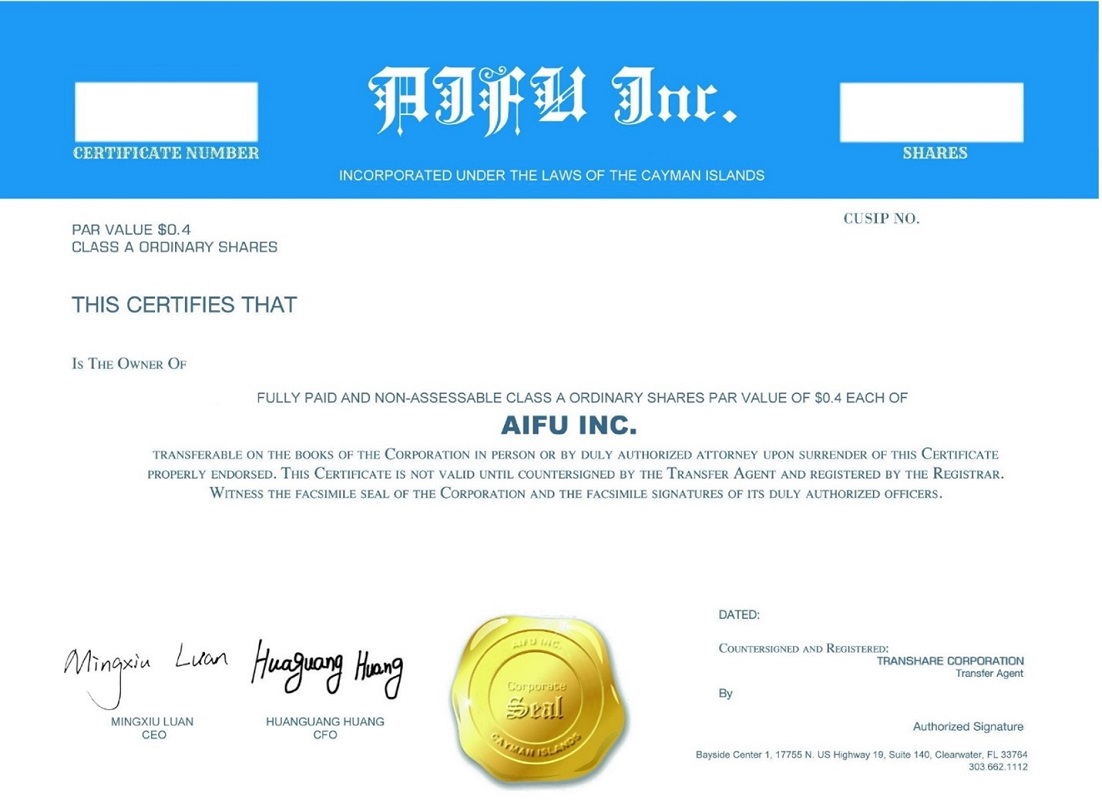
Exhibit 5.1

| Our ref | YCU/628018-000001/86711236v3 |
AIFU Inc.
Room 1, Building 10
Jinzhong Guobin Hui Qinyuan 2nd Road
Lihu Community, Xili Street
Shenzhen, 518055
People’s Republic of China
26 May 2026
Dear Sirs
AIFU Inc.
We have acted as Cayman Islands legal advisers to AIFU Inc. (the “Company”) in connection with the Company’s registration statement on Form F-3, including all amendments or supplements thereto (the “Registration Statement”), filed with the Securities and Exchange Commission (the “Commission”) under the U.S. Securities Act of 1933, as amended to date, relating to (i) future issuance and sale by the Company, on a delayed or continuous basis, from time to time in one or more offerings, up to US$300,000,000 of the following securities (the “Securities”):
| (a) | certain Class A ordinary shares with a par value of US$0.002 each of the Company (the “Class A Ordinary Shares”); |
| (b) | certain preferred shares with a par value of US$0.002 each of the Company (the “Preferred Shares”); |
| (c) | warrants to subscribe for Class A Ordinary Shares of the Company (the “Warrants”) to be issued under warrant agreements to be entered into between the Company and the warrant agent for such Warrants thereunder (the “Warrant Agreements”); |
| (d) | subscription rights to purchase Class A Ordinary Shares of the Company (the “Rights”) to be issued under standby underwriting agreements or subscription right agreements to be entered into among the Company and one or more underwriters for such Rights thereunder (the “Rights Agreements”); and |
| (e) | units comprising of one or more of the Class A Ordinary Shares, Preferred Shares, Warrants and Rights in any combination (the “Units”) to be issued under unit agreements to be entered into between the Company and the unitholder for such Units thereunder (the “Unit Agreements”); |
and (ii) future resale by certain selling shareholders identified in the Registration Statement (each, a “Selling Shareholder”), on a delayed or continuous basis, from time to time in one or more offerings, up to 103,747,628 Class A Ordinary Shares held by them (the “Resale Shares”).
We are furnishing this opinion as Exhibits 5.1 and 23.2 to the Registration Statement.
| 1 | Documents Reviewed |
For the purposes of this opinion, we have reviewed only originals, copies or final drafts of the following documents:
| 1.1 | The certificate of incorporation of the Company dated 10 April 2007, the certificate of incorporation on change of name of the Company dated 12 December 2016, the certificate of incorporation on change of name of the Company dated 12 November 2024 and the certificate of incorporation on change of name of the Company dated 17 April 2025 issued by the Registrar of Companies in the Cayman Islands. |
| 1.2 | The amended and restated memorandum and articles of association of the Company as adopted by a special resolution passed on 29 April 2026 and effective on 13 May 2026 (the “Memorandum and Articles”). |
| 1.3 | The written resolutions of the board of directors of the Company (the “Board”) dated 26 May 2026 (the “Board Resolutions”). |
| 1.4 | A certificate of good standing dated 21 May 2026 issued by the Registrar of Companies in the Cayman Islands (the “Certificate of Good Standing”). |
| 1.5 | A copy of the register of members of the Company provided to us by the Company on 26 May 2026 (the “Register of Members”). |
| 1.6 | A certificate from a director of the Company, a copy of which is attached hereto (the “Director’s Certificate”). |
| 1.7 | The Registration Statement. |
| 2 | Assumptions |
The following opinions are given only as to, and based on, circumstances and matters of fact existing and known to us on the date of this opinion letter. These opinions only relate to the laws of the Cayman Islands which are in force on the date of this opinion letter. In giving these opinions we have relied (without further verification) upon the completeness and accuracy, as of the date of this opinion letter, of the Director’s Certificate, the Certificate of Good Standing and the Register of Members. We have also relied upon the following assumptions, which we have not independently verified:
| 2.1 | The Warrant Agreements, Rights Agreements and Unit Agreements (together, the “Transaction Documents”), and the Securities (other than the Class A Ordinary Shares and Preferred Shares), have been, or will be, authorised and duly executed and unconditionally delivered by or on behalf of all relevant parties in accordance with all relevant laws (other than, with respect to the Company, the laws of the Cayman Islands). |
2
| 2.2 | The Transaction Documents and the Securities (other than the Class A Ordinary Shares and Preferred Shares) are, or will be, legal, valid, binding and enforceable against all relevant parties in accordance with their terms under the laws of the State of New York and all other relevant laws (other than, with respect to the Company, the laws of the Cayman Islands). |
| 2.3 | The choice of the laws of the State of New York as the governing law of the Transaction Documents and the Securities (other than the Class A Ordinary Shares and Preferred Shares) has been, or will be, made in good faith and would be regarded as a valid and binding selection which will be upheld by the courts of the State of New York and any other relevant jurisdiction (other than the Cayman Islands) as a matter of the laws of the State of New York and all other relevant laws (other than the laws of the Cayman Islands). |
| 2.4 | Copies of documents, conformed copies or drafts of documents provided to us are true and complete copies of, or in the final forms of, the originals. |
| 2.5 | All signatures, initials and seals are genuine. |
| 2.6 | The capacity, power, authority and legal right of all parties under all relevant laws and regulations (other than, with respect to the Company, the laws and regulations of the Cayman Islands) to enter into, execute, unconditionally deliver and perform their respective obligations under the Transaction Documents and the Securities. |
| 2.7 | There is no contractual or other prohibition or restriction (other than as arising under Cayman Islands law) binding on the Company prohibiting or restricting it from issuing the Class A Ordinary Shares or the Preferred Shares or entering into and performing its obligations under the Registration Statement, the Transaction Documents and the Securities. |
| 2.8 | No monies paid to or for the account of any party under the Transaction Documents or the Securities or any property received or disposed of by any party to the Transaction Documents or the Securities in each case in connection with the Transaction Documents or the Securities, or the consummation of the transactions contemplated thereby, represent or will represent proceeds of criminal conduct or criminal property or terrorist property (as defined in the Proceeds of Crime Act (As Revised) and the Terrorism Act (As Revised), respectively). |
| 2.9 | There is nothing contained in the minute book or corporate records of the Company (which other than the records set out in paragraphs 1.1 to 1.5 of the opinion letter, we have not inspected) which would or might affect the opinions set out below. |
| 2.10 | There is nothing under any law (other than the law of the Cayman Islands) which would or might affect the opinions set out below. Specifically, we have made no independent investigation of the laws of the State of New York. |
| 2.11 | The Company will have sufficient authorised capital to effect the issue of the Class A Ordinary Shares and Preferred Shares at the time of issuance. |
| 2.12 | The Company will receive money or money’s worth in consideration for the issue of the Class A Ordinary Shares and the Preferred Shares, and none of the Class A Ordinary Shares or the Preferred Shares will be issued for less than their par value. |
3
| 2.13 | No invitation has been or will be made by or on behalf of the Company to the public in the Cayman Islands to subscribe for any of the Securities. |
| 2.14 | The Warrants, Rights, and Units will respectively be issued and authenticated as required in accordance with the provisions of a duly authorised, executed and delivered Warrant Agreement, Rights Agreement, and Unit Agreement (as the case may be). |
| 2.15 | The Transaction Documents and the Securities (other than the Class A Ordinary Shares and Preferred Shares) will be, or have been, duly executed and delivered by an authorised person of the parties thereto. |
| 3 | Opinion |
Based upon the foregoing and subject to the qualifications set out below and having regard to such legal considerations as we deem relevant, we are of the opinion that:
| 3.1 | The Company has been duly incorporated as an exempted company with limited liability and is validly existing and in good standing with the Registrar of Companies under the laws of the Cayman Islands. |
| 3.2 | The authorised share capital of the Company is US$20,000,000 divided into 10,000,000,000 ordinary shares, comprising of (i) 8,000,000,000 Class A Ordinary Shares of a nominal or par value of US$0.002 each and (ii) 2,000,000,000 Class B ordinary shares of a nominal or par value of US$0.002 each. |
| 3.3 | With respect to the Class A Ordinary Shares and the Preferred Shares, when (i) the Board has taken all necessary corporate action to approve the issue thereof, the terms of the offering thereof and related matters; (ii) the issue of such Class A Ordinary Shares or Preferred Shares has been recorded in the Company’s register of members (shareholders); and (iii) the subscription price of such Class A Ordinary Shares or Preferred Shares, (being not less than the par value of the Class A Ordinary Shares or Preferred Shares, as the case may be) has been fully paid in cash or other consideration approved by the Board, the Class A Ordinary Shares or Preferred Shares will be duly authorised, validly issued, fully paid and non-assessable. |
| 3.4 | With respect to each issue of Warrants, when (i) the Board has taken all necessary corporate action to approve the creation and terms of the Warrants and to approve the issue thereof, the terms of the offering thereof and related matters; (ii) a Warrant Agreement relating to the Warrants shall have been duly authorised and validly executed and delivered by the Company and the warrant agent thereunder in accordance with all relevant laws; and (iii) the certificates representing the Warrants have been duly executed, countersigned, registered and delivered in accordance with the Warrant Agreement relating to the Warrants and the applicable definitive purchase, underwriting or similar agreement approved by the Board upon payment of the consideration therefor provided therein, the Warrants will be duly authorised, legal and binding obligations of the Company. |
| 3.5 | With respect to each issue of the Rights, when (i) the Board has taken all necessary corporate action to approve the creation and terms of the Rights and to approve the issue thereof, the terms of the offering thereof and related matters; (ii) a Rights Agreement relating to the Rights shall have been duly authorised and duly executed and delivered by the Company and all the relevant parties thereunder in accordance with all relevant laws; and (iii) when such Rights issued thereunder have been duly executed and delivered on behalf of the Company and authenticated in the manner set forth in the Rights Agreement relating to such issue of Rights and delivered against due payment therefor pursuant to, and in accordance with, the terms of the Registration Statement and any relevant prospectus supplement, such Rights will be duly authorised, legal and binding obligations of the Company. |
4
| 3.6 | With respect to each issue of the Units, when (i) the Board has taken all necessary corporate action to approve the creation and terms of the Units and to approve the issue thereof, the terms of the offering thereof and related matters; (ii) a Unit Agreement relating to the Units and the Units shall have been authorised and duly executed and delivered by and on behalf of the Company and all the relevant parties thereunder in accordance with all relevant laws; and (iii) when such Units issued thereunder have been duly executed and delivered on behalf of the Company and authenticated in the manner set forth in the Unit Agreement relating to such issue of Units and delivered against due payment therefor pursuant to, and in accordance with, the terms of the Registration Statement and any relevant prospectus supplement, such Units issued pursuant to the Unit Agreement will be duly authorised, legal and binding obligations of the Company. |
| 3.7 | Based solely of our inspection of the Register of Members, each Selling Shareholder has valid title to its Resale Shares and such Resale Shares have been duly authorised, legally issued and (assuming the purchase price therefor has been paid in full) are fully paid and non-assessable and there are no entries or notations indicating any third party interests, including any security interest as at the date hereof. |
| 4 | Qualifications |
The opinions expressed above are subject to the following qualifications:
| 4.1 | To maintain the Company in good standing under the laws of the Cayman Islands, annual filing fees must be paid and returns made to the Registrar of Companies within the time frame prescribed by law. |
| 4.2 | The obligations assumed by the Company under the Transaction Documents, the Securities (other than the Class A Ordinary Shares and Preferred Shares) will not necessarily be enforceable in all circumstances in accordance with their terms. In particular: |
| (a) | enforcement may be limited by bankruptcy, insolvency, liquidation, reorganisation, readjustment of debts or moratorium or other laws of general application relating to, protecting or affecting the rights of creditors and/or contributories; |
| (b) | enforcement may be limited by general principles of equity. For example, equitable remedies such as specific performance may not be available, inter alia, where damages are considered to be an adequate remedy; |
| (c) | some claims may become barred under relevant statutes of limitation or may be or become subject to defences of set off, counterclaim, estoppel and similar defences; |
| (d) | where obligations are to be performed in a jurisdiction outside the Cayman Islands, they may not be enforceable in the Cayman Islands to the extent that performance would be illegal under the laws of that jurisdiction; |
| (e) | the courts of the Cayman Islands have jurisdiction to give judgment in the currency of the relevant obligation and statutory rates of interest payable upon judgments will vary according to the currency of the judgment. If the Company becomes insolvent and is made subject to a liquidation proceeding, the courts of the Cayman Islands will require all debts to be proved in a common currency, which is likely to be the “functional currency” of the Company determined in accordance with applicable accounting principles. Currency indemnity provisions have not been tested, so far as we are aware, in the courts of the Cayman Islands; |
5
| (f) | arrangements that constitute penalties will not be enforceable; |
| (g) | enforcement may be prevented by reason of fraud, coercion, duress, undue influence, misrepresentation, public policy or mistake or limited by the doctrine of frustration of contracts; |
| (h) | provisions imposing confidentiality obligations may be overridden by compulsion of applicable law or the requirements of legal and/or regulatory process; |
| (i) | the courts of the Cayman Islands may decline to exercise jurisdiction in relation to substantive proceedings brought under or in relation to the Transaction Documents or Securities (other than the Class A Ordinary Shares and Preferred Shares) in matters where they determine that such proceedings may be tried in a more appropriate forum; |
| (j) | we reserve our opinion as to the enforceability of the relevant provisions of the Transaction Documents or Securities (other than the Class A Ordinary Shares and Preferred Shares) to the extent that they purport to grant exclusive jurisdiction as there may be circumstances in which the courts of the Cayman Islands would accept jurisdiction notwithstanding such provisions; |
| (k) | a company cannot, by agreement or in its articles of association, restrict the exercise of a statutory power and there is doubt as to the enforceability of any provision in the Transaction Documents or Securities (other than the Class A Ordinary Shares and Preferred Shares) whereby the Company covenants to restrict the exercise of powers specifically given to it under the Companies Act (As Revised) of the Cayman Islands (the “Companies Act”), including, without limitation, the power to increase its authorised share capital, amend its memorandum and articles of association or present a petition to a Cayman Islands court for an order to wind up the Company; and |
| (l) | enforcement or performance of any provision in the Transaction Documents or Securities (other than the Class A Ordinary Shares and Preferred Shares) which relates, directly or indirectly, to an interest in the Company constituting shares, voting rights or ultimate effective control over management in the Company may be prohibited or restricted if any such relevant interest is or becomes subject to a restrictions notice issued under the Beneficial Ownership Transparency Act (As Revised) (“BOT Act”). |
| 4.3 | We express no opinion as to the meaning, validity or effect of any references to foreign (i.e. non-Cayman Islands) statutes, rules, regulations, codes, judicial authority or any other promulgations and any references to them in the Transaction Documents or Securities (other than the Class A Ordinary Shares and Preferred Shares). |
| 4.4 | We have not reviewed the final form of any of the Warrant Agreements or the Warrants to be issued thereunder, the Rights Agreements or the Rights to be issued thereunder, or the Unit Agreements or the Units to be issued thereunder, and our opinions are qualified accordingly. |
6
| 4.5 | We reserve our opinion as to the extent to which the courts of the Cayman Islands would, in the event of any relevant illegality or invalidity, sever the relevant provisions of the Transaction Documents or Securities (other than the Class A Ordinary Shares and Preferred Shares) and enforce the remainder or the transaction of which such provisions form a part, notwithstanding any express provisions in this regard. |
| 4.6 | Under the Companies Act, the register of members of a Cayman Islands company is by statute regarded as prima facie evidence of any matters which the Companies Act directs or authorises to be inserted therein. A third party interest in the shares in question would not appear. An entry in the register of members may yield to a court order for rectification (for example, in the event of fraud or manifest error). |
| 4.7 | Note that under the Companies Act, it is not necessary to include third party interests in the Register of Members and its inclusion of such interests in the Register of Members does not perfect the securities created with such interest and the failure to make entry in the Register of Members does not mean that no third party interest exists over the issued shares of the Company and would not invalidate the security interest created by the third party. |
| 4.8 | In this opinion the phrase “non-assessable” means, with respect to the issuance of shares in the Company, that a shareholder shall not, in respect of the relevant shares and in the absence of a contractual arrangement, or an obligation pursuant to the memorandum and articles of association, to the contrary, have any obligation to make further contributions to the Company’s assets (except in exceptional circumstances, such as involving fraud, the establishment of an agency relationship or an illegal or improper purpose or other circumstances in which a court may be prepared to pierce or lift the corporate veil). |
| 4.9 | The obligations of the Company may be subject to restrictions pursuant to: |
| (a) | United Nations and United Kingdom sanctions extended to the Cayman Islands by Orders in Council; and |
| (b) | sanctions imposed by Cayman Islands authorities under Cayman Islands legislation. |
Except as specifically stated herein, we make no comment with respect to any representations and warranties which may be made by or with respect to the Company in any of the documents or instruments cited in this opinion or otherwise with respect to the commercial terms of the transactions, which are the subject of this opinion.
The opinions in this opinion letter are strictly limited to the matters contained in the opinions section above and do not extend to any other matters. We have not been asked to review and we therefore have not reviewed any of the ancillary documents relating to the Transaction Documents or Securities and express no opinion or observation upon the terms of any such document.
7
We hereby consent to the filing of this opinion as an exhibit to the Registration Statement and to the reference to our name under the headings “Enforceability of Civil Liabilities” and “Legal Matters” and elsewhere in the prospectuses included in the Registration Statement. In giving such consent, we do not thereby admit that we come within the category of persons whose consent is required under Section 7 of the U.S. Securities Act of 1933, as amended, or the Rules and Regulations of the Commission thereunder.
Yours faithfully
/s/ Maples and Calder (Hong Kong) LLP
Maples and Calder (Hong Kong) LLP
8
Exhibit 8.1
5/9/10/13/17 Floor, Broadcasting Tower,
No 14A Jianguomenwai Avenue
Chaoyang District,
Beijing, 100022
China
Date: May 26, 2026
| To: | AIFU Inc. Room 1, Building 10, Jinzhong Guobin Hui Qingyuan 2nd Road Lihu Community, Xili Street Shenzhen, 518055 People’s Republic of China +86 755 22671879 |
Dear Sirs or Madams,
We are lawyers qualified to practice in the People’s Republic of China (the “PRC” or “China”, which, for the purpose of this opinion only, does not include the Hong Kong Special Administrative Region, the Macau Special Administrative Region and Taiwan Region) and as such are qualified to issue this opinion on the PRC Laws (as defined below).
We are acting as PRC counsel to AIFU Inc. (the “Company”), a company incorporated under the laws of the Cayman Islands, in connection with the Company’s registration statement on Form F-3 (including all amendments or supplements thereto, the “Registration Statement”), filed by the Company with the Securities and Exchange Commission under the U.S. Securities Act of 1933 (as amended), in relation to the (1) offering of Class A ordinary shares, preferred shares, warrants, subscription rights and/or a combination of such securities, separately or as units, of an aggregate offering price of up to US$ 300,000,000; and (2) the offer and resale by the selling securityholders named in the Registration Statement of up to an aggregate of 103,747,628 Class A ordinary shares.
A. Documents and Assumptions
In rendering this opinion, we have examined copies of the Registration Statement and other documents (collectively the “Documents”) as we have considered necessary or advisable for the purposes of rendering this opinion. Where certain facts were not independently established and verified by us, we have relied upon appropriate representatives of the Company and the PRC Companies (as defined below).
In rendering this opinion, we have made the following assumptions (the “Assumptions”):
(1) all signatures, seals and chops on the Documents are genuine, and each signature on behalf of a party thereto is that of a person duly authorized by such party to execute the same, and all Documents submitted to us as originals are authentic, and all Documents submitted to us as copies conform to the originals;
(2) each of the parties to the Documents, (i) if a legal person or other entity, is duly organized and is validly existing in good standing under the laws of its jurisdiction of organization and/or incorporation, and (ii) if an individual, has full capacity for civil conduct, and has full power and authority to execute, deliver and perform its, her or his obligations under the Documents to which it, she, he is a party in accordance with the laws of its jurisdiction of organization and /or the laws that it, she or he is subject to;
(3) the Documents presented to us remain if full force and effect on the date of this opinion and have not been revoked, amended or supplements, modifications or other changes have been made, and no revocation or termination has occurred, with respect to any of the Documents after they were submitted to us for the purposes of this opinion;
(4) the laws of jurisdictions other than the PRC which may be applicable to the execution, delivery, performance or enforcement of the Documents are complied with;
(5) all requested Documents have been provided to us and all factual statements made to us by the Company and the PRC Companies in connection with this opinion, including but not limited to the statements set forth in the Documents, are true, correct and complete;
(6) all explanations and interpretations provided by government officials duly reflect the official position of the relevant Governmental Agencies (as defined below) and are complete, true and correct;
(7) each of the Documents is legal, valid, binding and enforceable in accordance with its respective governing laws in any and all respects; and
(8) all Governmental Authorizations (as defined below) and other official statements and documentation obtained by the Company or any PRC Company from any Governmental Agency have been obtained by lawful means in due course, and the Documents provided to us conform with those documents submitted to Governmental Agencies for such purposes.
2
In addition, we have assumed and have not verified the truthfulness, accuracy and completeness as to the factual matters of each Document we have reviewed.
B. Definitions
In addition to the terms defined in the context of this opinion, the following capitalized terms used in this opinion shall have the meanings ascribed to them as follows.
| “Governmental Agency” | means any national, provincial or local governmental, regulatory or administrative authority, agency or commission in the PRC, or any court, tribunal or any other judicial or arbitral body in the PRC, or any body exercising, or entitled to exercise, any administrative, judicial, legislative, law enforcement, regulatory, or taxing authority or power of a similar nature in the PRC. |
| “Governmental Authorization” | means any license, approval, consent, waiver order, sanction, certificate, authorization, filing, declaration, disclosure, registration, exemption, permission, endorsement, annual inspection, clearance, qualification, permit or license by, from or with any Governmental Agency pursuant to any PRC Laws. |
| “PRC Companies” | mean, collectively, all entities in the PRC consolidated by financial statements of Company, and each, a “PRC company”. |
| “PRC Laws” | mean all applicable national, provincial and local laws, regulations, rules, notices, orders, decrees and judicial interpretations of the PRC currently in effect and publicly available on the date of this opinion. |
C. Opinions
Based on our review of the Documents and subject to the Assumptions and the Qualifications (as defined below), we are of the opinion as of the date hereto that:
1. Taxation.The statements made in the Registration Statement under the caption “Taxation” with respect to the PRC tax laws and regulations, constitute true and accurate described therein in all material aspects.
Our opinion expressed above is subject to the following qualifications (the “Qualifications”):
(1) Our opinion is limited to PRC Laws of general application on the date hereof. We have made no investigation of, and do not express or imply any views on, the laws and regulations of any jurisdiction other than the PRC, and we have assumed that such other laws or regulations would affect our opinions expressed above.
3
(2) PRC Laws referred to herein are the laws and regulations publicly available and currently in force on the date hereof and there is no guarantee that any of such PRC Laws, or the interpretation or enforcement thereof, will not be changed, amended or revoked in the future with or without retrospective effect.
(3) Our opinion is subject to (i) applicable bankruptcy, insolvency, fraudulent transfer, reorganization, moratorium or similar laws in the PRC affecting creditors’ rights generally, and (ii) possible judicial or administrative actions or any PRC Laws affecting creditors’ rights.
(4) Our opinion is subject to the effects of (i) certain legal or statutory principles affecting the validity and enforceability of contractual rights generally under the concepts of public interests, social ethics, national security, good faith, fair dealing, and applicable statues of limitation, (ii) any circumstances in connection with the formulation, execution or performance of any legal documents that would be deemed materially mistaken, clearly unconscionable, fraudulent, coercionary or concealing illegal intentions with a lawful form, (iii) judicial discretion with respect to the availability of specific performance, injunctive relief, remedies or defenses, or the calculation of damages, and (iv) the discretion of any competent PRC legislative, administrative or judicial bodies in exercising their authority in the PRC.
(5) This opinion is issued based on our understanding of PRC Laws. For matters not explicitly provided under PRC Laws, the interpretation, implementation and application of the specific requirements under PRC Laws, as well as their application to and effect on the legality, binding effect and enforceability of certain contracts, are subject to the final discretion of competent PRC legislative, administrative and judicial authorities, and there can be no assurance that the Governmental Agencies will not take a view that is contrary to or otherwise different from our opinion stated herein.
(6) The term “enforceable” or “enforceability” as used in this opinion means that the obligations assumed by the relevant Documents assumed by the relevant obligors under the relevant Documents are of a type which the courts of the PRC may enforce. It dose not mean that those obligations will necessarily be enforced in all circumstances in accordance with their respective terms and/or additional terms that may be imposed by the courts. As used in this opinion, the expression “to our knowledge” or similar language with reference to matters of fact refers to the current, actual knowledge of the attorneys of this firm who have worked on matters for the Company and the PRC Companies in connection with this opinion. We may rely, as to matters of fact (but not as to legal conclusions), to the extent we deem proper, on certificates, statements and confirmations made by the responsible officers of the Company, the PRC Companies and/or the Governmental Agencies.
4
(7) We have not undertaken any independent investigation, search or other verification action to determine the existence or absence of any fact or to prepare this opinion, and no inference as to our knowledge of the existence or absence of any fact should be drawn from our representation of the Company or the PRC Companies or the rendering of this opinion.
(8) This opinion is intended to be used in the context which is specifically referred to herein, and each paragraph shall be construed as a whole and no part shall be extracted and referred to independently.
The opinion expressed herein is solely for the benefit of the Company and without our prior written consent, neither our opinions nor this opinion may be disclosed to or relied upon by any other person. We hereby consent to the use of this opinion in, and the filling hereof as an exhibit to the Registration Document, and to the reference to our name in such Registration Statement.
This opinion is strictly limited to the matters stated herein and no opinion is implied or may be inferred beyond the matters expressly stated herein. The opinion expressed herein is rendered only as of the date hereof, and we assume no responsibility to advise you of facts, circumstances, events or developments that hereafter may be brought to our attention and that may alter, affect or modify the opinion expressed herein.
(Remainder of Page Intentionally Left Blank)
Yours faithfully,
| /s/ Hairun Law Firm | |
| Hairun Law Firm |
5
Exhibit 23.1

CONSENT OF INDEPENDENT REGISTERED PUBLIC ACCOUNTING FIRM
We consent to the incorporation by reference in registration statement on Form F-3 of our reports dated April 28, 2026, relating to the financial statements of AIFU Inc. (formally known as “AIX Inc.” and “Fanhua Inc.”) and the effectiveness of AIFU Inc. (formally known as “ AIX Inc. “ and “ Fanhua Inc.”) internal control over financial reporting, appearing in the Annual Report on Form 20-F for the year ended December 31, 2025. We also consent to the reference to us under the heading “Experts” in such Registration Statement.
/s/ Enrome LLP
Singapore
May 26, 2026
| Enrome LLP | 143 Cecil Street #19-03/04 GB Building Singapore 069542 |
admin@enrome-group.com www.enrome-group.com |
Exhibit 23.2
CONSENT OF INDEPENDENT REGISTERED PUBLIC ACCOUNTING FIRM
We consent to the incorporation by reference in this Registration Statement on Form F-3 of our report dated April 29, 2024, relating to the financial statements of AIFU Inc. (formerly known as “AIX Inc.” and “Fanhua Inc.”) appearing in the Annual Report on Form 20-F of AIFU Inc. for the year ended December 31, 2025.
We also consent to the reference to us under the heading “Experts” in such Registration Statement.
/s/ Deloitte Touche Tohmatsu Certified Public Accountants LLP
Shenzhen, the People’s Republic of China
May 26, 2026
|
Calculation of Filing Fee Tables |
|||
|
|
|||
|
|
|||
| Table 1: Newly Registered and Carry Forward Securities |
|---|
|
Security Type |
Security Class Title |
Fee Calculation or Carry Forward Rule |
Amount Registered |
Proposed Maximum Offering Price Per Unit |
Maximum Aggregate Offering Price |
Fee Rate |
Amount of Registration Fee |
Carry Forward Form Type |
Carry Forward File Number |
Carry Forward Initial Effective Date |
Filing Fee Previously Paid in Connection with Unsold Securities to be Carried Forward |
||
|---|---|---|---|---|---|---|---|---|---|---|---|---|---|
| Newly Registered Securities | |||||||||||||
|
|
|
|
|||||||||||
|
|
|
|
|||||||||||
|
|
|
|
|||||||||||
|
|
|
|
|||||||||||
|
|
|
|
|||||||||||
|
|
1 |
|
|
$
|
|
$
|
|||||||
|
|
2 |
|
|
|
|
$
|
$
|
|
$
|
||||
| Fees Previously Paid | |||||||||||||
| Carry Forward Securities | |||||||||||||
| Carry Forward Securities | |||||||||||||
|
Total Offering Amounts: |
$
|
$
|
|||||||||||
|
Total Fees Previously Paid: |
$
|
||||||||||||
|
Total Fee Offsets: |
$
|
||||||||||||
|
Net Fee Due: |
$
|
||||||||||||
|
Offering Note |
|
1 |
|
||||||
|
|
|||||||
|
2 |
|
||||||
|
|
|||||||
| Table 2: Fee Offset Claims and Sources |
|---|
| Registrant or Filer Name | Form or Filing Type | File Number | Initial Filing Date | Filing Date | Fee Offset Claimed | Security Type Associated with Fee Offset Claimed | Security Title Associated with Fee Offset Claimed | Unsold Securities Associated with Fee Offset Claimed | Unsold Aggregate Offering Amount Associated with Fee Offset Claimed | Fee Paid with Fee Offset Source | |||
|---|---|---|---|---|---|---|---|---|---|---|---|---|---|
| Rules 457(b) and 0-11(a)(2) | |||||||||||||
| Fee Offset Claims | |||||||||||||
| Fee Offset Sources | |||||||||||||
| Rule 457(p) | |||||||||||||
| Fee Offset Claims | |||||||||||||
| Fee Offset Sources | |||||||||||||
| Table 3: Combined Prospectuses |
|---|
|
Security Type |
Security Class Title |
Amount of Securities Previously Registered |
Maximum Aggregate Offering Price of Securities Previously Registered |
Form Type |
File Number |
Initial Effective Date |
|
|---|---|---|---|---|---|---|---|